
MAVCOR Journal is an open access born-digital, double blind peer-reviewed journal dedicated to promoting conversation about material and visual cultures of religion. Published by the Center for the Study of Material and Visual Cultures of Religion at Yale University and reviewed by members of our distinguished Editorial Board and other experts, MAVCOR Journal encourages contributors to think deeply about the objects, performances, sounds, and digital experiences that have framed and continue to frame human engagement with religion broadly understood across diverse cultures, regions, traditions, and historical periods.
A special issue guest edited by Laura S. Levitt and Oren Baruch Stier
 Tending to Holocaust Objects: An Introduction
This introductory essay presents the origins and aims of the special issue. It examines how objects marked by violence and loss acquire dimensions of sacrality and affect, and highlights the essential—often invisible—professional labors of care and conservation in sustaining historical memory.
We begin, appropriately, by examining a range of institutional practices in comparative perspective, considering both how Holocaust objects come to be held in archives and museums and their subsequent trajectories. These objects are initially shaped by distinct practices of donation, acquisition, and accession and their transfer between intimate, family collections and public institutions, and later through curation, custody, storage, and display. Attuned to the ways in which objects marked by violence, trauma, and dislocation resonate socially and culturally, the authors of these first three pieces ask how objects signify—how they make the past present, how they become meaningful, how their materiality resonates viscerally—and how context impacts such signification. Such contexts include donor ambivalence, the conditions of storage, shifts in custody, how objects are handled, decisions concerning care and use, spatial considerations, and more. It is important to note that these contexts are often evolving and changing: objects can become artifacts or relics, accentuated by their relationship to extremity. We can question their ontological status; we can track them on their journeys into representation, as they circulate and recirculate from one person to another, from one institution to another. Throughout these first three essays, the affective aspect of Holocaust objects emerges: these materials can evoke powerful emotional responses directed at the people who are connected to them. Thus, we see here how institutional practices matter in making the invisible visible. - OBS, LSL
 In(ani)mate Objects: Between the Sacred and the Everyday
Objects shape and legitimate human identity, especially in terms of interpersonal relations. In this article, Stone compares and contrasts how the Arolsen Archives and the United States Holocaust Memorial Museum care for the objects in their possession. The varying approaches of the two institutions leads to different sorts of knowledge about the past, and has much to tell us about contemporary understandings of Holocaust museum curatorship and Holocaust memory.
 Transporting the Past: Suitcases, Briefcases, and Histories of Displacement
Suitcases, and their smaller cousins, the briefcase, hold things. They are both object and container, possessing a range of physical properties and material connections. They are also inherently material in their demands for care and curation, creating challenges for institutions that hold them to make sense of violent and traumatic pasts.
 “Disgraceful” Objects: Reacting to and Engaging with Perpetrator Materials in Archival Collections and Holocaust Museums
An exploration of how Holocaust museums and archives confront and contextualize perpetrator materials, addressing the ethical challenges of exhibiting “disgraceful” objects, this essay examines curatorial and archival approaches to preservation, interpretation, and display, and reflects on how these materials shape public engagement, historical understanding, and moral responsibility.
In this section we pivot to those objects that are the most intimate, due to their proximity to the human body. This intimacy straddles the boundary between the living and the dead and raises questions concerning how the body is treated in a Holocaust context. How do we tend to human remains, survivor bodies, and surviving materials worn on or hidden inside the body—items that may have outlived the bodies that once bore them? How do the range of practices around death and burial accommodate the objects unearthed in the process? Does body proximity impact the sacrality of a Holocaust artifact, and what happens when an object is separated from its bearer? The essays in this section speak to ethical considerations as well, as body proximity accentuates personal, professional, and institutional concerns for the proper care and handling of these materials, raising questions about their ownership. The essays in this section engage with the forensic turn in the human sciences, contributing to our understanding of these objects as well as the events that produced them. As remnants embodying loss, these objects and even the material traces of their own prior histories can be used to reconstruct individual histories of the victims, rescuing them from oblivion and from the perpetrators’ gaze. They thus constitute elements of a counter-archive of testimonial objects that speaks against Nazi attempts to commodify the victims’ bodies and their material belongings. - OBS, LSL
 Examining Body Proximity and “Sacredness” at/in Relation to Treblinka Extermination Camp
This article presents four objects, all relating to the Treblinka death camp, that would have been worn on the bodies of Holocaust victims. Each one, however, illustrates differences in the journeys, uses, spatialities, and temporalities of proximity. These items give pause to reflect on how value and sacrality are affected when objects have been in extremely close physical contact with the (living or dead) human body, and how the context in which they are found may affect their perceived status.
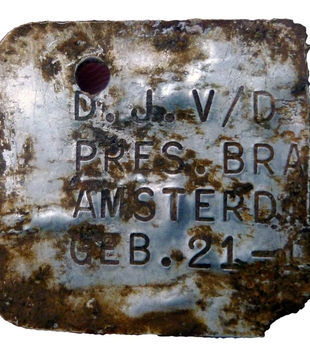 The Excavated Nametag of David Juda van der Velde
What is evoked when one encounters a child’s nametag, exhumed from the soil of a former Nazi death camp? For Holocaust archaeologists, such moments collapse temporal distance, raising pressing affective and ethical questions about the persistence of the past within the material present. When such objects enter museum narratives, they bring the emotional labor and spiritual attachments of families with them, complicating the “afterlives” of things displaced by war.
 Five Points of Entry: Judy Lachman's Group Photo from August 1942
Through war, ghettoization, deportations, and forced labor, Judy Lachman carried and protected from harm photographs of friends and family members, mementos of her life before and during World War II. One of these pictures depicts members of the youth Zionist organization Akiva. This article examines the photograph’s visual and material qualities, the transformations it underwent during the war, and its mediation and remediation after the war.
Our third section continues many of the themes of the previous one, in that items worn on the body also share in the body’s intimacy, especially those garments that are not visible, worn underneath other clothing. This invisibility extends to objects’ origins, in cases where the items were created covertly, and to their inaccessibility: many of the items discussed in this special issue are not on public view, and in this section we ask what that might mean for Holocaust memory and representation. How might “de-centering” the role of museum exhibitions lead to a broader consideration of the multiple functions of a museum and the different epistemes—worldviews—undergirding the objects in its care? The essays here extend the narrative potential of objects previously discussed, transcending time and space and reflecting on the ways objects themselves tell stories, both literally and metaphorically, revealing a material agency that can, at times, telegraph hopefully and poignantly into the future. In some cases, the artifacts themselves record and preserve accounts of life in the ghettos and camps, documenting experiences of labor and loss and serving as records of the transactional economies in spaces of incarceration. The objects in this section are purposive, reflecting the intentions of their creators while also assuming the qualities of the wearers. Archival records can try to capture these qualities, but we recognize that they are by nature incomplete; there is only so much we can know about these remnants, even with ongoing meticulous research. The authors of these essays ask us to consider the function of worn objects, whether decorative or ritual; readers will note several items’ individuality as well as the gender distinctions that mark particular garments historically. Here, artifacts are themselves mediators of memory, offering enticing visual records of ghetto and camp life and embodying the experiences of people before, during, and even after World War II, beyond both written narrative and oral testimony. - OBS, LSL
 Objects of Witness: Holocaust Jewelry Constructed in Camps and Ghettos
Covertly constructed from scrap or excess metal in forced labor factories and workshops, pendants, pins, bracelets, and other metal objects made in Holocaust-era ghettos and camps by prisoners were largely given as gifts to friends and family or exchanged for food or other resources. A consideration of these rare surviving objects reveals how prisoners understood the conditions they were living in and represented them in material culture, and by doing so asserted a form of material agency amid confinement and forced labor.
 Wedding Dresses: Soft Landings, a Ritual Garment, and the Promises and Perils of Life After
At the close of World War II, numerous Jewish brides in a Displaced Persons camp wore a remarkable parachute wedding dress now in the collection of the United States Holocaust Memorial Museum. According to the Oxford English Dictionary (OED) a parachute is "something which inflates to control the descent of a falling body." Not all who wore this dress or the others like it in the UHSMM collection experienced soft landings. Wedding dresses never come with guarantees.
 Inaccessible Objects: Armin Loeb’s Tallit Katan at the United States Holocaust Memorial Museum
The importance of the Holocaust for Jewish and general memory has led to scholarly discussion of the United States Holocaust Memorial Museum in religious terms. The USHMM, like many other Holocaust memorial museums, is not, however, owned or run by a religious community and does not serve as a space of prayer. Yet visitors treat the museum space and its objects with a sense of reverence reserved for ritual spaces and relics. But what happens if such religious objects are not on display? In this article, the author turns to Armin Loeb’s tallit katan to show the value of analyzing inaccessible objects.
The authors of the essays in this section focus on ritual-textual objects. These items had specific religious functions in their original contexts, before being brushed by violence. During and after the Holocaust, these objects accumulated additional accretions of significance. The reflections here reveal the multilayered meanings of sacred objects. They also demonstrate the entangled histories of texts and things, where documentation helps in identifying and, indeed, accentuating an object’s power. Remnants of the past, the artifacts discussed in this section are both surviving and survivor objects, and their sacrality is bound to both of these roles. How do we understand the “sacred” beyond its context in “religion?” These essays address overlapping categories of sacredness, including religious, historical, personal, and associative types, and the ways objects move or are made to move between these classifications depending on ownership and accessibility, provenance and display. What happens to revered objects when they are transferred between custodians and contexts? Is the “sacred” a transferable quality? What happens if a donor does not want to part with certain items? How do the interventions of creators and curators transform an object’s sacrality? Here, objects act as anchors, sources of comfort during difficult times and orientation points afterwards. They can be embedded in networks in which ordinary and extraordinary functions and meanings overlap. These objects reflect as well the individual agency and personalities of their original owners, inheritors, and donors and often reflect those individuals’ decisions regarding their creation, care, and custody. These items are, ultimately, deeply personal reminders of individual and familial experiences. - OBS, LSL
 Sacred in Function, Sacred in Memory: A Rosary and Missal from the Holocaust
This article examines a rosary and missal given to Beatrice "Trixie" Muchman for her confirmation while she was hiding in a small French town during the Holocaust. Although she returned to her Jewish faith following the war, she still revered the objects, keeping them long after donating the rest of her Holocaust-related materials to the United States Holocaust Memorial Museum for safekeeping. The article explores the multiple layers of sacredness imbued in Muchman's rosary and missal, and considers how a federal, non-denominational institution such as the USHMM should curate and display such objects.
 A Conversation with Holocaust Survivor Beatrice Muchmann
Susan Goldstein Snyder, formerly an acquisitions curator at the United States Holocaust Memorial Museum, interviews Beatrice "Trixie" Muchman, who survived the Holocaust in hiding in Belgium.
 Two Layers of Text, Many Layers of Meaning: The Materiality of the Pál Szegö Diary
Pal Szegö’s Holocaust diary is written in the only book he had available, a Hungarian language copy of the New Testament. While the diary entries are a rich text that merits attention, examining the diary as a unique bound object that preserves traces of the diarist’s interactions with it and some of the experiences detailed in the entries foregrounds Szegö’s individuality and agency amid changing circumstances, offers insight into his complex identity as a devoted Christian convert persecuted for being Jewish, and emphasizes the significance of the diary as a survivor object.
 The Missing Mezuzah
The mezuzah on a wall inside the United States Holocaust Memorial Museum, donated by Benjamin Meed, is the only object among the countless artifacts identified and displayed in the USHMM's Permanent Exhibition installed as if it is a useable object, i.e., without a display case and in the position of a ritually functional mezuzah. What is the place of such an object within the museum and what does it signify?
Tying a number of this special issue’s themes together, this final section features analyses of graphic objects that embody different forms of intentional communication: gratitude, instruction, desperation, desire, longing. These various, often personal, transmissions connect past with present and future and bridge wartime and postwar narratives. The range of forms of visual and textual objects discussed here constitute an appeal for materiality and its importance in telling the stories of the Holocaust. Paper, in particular. Paper is critically important for the survival and movement of both people and objects, especially in an increasingly digital age in which paper is already disappearing. Documents, both authentic and falsified, everyday and exceptional, record the spatial, temporal, and conceptual distances traveled from their origins to their final, often archival, resting places, serving as symbolic grave markers. They register multiple border crossings, both national and artistic, asking whether such boundaries are sites of constraint or negotiation, and what role bureaucracy plays in regulating identity. Yet, the contingency of the materials often used and the chance survival of the artifacts themselves point to these items’ precarity. At the same time, even tiny, nearly insignificant objects serve as powerful witnesses to an ever-distant past. The survival of such objects and their preservation testify to their resilience. These final essays have a tactile presence and an affective allure. They speak to the intimate experiences of exile and displacement for people as well as things. They show us how we may orient ourselves and navigate memory in time and space as they guide future generations in their journeys into the past. - OBS, LSL
 “The book is small so it can be hidden”: Leia Kreimer’s Tiny Book from the Vapniarka Concentration Camp
During the Holocaust, even within the extreme conditions of life in concentration camps, people chose to keep and—in some cases—create objects that do not appear to fulfill essential human needs. Leia Kreimer’s tiny book, made for her as a gift, is one example. Its production, exchange, and ultimate survival illuminate the enduring resilience of the book as a cultural form that is both text and object.
 From the Umschlagplatz to The Wiener Holocaust Library: Maria and Maximillian Wortman’s Last Letters
In September 1942, in the Warsaw ghetto in German-occupied Poland, Maria and Maximilian Wortman hastily wrote a letter to their daughter, Dziunia, from whom they had become separated. The couple had been selected for deportation to the death camp Treblinka, and they were gathered on the Umschlagplatz, the railway siding from where the deportation trains departed. Their final words to their daughter are written on the reverse of a scrap of paper no larger than 11 x 15 cm.
 Hedda Sterne’s Photomontages: Passport to Life
This essay examines Hedda Sterne's 1941 Romanian passport and her little-known photomontages from Life magazine as parallel "documents of exile." The passport traces her perilous flight from Europe, serving as an unintended autobiography of survival. Her photomontages, composed from magazine clippings, became visual testimonies that confront the dissonance between American popular culture and her feelings of anxiety as a refugee. This study uses a conservation and art history lens to explore how paper, in both bureaucratic and artistic forms, mediated Sterne's identity and experience of displacement.
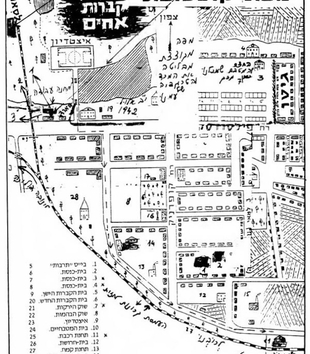 Maps as Artifacts of Remembrance: The Sefer Kostopol
Yizkher bukher, collaboratively authored memorial books devoted to single cities, can offer descendants of Holocaust survivors access to the places their ancestors were forced to flee. Jennifer Rich reflects on her encounter with Sefer Kostopol, the book written about her grandmother's hometown of Kostopol, Ukraine, and specifically the way maps in this and other yizkher bikher can help envision spaces now lost and destroyed.
 On the Multiple Lives of Bannerstones: Indigenous North America 6,000 BCE to the Present
Looking at Indigenous bannerstones from what is known as North America, their unique shapes and symmetrically drilled holes carved from an array of lithics, from sedimentary stone to quartz, I wonder what stories they are telling. Do their stories begin with the sculptors who made them east of the Mississippi Valley in 6,000 BCE or do they begin four billion years ago when volcanic heat from the earth’s core melted and congealed minerals to form the oldest terrestrial rocks?
 In Search of Beijing's Tibetan Buddhist Past and Present: Religious Heritage, History, and Identity in Modern Beijing
Beijing's Tibetan Buddhist temples have always been places through which diverse groups of people moved. During the Qing, these were spaces where elites from different backgrounds met, collaborated, and enacted the multicultural character of the empire within the capital. The temples themselves announced the pluralistic nature of the Qing dynasty, as well as its grandeur, through their public display of signs and stelae aimed at the multi-ethnic audiences of the empire.
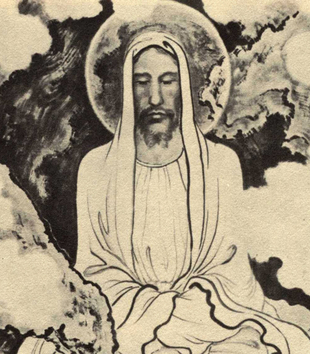 In Search of Multiple Colors of Christ: Daniel J. Fleming and the American Protestant Encounter with Asian Christian Visual Arts, 1937-1940
Fleming’s trilogy illustrates the complex dynamics of race, religion, and visual arts in the interwar United States. Though the extant scholarship highlights the increasing Anglo-Saxonization of Jesus’s body in American visual culture in this era, Fleming’s story reveals a virtually opposite impulse in liberal Protestantism: to search for multiple colors of Christ.
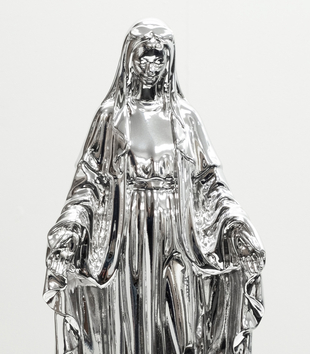 Like a Virgin? Breaking, (un)making, and replicating the Madonna across time, space, and toy stores
The authors set the nucleating body of the medieval Virgin in conversation with contemporary reimaginings of the Madonna to ask how hybridization, fracture, insertion, assemblage, color, multiplicity, and meaning around sacred and secular exchange can change the way we know and see in relation to these forms from the medieval to the postmodern.
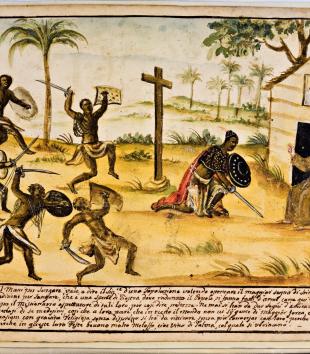 Resoundings of Early Modern Afro-Catholic Festive Culture
This Constellation is intended to complement the author's book and give readers access to color versions of some of its illustrations, which could only be printed in black and white in the original publication. As in other parts of the Iberian world (i.e., the Iberian Peninsula and all the territories under Spanish and Portuguese control), these performances were usually staged by lay Catholic confraternities.
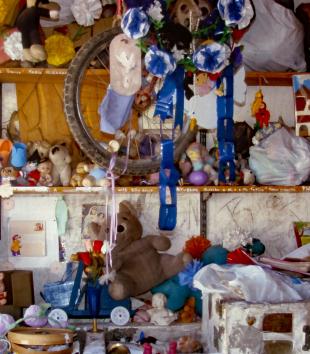 Petitionary Devotion: Folk Saints and Miraculous Images in Spanish America
Votive practice in the Americas has Indigenous, Christian, and syncretic origins that contribute to the diversity of offerings, as do social class, gender, age, and region. Petitionary devotion is structured by an exchange that the votary proposes to a folk saint or miraculous image. The offerings that votaries promise are based on the presumption that folk saints and miraculous images, because they are like us, value what we value.
A special issue curated by Kati Curts and Alex Kaloyanides
 Characterizing Material Economies of Religion in the Americas: An Introduction
Kati Curts and Alex Kaloyanides introduce this special issue of MAVCOR Journal devoted to examining four key categories: “Material,” “Economies,” “Religion,” and “America(s).” The ambition of this issue is that the collective inquiries of its authors, which span various interpretive histories and genealogical fragments, can offer ways to better understand their assorted conveyances, as well as the powerful grip of their critical conjunction.
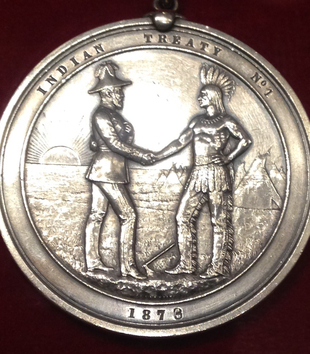 Medals, Memory, and Findspots
For many Indigenous people of Turtle Island, also known as North America, treaty medals are material reminders of sacred promises made between their nations and the British Crown or the U.S. Government. Settlers and colonial officials, by contrast, have often treated these medals as mere trinkets.
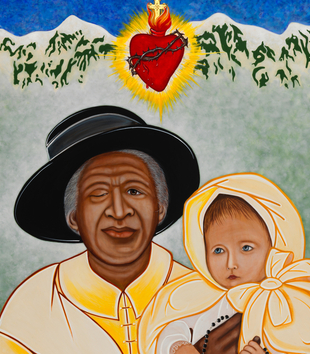 Julia Greeley, Denver’s Angel of Charity
More than a portrait of a holy person, an icon structures a present encounter with a saint and the community that the saint represents. What kind of encounter does Greeley’s icon conjure with race and Catholicism in the Old West?
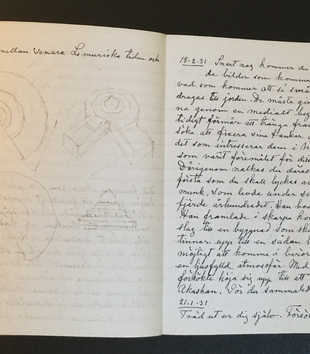 Hilma af Klint's Temple for the Paintings
Through Af Klint’s journal entries and sketches, we can shift analyses of sacred space from the guise of transcendent force that simply “appears,” in the phenomenological nomenclature, and instead approach it as technique.
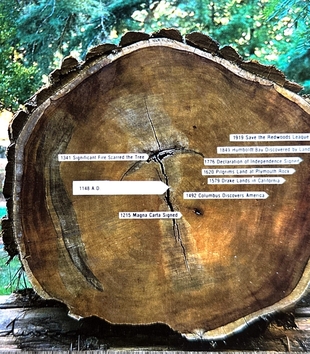 Tree Rings and Blood Lines
These redwood rings are both family trees and family circles, literally naturalizing a canonical “American” familial heritage insistently recited and instantiated in many media and locations: artistic and built environments, judicial practice, legislation and policy, textbooks, land use, and national land theory. Heritage is a family business.
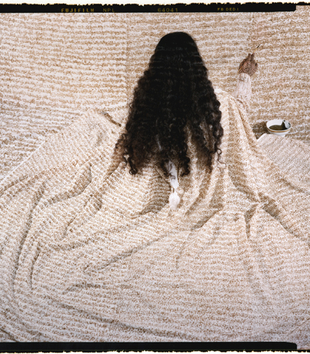 Corporealizing Moroccan Place
I wondered—how does a person become a place? A street, city quarter, mosque, or town could take the name of the wali interred there, like the cities of Sidi Slimane and Mawlay Idris. The sacred enters physical space through the body.
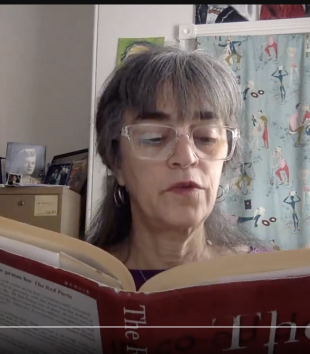 A Photograph in Words
In her memoir, The Red Parts, Maggie Nelson writes about the over-thirty-year-old unsolved murder of her aunt, Jane Mixer, a case brought back to life in a Michigan court room. Who gets to tell this story? How should it be told?
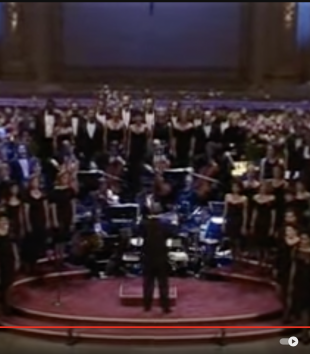 Pausing on a Sunday: What Kind of Secular is the American Musical?
The musical in which this song appears includes archetypal depictions of the modern artist and his attendant gendered capacities and failures. Sondheim would point out: its lyric is a single sentence; it is a description of a process; it includes a word, “forever,” that he observes makes him cry.
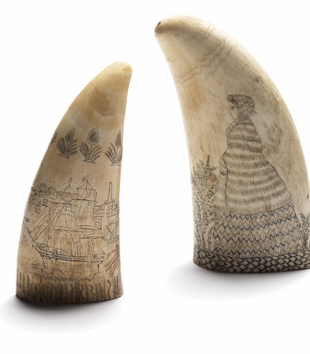 Sperm Whale Teeth in Circulation: A Case Study in Material Economics
From Fijian ceremonial objects to nineteenth-century American whaling souvenirs, to airline membership cards, this constellation explores material economies through one raw material: sperm whale teeth.
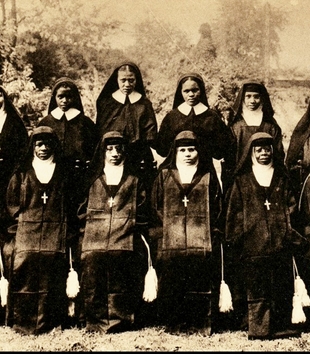 “Colored Magdalens,” House of the Good Shepherd for Colored Girls, Baltimore, ca. 1930s
Was [the Magdalens'] decision to own in perpetuity the status of penitent a judgment on waywardness, or a benediction? An internalization of white surveillance, or its repudiation?
 Let. It. Burn. SoulCycle's Jonathan Adler Grapefruit Scented Candle
While a stationary bike is the main conduit for the SoulCycle experience, perhaps no object plays a greater role in facilitating SoulCycle’s choreography of emotion than the brand’s signature grapefruit-scented candle.
 The Sticky Cookies of Biblical Womanhood
Biblical womanhood blogs often resemble the idealized Christian home they encourage women to build. Businesses have long recognized the potential for profit in networked domesticity, enticing bloggers to participate in commercial enterprise by promising percentages of purchase costs made through their sites.
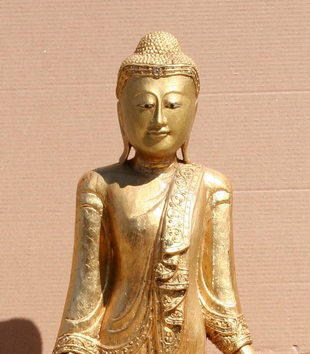 eBay Buddha
This golden Buddha, which has a striking resemblance to a Burmese Buddha in the British Museum, came up for sale on eBay for the sum of $5,000.00. The material of teak, the economies of the British and Burmese empires, the religion then being named "Buddhism," now give us this American eBay Buddha.
 Wifey
Wifey
The fragrance Wifey by KKW Fragrances was released in 2019. As wife to black artist Ye (formerly Kanye West), Kim KW claimed and sold the role of wifey. The “wifey” is not simply a wife. She is a model or caricature of a wife, a down-ass. The “wifey” signifies a new ideal in our contemporary popular culture.
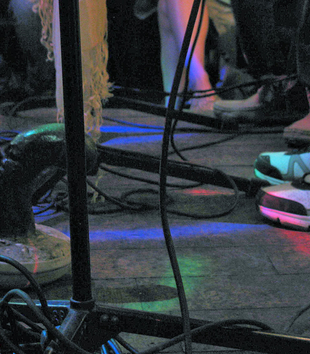 Making Paths with Stone
Eshu-Elegguá is a divinity in the Regla de Ocha-Ifá pantheon characterized as a warrior and messenger. Enslaved Africans in Cuba taught their descendants that a good relationship with this divinity is helpful for making risky choices and providing protection when embarking on a treacherous new beginning.
 Fuel for the Soul
The bible "God's Word for the Oil Patch: Fuel for the Soul" offers insight into how people theorise both the value of energy and the kind of lives people need to live to access this value. The publication implies that to have the kind of soul that lives a good life, you need to manage oil and its energy: souls are things that need fuel, be it "God's word" or oil itself. Oil work, in this context, becomes soul work.
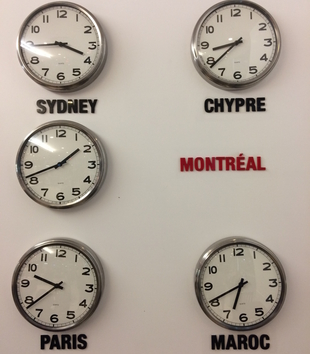 Bus Station Clocks
A row of clocks. Each one with an identical, nondescript face—except for the hands, which are conspicuous in their different orientations. Clocks are the kind of “religion” that spills out beyond the sphere of the sacred. Rows of clocks that evoke utopian, aspirational feelings of global connectedness. These are “religious” feelings in the deepest sense of the term.
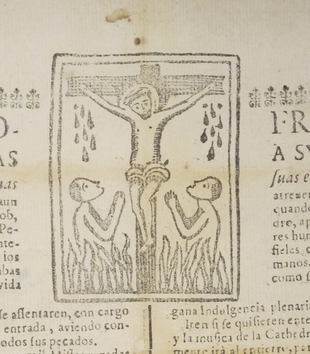 Confraternal Letter
A simple woodcut on a late-seventeenth-century membership letter of the confraternity of Souls of the Cathedral of Lima depicts two souls bathed in flames, gazing up at Christ crucified. Stylized drops of blood pour from each of Christ’s wounded hands, visual embodiments of the doctrinal logic behind indulgences—the great sacrifice of Christ and of the martyrs of the church created a treasury of merit that ordinary sinners could draw upon.
 Wudhu Socks
This is a pair of highly engineered, durable waterproof socks that exemplifies the rebranding of sportswear for the American Muslim market. Marketed as “wudhu socks,” the socks protect the feet and ankles from ritual impurities, and are intended to allow one not to wash one’s feet between ablutions.
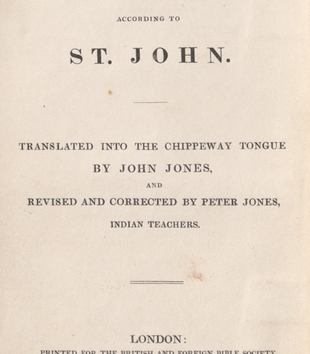 Biblical Gifts & Colonial Relations
On April 5, 1832, Peter Jones presented King William IV with a bible he translated into Anishinaabemowin. This exchange reflects Anishinaabe gift-giving practices, in which bible gifts can be regarded as practices used to build and refuse particular religious, political, and material relations.
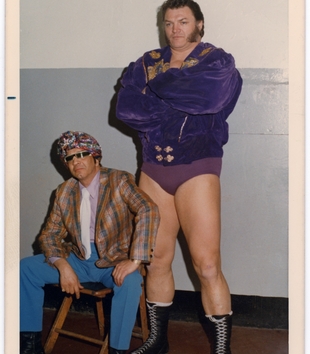 The Mormon Heel
Don Leo Jonathan was born 1931 to a Mormon family in Utah. During his professional wrestling career, Don Leo capitalized on certain anti-Mormon prejudices during a period of Mormonism’s erstwhile mainstreaming and clean-cut imagination in American culture, often performing as the "heel," or villain.
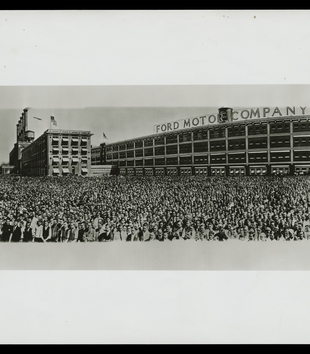 Relics and Rubber
In 1929, Henry Ford opened the Henry Ford Museum. That same year Ford Motor Company set ablaze vast swaths of rainforest in Brazil to clear land for Fordlandia, one of Ford’s rubber plantations. In Ford’s “progressive” trail across the Americas and in pictured masses arrayed outside Ford’s plants, we glimpse material economies of religion christened as political economy and mass produced in Ford’s name.
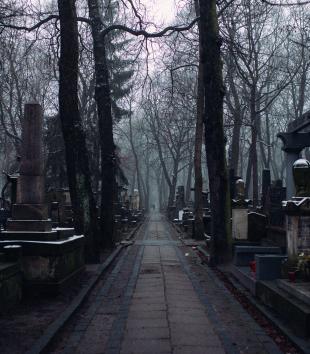 Material Economies of Life-Time: Grief, Injury, Expiation, Desire
Tracy Fessenden, Hillary Kaell, and Alexia Williams discuss three iterations of religious, material economies: bus stop clocks, cloistered Magdalens, and a Catholic prayer card from Denver.
 The Intimate Ironies of the Wifey: Material Religion and the Body
From the familiarity of scent to the spread of colonial/space time, and through Black vernacular culture and “linking” us to divine power through the digital, Ellen Amster, Dusty Gavin, and Suzanne van Geuns introduce us to the strange intimacies of the wifey.
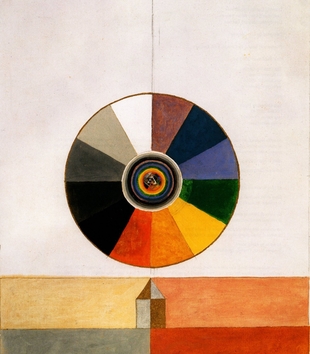 Designing Risk, Accumulating Failure: Purgatory, the Planned, and Primitive Accumulation
In Fall 2020, Paul Johnson, Emily Floyd, and Kati Curts met on Zoom. In this edit of their extended conversation, the authors question “planned sacred space,” the role of design in creating religious experience, and the category of the “relic.”
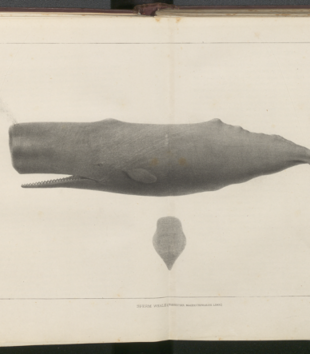 The Old Gods: Whales, Oil, and Teak
Judith Ellen Brunton, Richard Callahan, and Alexandra Kaloyanides endeavor to find the resonances their images pose to characterizing material economies of religion in the Americas. In emails from the autumn of 2020, each offers moments of speculation on the contexts shaping their research objects, and the supernatural powers and economies they enchant.
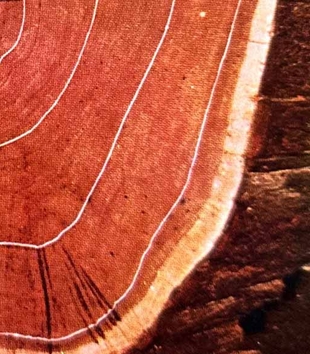 American Performances, Economies, and Genealogies of Constraint
In this collaboratively written exercise, the authors discuss the material significance of embodied sense perceptions and affects. Despite Protestant secularity’s claims to the contrary, sensation and affect are no more confined to interiorized subjective mental states than is religion merely belief.
 The Currency of Religion in America in Three Acts: Market Logics, Emissaries of Kinship, and Technologies of Feeling
Cody Musselman, Kambiz GhaneaBassiri, and Roxanne Korpan each present an object for consideration. Together they think about what it means for each object to be involved in the material economy of religion. Their conversation traverses various geographies and traditions, and ponders how material objects can be carriers of religion.
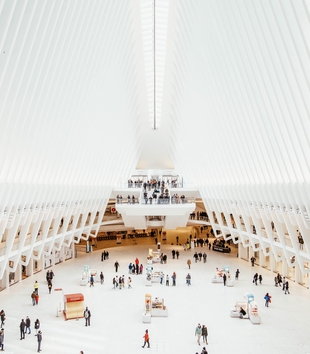 A Closing Conversation
If the Marxian dialectic culminates with the mystification of the commodity, these essays seem to envision a sacralization and re-sacralization of the profane, such that matter is the accumulation of sacred value. Transcendence and enchantment in this account are very much “real” and just as ontologically entrenched as capitalism.
A special issue guest edited by Kambiz GhaneaBassiri and Anna Bigelow.
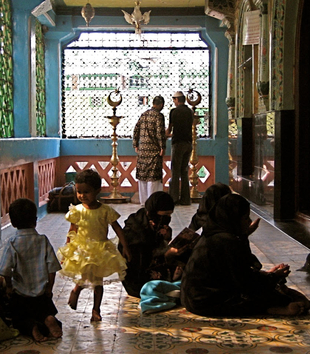 Introduction to the Special Issue: Material Islam
Anna Bigelow and Kambiz GhaneaBassiri introduce this special issue of MAVCOR Journal devoted to Material Islam. It explores devotional objects, the Islamic sensorium, the book as a material object, the Muslim body, and the various roles of the mosque as a social, political, and spiritual space. Taken together, its varied essays demonstrate an incredibly wide-ranging, rich, and exciting arena of study.
 In Conversation with Christiane Gruber on Material Islamic Studies
Kambiz GhaneaBassiri and Anna Bigelow speak with Christiane Gruber about changes and growth in field of Material Islam, new arenas of inquiry, and their hopes for further interdisciplinary scholarship.
 Ablution Socks: The Logic of Market Capitalism and Its Limits
The marketing of “wudhu socks" provides an interesting window onto how the forces of consumer capitalism in twenty-first-century America are brought to bear on a centuries-old hermeneutical, legal, and theological tradition in Islam that has long conceptualized purity through embodiment and objects.
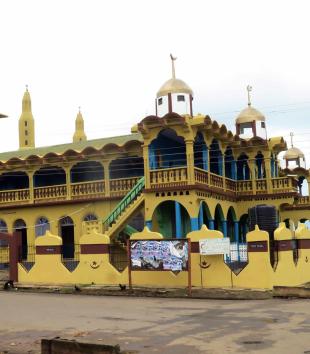 The Transcontinental Genealogy of the Afro-Brazilian Mosque
This article examines the genealogy of Afro-Brazilian mosques, answering some of the most immediate and puzzling questions that they force all who see them to ask. The answers to these questions demonstrate the fluidity of categories such as European, African, Islamic, and Christian, and how West African Muslims effectively drew on an architectural vocabulary with connections to three continents to forge an emergent cosmopolitan identity.
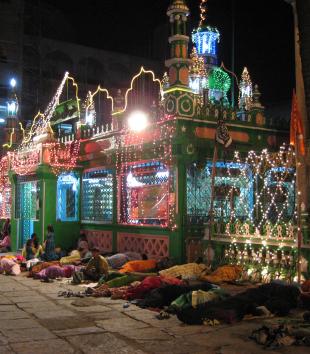 Senses of Belonging: Materiality, Embodiment, and Attunement at Sufi Shrines in India
In exploring the multiple modalities of Muslim belonging and unbelonging in India, the arenas in which Muslims and non-Muslims interact, especially at shared holy places, are extremely illuminating locales. This essay explores the ways in which material and somatic forms of interreligious encounter at a Sufi dargah (درگاہ), or tomb shrine, in Bengalaru (Bangalore) exemplify everyday as well as spectacular practices of shared piety that also reimagine the possibility of collective belonging in a time of precarity.
Senses of Belonging: Materiality, Embodiment, and Attunement at Sufi Shrines in India
In exploring the multiple modalities of Muslim belonging and unbelonging in India, the arenas in which Muslims and non-Muslims interact, especially at shared holy places, are extremely illuminating locales. This essay explores the ways in which material and somatic forms of interreligious encounter at a Sufi dargah (درگاہ), or tomb shrine, in Bengalaru (Bangalore) exemplify everyday as well as spectacular practices of shared piety that also reimagine the possibility of collective belonging in a time of precarity.
 Bībī kā ʿAlam
The Bībī kā ʿalam, as it is popularly known, occupies a special, sacred class of ʿalams for the Hyderabadi Shiʿa. Containing Fatimah’s funerary plank, is a reliquary ʿalam and, while Hyderabad is distinctive for the extraordinary number of relics it possesses that are associated with the Imams and Ahl-e Bait, very few connect to Shiʿi women saints.
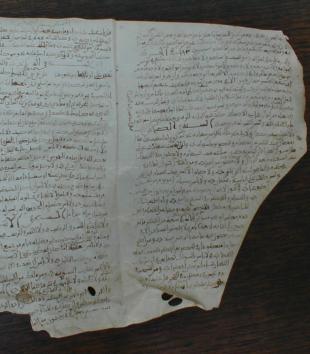 A tenth-century Islamic manuscript from Kairouan, Tunisia
A parchment bifolio from the Kairouan collection presents a mystery. But like pottery in an archeological dig, this fragment is in situ, and clues to the identity of the author, the text, and the community of scholars that wrote and preserved it, are found in the rich context of this unique collection. Together, these manuscripts bear witness to a fascinating history of literary and cultural production, not only in North Africa, but in the broader Islamic world of the ninth and tenth century.
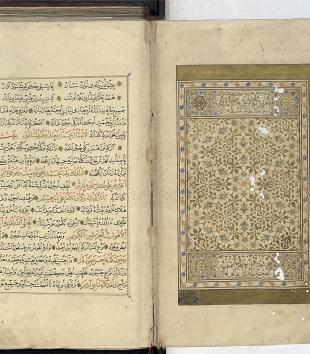 Adorning the King of Islam: Weaving and Unraveling History in Astarabadi’s Feasting and Fighting
This article traces a fourteenth-century Persian history from Anatolia, Bazm wa Razm (Feasting and Fighting), written by ʿAzīz al-Dīn Astarābādī, from its presentation copy to its various recensions down to the modern period, examining how each era visually refigures this textual manifestation of its original patron, Burhān al-Dīn Aḥmad (r. 783-800 AH/1381-1398 CE), for a new purpose.
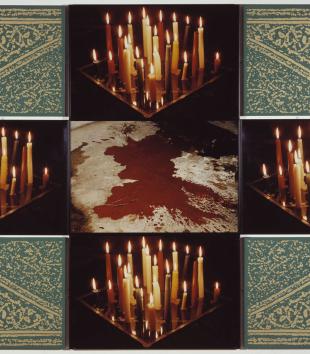 Rasheed Araeen’s Bismullah
Rasheed Araeen’s Bismullah is noteworthy as the first work by the Karachi-born, London-based artist to enter the collection of Britain’s Tate Gallery in 1995. Bismullah deploys strategies of juxtaposition, disjunction, and doubling to combine visual imagery that references religion, empire, art history, and the artist’s personal biography. Through its montage tactics Bismullah not only maps the binaries of self and other that structure colonial discourse within and beyond the artistic field, but also recontextualizes these signifiers.
 Hikmet Barutçugil's Hüdayi Yolu
Hüdayi Yolu represents a modern artist’s loving depiction of his hometown and neighborhood, an homage to a local Sufi saint, the romanticized communal memory of Istanbul as an Ottoman metropolis, and Barutçugil’s approach to “Sufi” art.
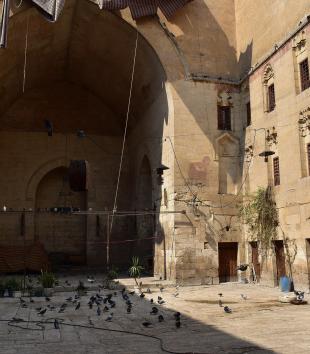 On the Material and Social Conditions of Khalwa in Medieval Sufism
Ubiquitous across the medieval Islamic world, khalwa is the practice of self-isolation, typically in a small cell, in order to focus on pious devotions. This article offers one possible approach to theorizing the heterogenous elements of khalwa coherently by insisting that we take the material and the social as seriously as we do the human and the spiritual.
 Ayat Al Kursi Round
Crowned by the word “Allah,” a dense piece of Arabic calligraphy carved out of stainless steel wraps around an embellished center. The text is the ayat al-kursī, or “The Throne Verse,” a portion of the Qur’an (2:256) often recited before sleep or travel because of its reputation for spiritual and physical protection. While the Illinois-based company Modern Wall Art produces the above “Ayat Al Kursi Round,” at least six other businesses manufacture their own ayat al-kursī pieces in the same circular visual style. These pieces of Islamic decor appeal to different tastes in spite of the repetitiveness of their visual content. By attending to the specific production method and branding of “Ayat Al Kursi Round,” we can identify how the materialization of God’s words in wall art entangles Islamic ethics and the aesthetics of class formation.
 Depicting Kongo and Angola in the Seventeenth and Eighteenth Centuries
As part of their activities in Kongo and Angola Capuchin Franciscan friars created dozens of images and wrote hundreds of pages of text in works that they called "practical guides." These Capuchin didactic images form an exceptionally important corpus that enriches our knowledge of central Africa and dramatically multiplies the European-format visual record about the African continent before 1800.
 Nature, Culture, and Faith in Seventeenth-Century Kongo and Angola
Early modern central Africa comes to life in the images that Capuchin friars. This Capuchin central African corpus consists today in four extant manuscripts connected by form and content. This essay offers additional visual material from the corpus by featuring details of each individual vignette that comprise the 1650s poster now in the Museo Francescano, as well as the unpublished versos of the Parma Watercolors that feature text.
 The Black Cross
Donald Jackson’s The Black Cross illustrates some of the ways contemporary calligraphic art engages sacred writ: through the interplay of word and image, recording the artist’s physical gestures, and making visible the divine.
 Models of a Bygone World: Popular Nineteenth-Century Nativity Scenes as a Representation of Chilean Society
Embracing the belief that the humblest of individuals participated in Jesus’s birth with their presence and their gifts alongside the wisest, Christians of every era have wished to display their own participation and contribution to this foundational Christian event. This article describes the ways in which a traditional, rural-inspired society like that of Santiago, Chile at the end of the nineteenth and the beginning of the twentieth centuries expressed itself through its nativity scenes.
Guest edited by Amy Holmes-Tagchungdarpa and Kalzang Dorjee Bhutia in collaboration with MAVCOR Journal Editor Emily C. Floyd. The call for papers for this special issue invited scholars coming from diverse disciplines (religious studies, anthropology, archaeology, history of art, visual studies, etc) and working across a range of high altitude ecologies, from the Andes to the Himalayas and beyond, to consider how the specificities of these regions impact material and visual aspects of religious practice. This special issue is published on a rolling basis.
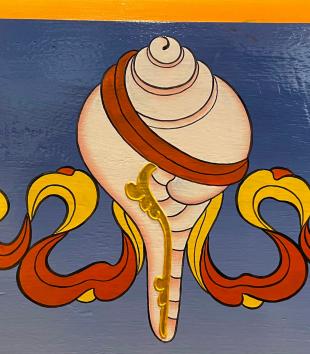 Flying Conches in the High-Altitude Oceans of the Himalayas: Displaced Objects and Multiscalar Relations in the Mountains of Sikkim
Conch shells frequently appear as objects in religiously inspired artwork and shrines in Sikkim, west India. Their frequent appearance in material culture and invocation in Classical Tibetan-language literary culture is indicative of a rich repository of connections. This essay explores some of their many resonances, in particular their significance as indicators of ecological change in the Himalayas.
 The Ritual Ascent at Mount Tlaloc, Mexico
Bridging ecology, ethnohistory, linguistics, and art historical inquiry, this article argues that the various forms of vegetation encountered along the slope of Mount Tlaloc during the ascension of the tlahtoque were of ritual significance within Nahua worldview.
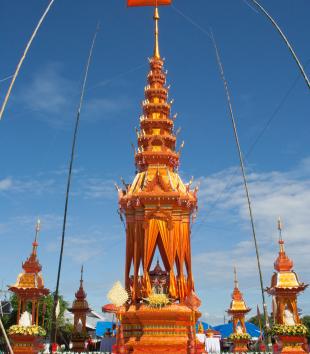 Gold Palaces: Merit, Beauty, and Perfection in the Cremation Structures of Monks in Northern Thailand
Cremation structures serve the utilitarian purpose of incinerating a corpse to aid transition from life to death, but in contemporary practice in Northern Thailand, opulent, golden-colored cremation structures called prasat sop also create a stunning sight that give local viewers a deeper understanding of all sentient beings’ connection to death.
 Qoyllur rit’i: El señor de la Estrella de Nieve
En 2012 empecé a hacer un registro gráfico del peregrinaje que poco a poco se convirtió en un proyecto fotográfico. Al intentar comprender este mundo sincrético, la fotografía me permitió plasmar y narrar lo que veía.
 Qoyllur rit’i: The Lord of the Snow Star
In 2012, I began to make a graphic record of the pilgrimage, which little by little evolved into a photographic project. In attempting to comprehend the syncretic world of the festival, photography allowed me to capture and narrate what I saw.
 The Book as a Generative Agent: The Buddhist Canon as a Community Member in Book Procession Rituals of the Himalayas
Known as the Bumkor, the books that make up the Bum are not just objects, but are generative, active agents that are capable of producing and renewing auspiciousness in the local human and nonhuman community that reside in the landscape.
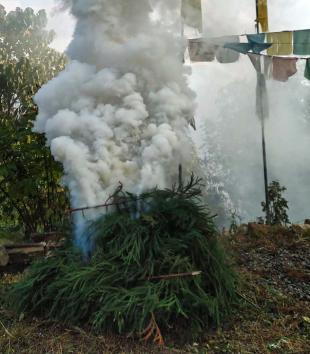 Purifying Multispecies Relations in the Valley of Abundance: The Riwo Sangchö Ritual as Environmental History and Ethics in Sikkim
The Riwo Sangchö is a ritual exchange that facilitates smoky relations between humans and spirits resident in landscapes around the world.
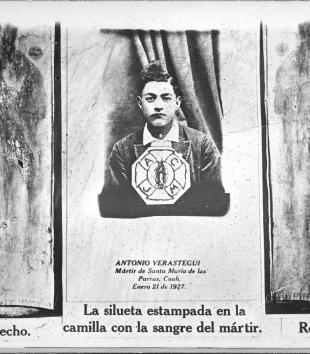 Photographic Postcard Commemorating Antonio Verástegui
A postcard commemorating a young “martyr” of Mexico’s Cristero War named Antonio Verástegu engages the spectator in an act of witnessing that entails both religious and political consequences.
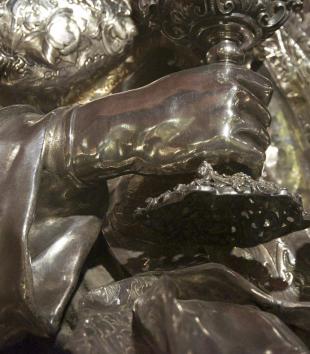 Colonial Materiality: Silver’s Alchemy of Trauma and Salvation
Embedded in power relations, coloniality, and matters of purification, early modern silver was a particularly generative site. Might its peculiar paradoxes be usefully thought in terms of a materiality of trauma?
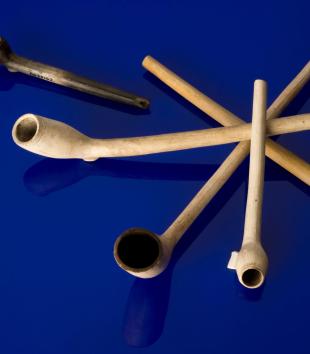 Material Technologies of Empire: The Tobacco Pipe in Early Modern Landscapes of Exchange in the Atlantic World
The look and shape, feel and function of the tobacco pipe footnote the transformational features of the early modern Atlantic world: landscapes of exchange.
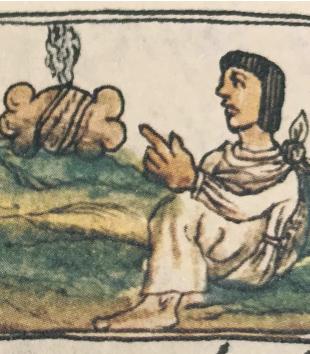 Locking Eyes with the Sun: Perception, Landscape, and the Fame of Greenstone in a Sixteenth-Century Nahuatl Narrative
A narrative describing interactions between a human knower, sun, and precious stones enables a new interpretation of Nahua accounts of precious stones releasing vapors, while also providing greater insight into the nature of sensory experience in Nahua thought more generally.
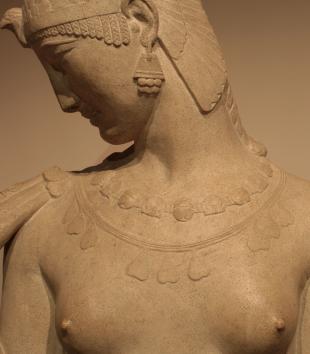
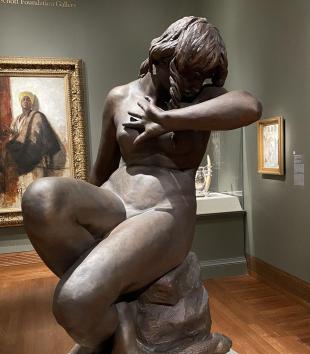 Moses Jacob Ezekiel, Eve Hearing the Voice
In 1876, Moses Jacob Ezekiel, the first Jewish American artist of international stature, sculpted the world’s first woman, to which he gave the title, Eve Hearing the Voice.
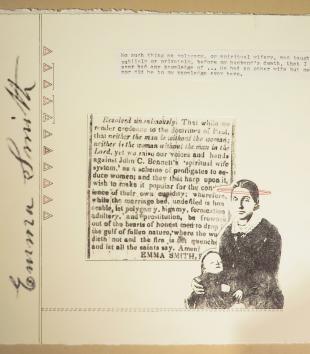 Art, Religious Memory, and Mormon Polygamy
What happens when part of the religious history a person believes in turns out to be incorrect?
 Mural Paintings, Church of the Summer Residence of the Maronite Patriarch, Diman
Since its construction around the turn of the twentieth century, Our Lady of Diman has served as the summer residence of the Maronite Catholic Patriarch. The prestige of the building is everywhere apparent: in the inlaid marble floor, in the gold and blue panes of the stained-glass windows. The church’s most remarkable feature, however, is the ceiling over its nave, with frescoes completed in the late 1930s by celebrated Lebanese painter Saliba Douaihy (1913-1994).
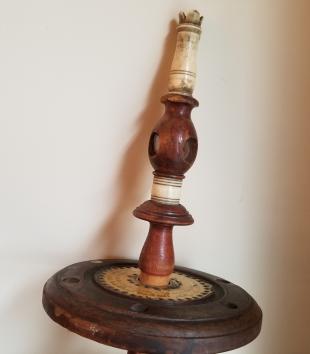 A Stick of Wood, a Tree of Life
This Ets Chayim, a Tree of Life, is obsolete, redundant, out of time and out of place. It is detached both from the Torah scroll for which it was made, and from its mate that once served that scroll’s other end. It is not supposed to be here anymore—here, that is, in a transformed, glass-sheathed, twenty-first-century Lower East Side, where the traces of immigrant life have been erased, sanitized, and gathered into museums, or commodified as “atmosphere” for an urban playground. Perhaps the act of marking it—noting its persistence beyond obsolescence, shorn of the text to which it was once an auxiliary, bereft of the hands that once grasped it and the congregation that once stood as it was lifted up—is a minor act of resistance in itself.
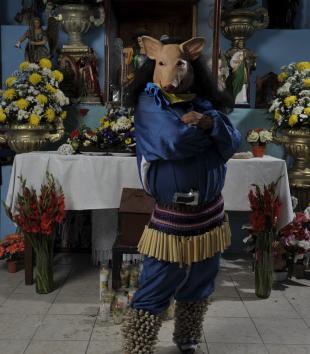 Fernando Brito and Héctor Parra, Judío
In Judío, photographer Fernando Brito attempts to find an ad-hoc visual representation for the Yoremem or Mayo Indians in his native state of Sinaloa, Mexico. This portrait pays tribute to the foundational value of the community’s ritual, which combines indigenous cosmology with seventeenth-century Jesuit influence, as crucial to its survival and cohesion.
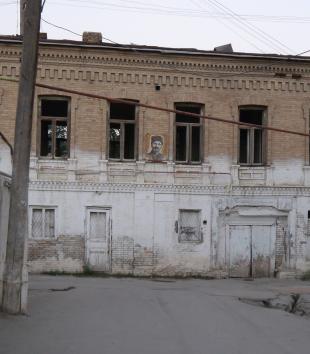 A Dying House in Samarkand’s Jewish Neighborhood
Pagiel Leviyev’s house is very sick. Built in Samarkand over a century ago, the structure was designed as a mansion for a wealthy mercantile family. Today, it stands as a crumbling reminder of the Jewish community’s long and complex history in this unexpected spot of the world.
This special joint issue is published with The Journal of Southern Religion (JSR). The journals issued a call for papers together in 2017 and are pleased to publish these four peer-reviewed articles, two editorial introductions, and one editorial reflection. In his editorial reflection, Bill Ferris considers his own history with southern religion and material culture. Jason Young and Louis P. Nelson offer introductions for the four articles, with additional reflection on the state of the field.
 Material and Visual Cultures of Religion in the American South
Described by Flannery O’Connor as “Christ-haunted,” southern identity is and always has been shaped by religion. The still familiar sight of churches and hand-painted religious signs along highways and roads are powerful reminders of religion throughout the region. As the field of Southern Studies has evolved, so has our understanding of religion and its expression in material and visual culture in the region.
 Critical Reflections on Visual and Material Religion
This joint edition of MAVCOR Journal and the Journal of Southern Religion has focused needed attention on the ways that visual and material cultures have played and continue to play a critical role in shaping religious belief and practice in the American South. The very kind offer by the editors to write an editorial introduction to the edition encouraged me to reflect a bit more deeply on the trajectories of recent scholarship and some of the holes I see in the current historiography.
 On the Religion of Things
Though often perceived as an arena of human life devoted exclusively to the ethereal, the actual practice of religion, not to mention our study of it, is mediated through the material circumstances of life.
 The Second Great Awakening and the Built Landscape of Missouri
The simple, gable-end church form was suited to the material circumstances and to the socio-theological climate of the Second Great Awakening. Gable-end churches provided an affective and sensorial locus for newly created communities to position themselves as extensions of an evangelical Protestant national consciousness.
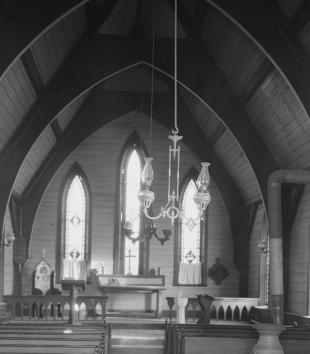 “A Doorkeeper in the House of My God”: Female Stewardship of Protestant Sacred Spaces in the Gulf South, 1830-1861
The movement to build and furnish new churches in the Antebellum South was not the moment of Protestant women’s religious domestication, but rather an opportunity for a new type of public stewardship of the church, one that encouraged female collective action. Women expressed their piety and leadership in the church by enhancing its materiality, they gave their churches permanence and social status.
 Horseshoe Crosses and Muddy Boots: Material Culture and Rural Masculinity in Cowboy Churches
In a large pasture in West Texas, thirty-five men and women sit mounted on horseback and forty more stand around them. Sitting astride a horse in front of them is their pastor, next to another man holding a large American flag. He reads to them from the Bible of the wondrous changes brought by the Lord and then invites them to church the next day. With this simple invocation, the pasture roping at the local cowboy church is now underway.
 Uncle Tom’s Bibles: Bibles as Visual and Material Objects from Antebellum Abolitionism to Jim Crow Cinema
Stowe’s deployments of bibles and artistic representations of them in illustrated editions offered a conservative abolitionism that emphasized the potential for peace among former slaves and masters. . . . bibles in the afterlives of Uncle Tom’s Cabin continued to offer moderation when it came to issues of race and racial interactions.
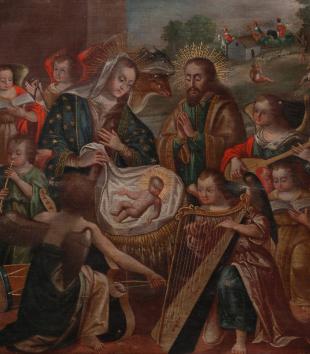 Audible Paintings: Religious Music and Devotion to the Infancy of Christ in the Art of the Viceroyalty of Peru
Paintings are silent, but not to those who know how to listen. Some paintings appeal to the sense of hearing in order to stimulate the beholder’s emotional engagement. For eighteenth-century nuns living in the Viceroyalty of Peru, paintings could evoke Latin polyphony or villancicos, songs in the vernacular performed in sacred contexts.
 Modern Art in Egypt and Constellational Modernism: A New Approach to Global Modern Art
To challenge the problematic narratives of modernity, perpetuated by both traditional and emergent approaches to modernism, Egyptian modern art should be analyzed through a new paradigm called, “constellational modernism.”
 Trump’s Wall: A Monument of (Un)Civil Religion?
Trump has relentlessly pushed for a “monument” that cannot be torn down or simply relocated: the wall.
 Adobe and Stone Churches of New Mexico: A Selection
The architecture of New Mexican village churches is often described as vernacular, which is to say that the construction materials (adobe, stone, vigas, latillas) are local; the design reflects local taste, tradition, and resources; the construction standards are idiosyncratic, pursuant to the experience, inclinations, and skills of the builders; and the finished product represents the history and cultural identity of the community.
 Elijah Pierce and Material Conversions
Obey God and Live (Vision of Heaven) is Elijah Pierce’s personal conversion narrative. In this piece of wood he depicted the definitive episode of his own spiritual autobiography, an event in his past that he understood to (re)organize, interpret, and frame his entire life.
 Street Altars in Mexico City
This series of images, taken over the course of six months, documents the street altars dotted around Mexico’s dense, urbanized capital, home to over twenty-one million people.
 Miki Kratsman, Diptych from The Resolution of the Suspect
In The Resolution of the Suspect, photographer Miki Kratsman builds on the reliquary nature and the transitive qualities of the carte-de-visite, creating a diptych: the historic image on one page of the centerfold and his own photograph of the bloody garment of a single unnamed Palestinian martyr on the other.
 Georgia O’Keeffe, Black Cross with Stars and Blue
In 1929, on her first visit to New Mexico, the American artist Georgia O’Keeffe (1887-1986) observed the animate potential of the region’s religious material culture.
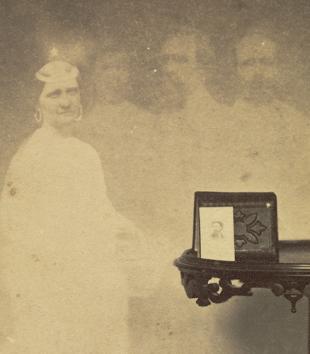 A Communion of Shadows: Religion and Photography in Nineteenth-Century America
The objects on display in this collection stitch together what I call the “communion of shadows” that began with the invention of photography in the early nineteenth century.
 The Canopy Tomb of Edward Shippen Burd
This American monument may even present an understudied alternative vision of the afterlife—one incorporating an intermediate phase just after death—that runs through nineteenth-century Protestant and Anglo-Episcopal sources.
 Reconstructing the Faces of the Saints, an Interview with Friar Luis Enrique Ramírez Camacho, O. P.
In 2014 the Dominican Order in Peru worked with Brazilian NGO EBRAFOL to produce digital facial reconstructions of Peruvian saints Rose of Lima, Martin of Porres, and John Macías.
 Nruhari Das on Material Culture and Krishna Consciousness
Ashley Makar interviewed Nruhari Das on September 22, 2012 at the Sri Sri Radha Govinda Mandir ISKON Hare Krisha Temple in Brooklyn, New York.
 Shep Parson on Material Culture and Protestant Ministry
Ashley Makar interviewed Shephard (Shep) Parsons in 2011 when Parsons was minister at Shelton Congregational Church in Shelton, Connecticut. He is currently Senior Pastor at First Church of Christ, Woodbridge, Connecticut.
MAVCOR began publishing Conversations: An Online Journal of the Center for the Study of Material and Visual Cultures of Religion in 2014. In 2017 we selected a new name, MAVCOR Journal. Articles published prior to 2017 are considered part of Conversations and are listed as such under Volumes in the MAVCOR Journal menu.
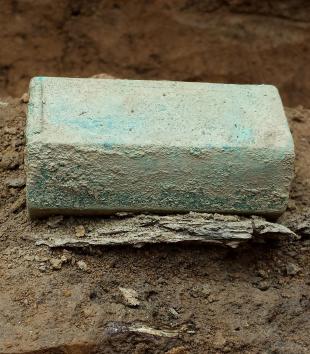 Jamestown’s Relics: Sacred Presence in the English New World
A remarkable reliquary helps us imagine new possibilities around the earliest English settlement in North America.
 An American Sufi Shrine, Bawa’s Mazar in Coatesville, Pennsylvania
An ethnically and religiously diverse spiritual community near Philadelphia founded by a Tamil teacher from Sri Lanka.
 From Illuminated Rumi to the Green Barn: The Art of Sufism in America
The role material culture has played in the introduction of non-Christian forms of spirituality into the United States as examined through Sufi art.
 Tears of the Sun: The Naturalistic and Anthropomorphic in Inca Metalwork
Why did the Inca approach metal so differently from other sculptural media, most notably stone?
 Making Crosses, Crossing Borders: The Performance of Mourning, the Power of Ghosts, and the Politics of Countermemory in the U.S.-Mexico Borderlands
If the land “was Mexican once and Indian always,” migrants are not outsiders or “illegals.” They—we—belong to the land.
 Interview with American Sufi Artist Michael Green
A follower of Bawa Muhaiyaddeen, Green is based in Pennsylvania and is best known for his illustrations in The Illuminated Rumi (1997).
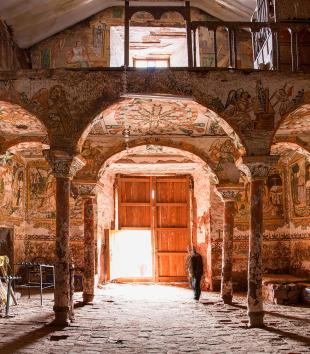 Painting Beyond the Frame: Religious Murals of Colonial Peru
With the Spanish invasion and colonization of Peru in the 1530s, the visual arts played an integral role in the religious indoctrination of indigenous and Afro-descendant communities to Catholicism. Mural painting in particular became a favored medium in early evangelization efforts because of its relatively low cost and shorter execution time in comparison to multimedia pieces such as retablos (altarpieces) and polychrome sculptures.
 Virtual Meditation Cushion (Zafu)
What does a virtual meditation cushion tell us about material and visual cultures of religion?
 Julian Voss-Andreae, Angel of the West
The power to protect against “nature” now dwells in the human scientific-technological skills mastered by a certain culture, whose prowess enables it to discover these new (meta)physical angels and harness their powers.
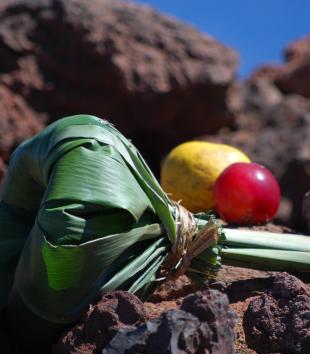 Material Establishment and Public Display
The cultural politics of space has to do not simply with space itself, but with how it is occupied, enacted, performed, and marked—and sometimes, in Hawaiʻi and elsewhere, at least apparently unmarked.
 Ex-Votos, Shrine of St. Roch, New Orleans
Ex-votos at the Shrine of St. Roch occupy a complex place within conceptions of New Orleans as the subject of Protestant fascination with exoticized material aspects of Catholic practice.
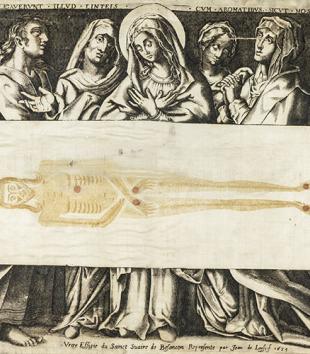 Printing the Body of Christ on Fabric
While most Renaissance and Baroque engravings, etchings, and woodcuts were printed on paper, some extraordinary impressions were produced on silk or linen. Contact relics provided a devotional inspiration for the most evocative of these prints on fabric.
 Carte-de-visite Photograph of Maximilian von Habsburg’s Execution Shirt
The carte-de-visite of Maximilian von Habsburg’s shirt satisfied a sensational interest in the political event and served as a mourning object, offering the living both visual and tactile connections to the deceased to aid in the grieving process.
 Fabric of Devotion: William Quiller Orchardson’s The Story of a Life and Women Religious in Victorian Britain
Produced in a Christian tradition for the viewing pleasure of the London art world's cultured audiences, William Quiller Orchardson’s The Story of a Life alludes to the controversies and contentions of religious life and women’s roles in mid-nineteenth-century Britain.
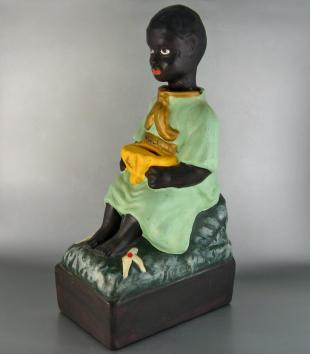 Chalkware
A Collection of chalkware from the Material Objects Archive
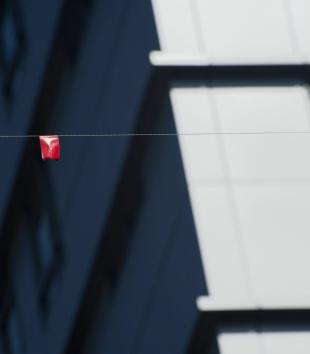 Introduction to the Eruv
The eruv boundary marks the borders of imagined courtyards. It is a work of architecture and urban planning whose program is the neighborhood, and whose materials are the appropriated accumulations of urban life. It is also a work of art whose simple line surrounds and defines the complexity of urban space while it defines the complex human community that inhabits its space.
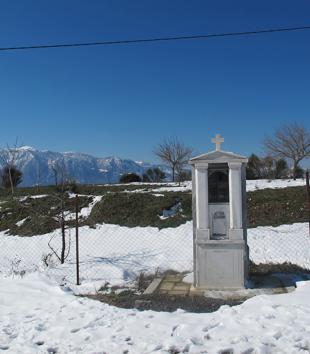 Eikonostasia
Eikonostasia (Greek: εικονοστάσια, singular: eikonostasi, literally: “icon stand”) are a constant if understated part of Greek urban and rural landscape.
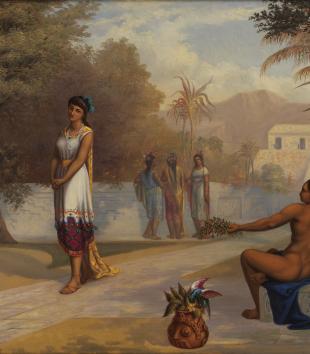 George Martin Ottinger, Aztec Maiden
Utah artist George Martin Ottinger painted Aztec Maiden during the last quarter of the nineteenth century, when numerous theories proliferated about the history and origins of indigenous American civilizations.
 Revisiting the Property Room: A Humanist Perspective on Doing Justice and Telling Stories
What does it mean to hold onto evidentiary objects, ordinary objects that may never make it to court, the evidence from the vast majority of crimes that remain otherwise unresolved, including so many of the horrific crimes that constitute the Holocaust?
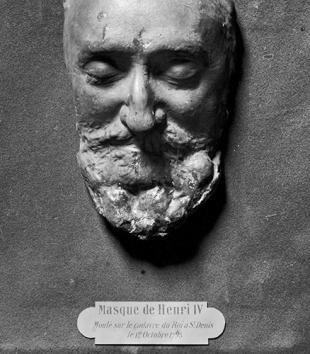 The Revolutionary Exhumations at St-Denis, 1793
The French Republic's July 1793 exhumation of the royal tombs intertwines not only contemporary religion and politics but also religious traditions with contemporary intellectual debate.
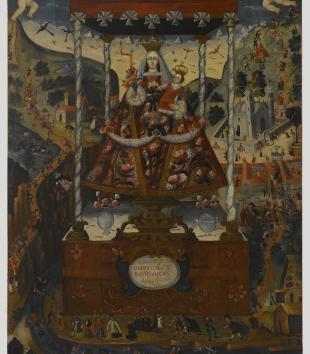 Our Lady of Cocharcas
Material objects, including a group of documentary paintings of Our Lady of Cocharcas, recall the processes by which ancient Andean pilgrimage traditions became deeply integrated into late-colonial socio-religious consciousness.
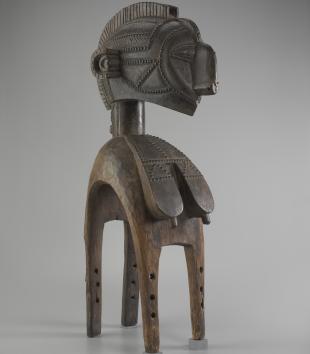 Mask with Superstructure Representing a Beautiful Mother (D'mba)
What is the meaning of the word "spirit" in Africa?
 The Politics of (Mere) Presence: The Islamic Center of Murfreesboro, Tennessee
The old Islamic Center of Murfreesboro was not, it seems, meant to be seen at all. A yearning to blend in, be ordinary, unremarkable, even overlooked, would, as I later discovered, inflect the architectural presentiments of the old and new centers alike, and provide an apt metaphor for the struggles that have confronted the Islamic community in this small city in central Tennessee.
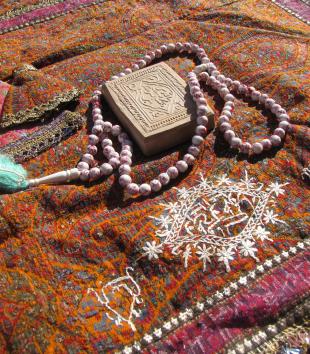 Praying through the senses: The Prayer Rug/Carpet and the Converging Territories of the Material and the Spiritual
Consumption as a material practice changes religious meanings and practices, and value comes to be invested in certain religious objects, rituals, and ideas rather than others.
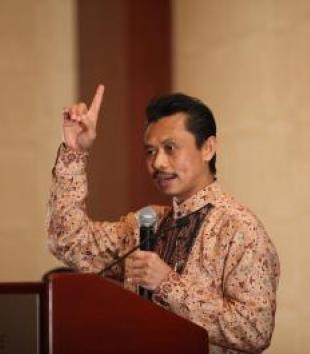 Imam Shamsi Ali: Thoughts on Islam and Material Culture
Imam Shamsi Ali is an Islamic scholar, Chairman of the Al-Hikmah Mosque in Astoria, and the Director of Jamaica Muslim Center in Queens.
 Reverend Alex Dyer: Tradition and Innovation in the Episcopal Church
Ashley Makar interviewed Reverend Alex Dyer, priest-in-charge of St. Paul and St. James Episcopal Church of New Haven, CT in May 2011.
 Martin Puryear, Desire
The world of handmade objects and manual labor turns strange in Puryear's Desire, and in this way, the ordinary becomes—here is list of options, choose one—estranged, uncanny, defamiliarized.
 William Vander Weyde, Leon F. Czolgosz, McKinley Assassin
Early debates around the use of the electric chair pivoted on the convergence of state and divine power.
 The Balvanera Escudo
Nun's badges worn in colonial New Spain not only articulated a woman’s religious affiliations, family fortune, and ethnic purity but also expressed her desire to influence political opinion.
 Adonai/Adidas T-Shirt
The t-shirt’s appropriation of a multinational sportswear corporation’s logo into a sacred Hebrew name for God could be simply a clever play on words, but a more critical approach might take into account the commodification of this sacred name for the deity and its subsequent selling in the marketplace for profit.
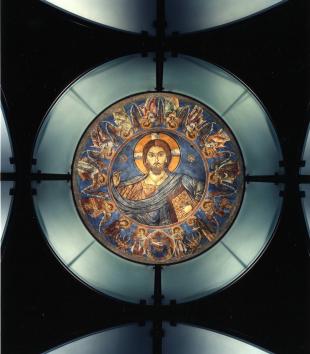
 Julie Dickerson: Creative Currents
Ashley Makar interviewed Julie Dickerson in 2010 while she was painting a mural of “dancing saints”—ranging from Moses’ sister Miriam to Martin Luther King—in the undercroft at St. James and St. Paul Episcopal Church in New Haven, Connecticut (affectionately nicknamed “St. PJ's”).
 C. C. A. Christensen, Joseph Preaching to the Indians
Although LDS doctrine esteemed Native Americans as literal descendants of the peoples of the Book of Mormon, relations between Mormons and Indians in Utah grew increasingly strained as resources became scarce. Christensen’s work reflects this divided perspective.
 Portable Altar of Countess Gertrude
The portable altar seems to have developed in the missionary world of the seventh century, to meet the Church's requirement that Mass be celebrated only on a consecrated altar—a requirement that strengthened the position of bishops, who alone could consecrate them.
 Thomas Eakins, The Crucifixion
In his 1880 The Crucifixion, Thomas Eakins, a reputed agnostic, crafted a realist interpretation of one of the central devotional subjects in Christian art, challenging the traditional iconography of the crucifixion by eliminating all signs of divine presence.
 Gordon Parks, Dresser in the bedroom of Mrs. Ella Watson, a government charwoman
Visibly claiming to regulate the prescribed Christian imitation of the biblical figures they represented, late-nineteenth and early-twentieth century statues of light-complexioned religious figures populated domestic spaces, churches, and missions fields, and implied that looking like Jesus or Mary or John might be more “natural” or “complete” for some than for others.
 Art That Breathes: Lewis deSoto’s Paranirvana (self-portrait)
Unlike its solid stone predecessor, deSoto’s work, made from painted polyethylene cloth, is hollow, filled only by air from a fan that keeps the sculpture inflated. The resemblance to the reclining Buddha is nonetheless remarkable, from the curls of hair to the folds of the robe, the one exception being that deSoto superimposed his own facial features, complete with goatee, on this Buddha.
 Chalkware, Plaster, Plaster of Paris
In the second half of the nineteenth century, in Europe and the United States, chalkware accomplished for three-dimensional devotional objects what chromolithography managed for images in two dimensions.
 James Latimer Allen, Madonna and Child
During the Harlem Renaissance, mother and child portraits and figure studies were especially popular in the African American media, signaling the importance placed on motherhood and the nurturing of future generations.
 Aparajita Guha: Conversation about Contemporary Hindu Spiritual Practice
This conversation about spirituality happened in the home of Aparajita Guha in Rexford, New York, on June 20, 2012. Guha, a practicing Hindu, is a family friend of Ashley Makar, who is a practicing Christian.
 Viaticum, Last Rites Cabinet, Sick Call Set
Among the material items that might occupy the pre-Vatican II American Catholic home, regardless for the most part of the occupant’s ethnicity or familial nation of origin, the last rites cabinet or viaticum (Latin for “supply of provisions for a journey”) asserted a powerful daily and nightly presence.
 Mark Rothko, No. 5/No. 22
Strong, gestural markings in the central red band distinguish this painting from Rothko’s other mature works. This anomaly consists of long, gently undulating lines formed by gouging the surface of the paint all the way to the canvas before it dried. Straining out from a central point, the horizontal lines contrast sharply with the fuzzy, indeterminate edges of the other elements of the painting.
 Ford Madox Brown, Work
Ford Madox Brown’s allegory of labor in all its forms is the most ambitious Pre-Raphaelite painting of modern life and a profound meditation on the relationship between art, religion, and labor in Victorian society.
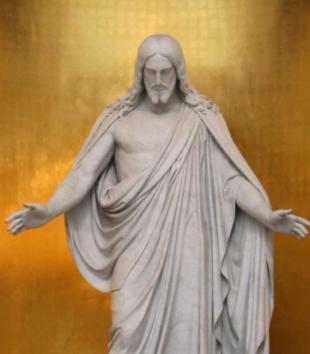 Bertel Thorvaldsen, Christus (Christ)
The internationally famous Danish sculptor Bertel Thorvaldsen (1789–1838) was asked to produce a series of colossal statues of Christ, John the Baptist, and the apostles for the new Neoclassical Vor Frue Kirke of Denmark. Of these, Christus (Christ) has become best-known. Copies of the sculpture, often true to size or even larger, can be found around the world.
 Rabbi Jordie Gerson: Reflections on Images and Jewish Traditions
Ashley Makar spoke with Rabbi Jordie Gerson on October 26, 2010 at Yale University’s Joseph Slifka Center for Jewish Life. Rabbi Jordie Gerson currently works as the Assistant Director and Campus Rabbi at University of Vermont Hillel.
 Barquitos del San Juan: La Revista de los Niños, Year 13, No. 23, 2007
Rolando Estévez Jordán, a visual artist, and Alfredo Zaldívar, a poet, co-founded Cuba’s Ediciones Vigía (Watchtower Editions) in 1985 to create an open forum for writers, musicians, and artists.
 Carte de visite Photograph Album
What photograph albums teach us about nineteenth-century viewing habits is that the reach of religion extended beyond compositionally “religious” subjects. Modes of beholding were often forms of religious practice that did not require a regulated rift between sacred and secular.
 Alexander Anderson, Abigail Hutchinson: A Young Woman Hopefully Converted
That “Protestants don’t have pictures” remains a common generalization. Yet in the early nineteenth century, nothing could be further from the truth. Protestant publishers like the nonsectarian American Tract Society (ATS) lavishly decorated their tracts with small but expressive printed illustrations.
 The Chapel of Our Lord of the Miracles (La Capilla de Nuestro Señor de los Milagros), San Antonio, Texas
No exact date is known for the founding in San Antonio, Texas, of the Capilla de Nuestro Señor de los Milagros (Chapel of the Lord of Miracles), or Capilla de los Milagros, as it is sometimes called. Visitors to the shrine and its central Christ image offer both their orations and material expressions of prayer.
 Opening Virgin (Vierge Ouvrante)
This object is an example of a type of small-scale Christian moveable-part medieval sculpture called a Vierge Ouvrante (“Opening Virgin”).
 Traveling Image of the Holy Child of Atocha (Santo Niño de Atocha), Plateros, Mexico
Each year, certain special religious images are ceremonially brought from Mexico and Central America to visit Catholic devotional communities in Southern California. These devotional statues of Catholic saints are “imágenes peregrinas,” pilgrim or traveling images.
 Arthur B. Davies, Sacramental Trees
Two maidens, one bright and one shadowy, lead an ox through a curiously dense, shallow, and cubistically-fragmented woodland, heading (one presumes) through the titular sacramental trees and towards an uncertain destination.
 Drain-spout in the Form of a Flying Celestial Figure
Hovering above the central courtyard of a Hindu monastery at the rural central-Indian village of Chandrehe was once a set of finely sculpted flying celestials, known within their original, tenth-century context as gandharvas, heavenly singers in the court of the gods, or vidya-dharas, meaning “carriers of truth.”
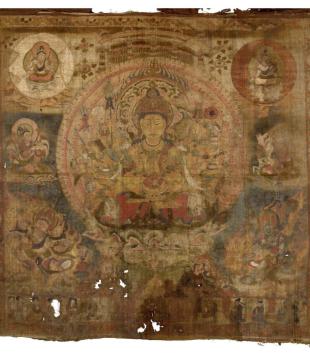 Thousand-armed and Thousand-eyed Avalokiteshvara
Avalokiteshvara, one of the most important bodhisattvas in Buddhism, was popularly known as the “perceiver of the world’s cries.” Bodhisattvas, meaning literally “enlightened beings,” were devoted, out of a deep sense of compassion, to aiding other sentient beings in their quest for enlightenment, even to the point of postponing their own entry into nirvana.
 The Vincent and Mary Markham Monument
In the summer of 1900, Denver acquired an unusual sculpture to mark the last resting place of pioneer attorney Vincent Daniel Markham (1826-1895) and his wife Mary (ca. 1834-1893).
 Cuzco Miter
The Cathedral of Cuzco, Peru holds several liturgical ornaments from the Spanish colonial period in its treasury. Among them is a magnificent embroidered miter, the headdress worn by bishops for blessings, baptisms, and processions.
 Kwame "Almighty" Akoto, The Supernatural Eyes of God
During a trip to Ghana in May 2010, I visited the roadside shop and atelier of painter Kwame Akoto, alias “Almighty,” a name he adopted so as to praise the power of God.
 Rightly Dividing the Word of Truth
Clarence Larkin’s dispensationalist chart “Rightly Dividing the Word of Truth” (1920) offers a detailed schematic of biblical history. The artistic product of an individual with experience in mechanical draftsmanship, Larkin’s chart shows how events and epochs fit together like parts in a salvation machine.
 Icon of Mary
Icons move. They cross national borders and traditional boundaries. They show up in the least expected places.
 Ancestor portraits at Mogao Cave 231
The integration of “secular” figures into a Buddhist cave complicates the separation established by both medieval Chinese authors and modern scholars of Buddhist art between practices of familial commemoration and religious devotion.
 Hans Holbein the Younger, Dead Christ Entombed
“Why, some people may lose their faith looking at that picture!” Dostoyevsky famously had his fictional character Prince Myshkin exclaim over Hans Holbein the Younger’s Dead Christ Entombed.
 Skull boxes
Skull boxes that both memorialized a dead individual and displayed the deceased person’s skull were made in Brittany from the eighteenth century to about 1900.
 External Eyes on Jain Temple Icons
These glass eyes seem to look intently at the viewer, seizing the viewer’s attention. This is precisely what they are intended to do by the Shvetambar Murtipujak Jains of western India; it is also precisely why the Digambar Jains of western India strenuously object to them.
 The Virgin of Guadalupe, Extremadura, Spain
This Marian icon cannot be characterized as a single object as the perception of her authenticity, from which she gains her numinous power, draws on two distinct representations, one nested inside the other.
 The Dolgellau Chalice and Paten
In 1890 two men working in the area around Dolgellau in North Wales discovered this pair of objects in a crevice between rocks. Encrusted with soil and plant matter, the objects were not at first identifiable.
 The Cross of Motupe
Credited with saving the town from sure disaster, the Cross of Motupe became the centerpiece of a devotion that drew pilgrims from throughout the region, and eventually from throughout Peru.
 Asher Durand, In the Woods
In June 1840, Asher Durand wrote in his journal: “Today again is Sunday. I have declined attendance on church service, the better to indulge reflection unrestrained under the high canopy of heaven, amidst the expanse of waters—fit place to worship God and contemplate the wonders of his power.”
 Buddhist votive stele with carved Buddhist figures and inscriptions
This is a Buddhist votive stele made in the sixth century in north central China. It probably stood either in the courtyard of a Buddhist monastery, or in a public place such as a market square, or at a major crossroads.
 Benjamin Paul Akers, St. Elizabeth of Hungary
Given the fact that Benjamin Paul Akers was a Protestant working at a time when nativist and anti-Catholic sentiments ran high in the United States, his choice to depict a miracle performed by an Eastern European saint seems peculiar, as does the popularity of his sculpture.
 Barnett Newman, The Stations of the Cross: Lema Sabachtani
According to the art critic Harold Rosenberg there is nothing religious about Barnett Newman’s series of fourteen roughly human-sized, black and white paintings, The Stations of the Cross: Lema Sabachtani.
 Mary Lyman’s Mourning Piece
Mary Lyman’s mourning piece served as visual and material evidence of her education, participation in mourning practices, and her religious and social formation.
 Madonna of the Fire
Forlì's Madonna of the Fire is a large fifteenth-century woodcut almost twenty inches high and sixteen inches wide.
 Christ Crucified in the Gellone Sacramentary
The image of Christ on the Cross, either as an element of a narrative scene (a Crucifixion) or as an isolated object of devotion (a Crucifix) is so common in the artistic and religious traditions of the last millennium of Western art, especially but not only in the Catholic tradition, that it is seldom recognized that such images are altogether absent during the first centuries of Christianity, and remain rare at least through the eighth century of the common era.
 Te amo heart
This object was purchased in an upscale novelty shop catering to tourists in downtown Boulder, Colorado, in 2010 for $11.95. Although at first blush it appears to be a Sacred Heart of Jesus, on second look the banner, which reads “te amo,” Spanish for “I love you,” indicates that the heart may not belong to Jesus.
 The Jade Buddha for Universal Peace
Numerous photographs appear to reveal what adherents are calling “mandala lights” around the Jade Buddha for Universal Peace as it makes its way around the world on a tour of Buddhist temples, monasteries, town squares, and museums.
 Carved rock outcropping, Machu Picchu
For the Inca, the landscape was both sacred and animate, full of forces that demanded respect and offerings. Distant mountain peaks, called apu—a term of respect meaning “lord”—were among the most powerful of these forces.
 Chicken-Feeding Girl
To most modern visitors, the Chicken-Feeding Girl displays the stereotypical concern of a doting mother, and a number of scholars have described this image as representative of the pastoral life of the region during the Song Dynasty (960—1279 CE). While this is in fact one way to interpret the work, the Song dynasty audience for Chicken-Feeding Girl read her presence at the site in an entirely different manner.
 Repurposed Choir Loft, Lake View Lutheran Church (ELCA), Chicago
Lake View Lutheran Church on Chicago’s north side is the fourth building of a congregation founded by Scandinavian immigrants in 1848. About 1960, demographic changes pushed the congregation to relocate and rebuild.
 Death Cart (La Muerte en su Carreta)
This dramatic death cart is an object that was used in acts of corporal penance performed by the Hermanos de la Fraternidad Piadosa de Nuestro Padre Jesús Nazareno (Brothers of the Pious Fraternity of Our Father Jesus of Nazareth).
 Buddha Image described as "King Udayana Image"
This form is replicated in over 70 statues remaining at Longmen. The votive inscriptions of the statues inform us that they were given the specific title “King Udayana Image,” and not considered as a general Tathagata image, such as the Buddha Sakyamuni.
 Woman performing her devotion to the Hindu god Shiva, in the form of a Linga
In this single folio, a woman is engaged in prayer. She sits on a pink cloth, her head in profile, with her body turned three-quarters to the viewer. Her right hand is covered by a golden textile, under which she counts beads on a rosary in meditation. She has garlanded the linga, or symbol of the Hindu god Shiva, and its three stripes of orange are mirrored on her forehead.
 John Valentine Haidt, Christ with a tau cross standing on top of the world and bleeding from his five wounds
This is the only known drawing by John Valentine Haidt, the most important Moravian artist of the eighteenth century. It appears at the opening of a small black-leather-bound hymnal that belonged to Haidt, upon a sheet of paper lightly stained and speckled with rusty spots.
 The Chart of the Magic Presence
The Chart of the Magic Presence is the visual synopsis of the self-centered teleology of “I AM,” a new religious movement founded in 1932 by Guy and Edna Ballard.
 Repositioning Plautilla Nelli’s Lamentation
My favorite underrated work of art is the Lamentation by Suor Plautilla Nelli (1523-1588), the first woman artist in Renaissance Florence with an oeuvre to go with her name. This large altar painting was created for the Dominican convent of Saint Catherine of Siena, where it stood, nearly ten feet high, on a prominent altar in the convent’s public church.
 Kongo Triple Crucifix
Elaborately crafted artworks, jealously kept insignia of power, and piously cherished devotional paraphernalia, central African crucifixes illustrate the Kongo people’s deep and enduring engagement with the visual forms and religious message of Christianity.
 The Bamberg Rider
A young king sits tall in the saddle, gazing intently at something in the distance. There is apparently nowhere for the steed to go: horse and rider are perched on a leafy pedestal that is just large enough to bear their life-size forms, and they have stood frozen there since they were carved into the fabric of Bamberg Cathedral in the thirteenth century.
 Holland Cotter: An Art Critic on Art and Religion
Ashley Makar spoke with Holland Cotter, co-chief art critic and a senior writer at The New York Times, at the American Academy of Religion (AAR) Conference in Chicago on November 18, 2012.