Rose Aslan

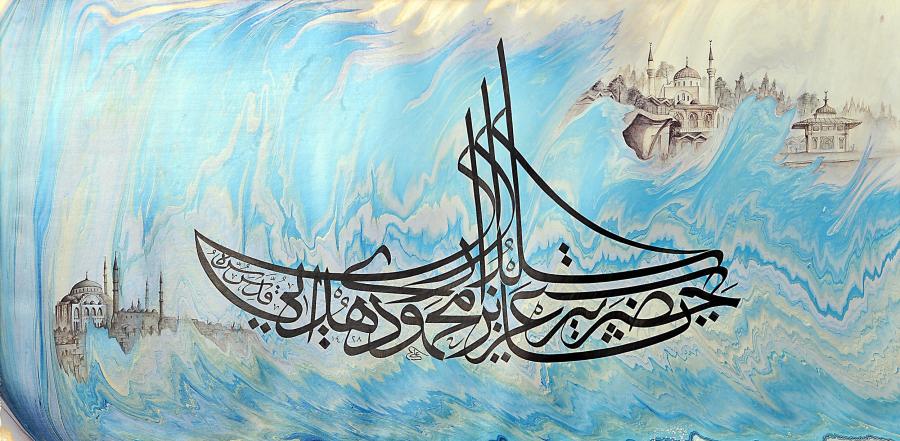
Fig. 1. Hikmet Barutçugil (ebru artist), Ali Hüsrevoğlu (calligrapher), and Hacer Ünal (miniaturist), Hüdayi Yolu, 2007, marbled paper and calligraphy. Courtesy of the artist. 

In this image, entitled Hüdayi Yolu (The Way of Hüdayi), we see a watery background constructed by abstract zigzags that represent the Bosporus strait dividing the Asian and European sides of Istanbul. Hikmet Barutçugil usually creates his ebru, or paper marbling art, and then commissions illustrators to work with the random and surprising outcomes of the process. Here, Hacer Ünal Hazar, a student of Barutçugil, completed the painting appearing in opposite corners of the work, and Ali Hüsrevoğlu, a well-known calligrapher, wrote the name Hazrat ‘Aziz Mahmut Hüdayi (d. 1628), which dominates the center of the work.1 Hüdayi was a Sufi scholar and poet, one of the principal founders of the Celvetîyye Sufi order and patron saint of Üsküdar, an older neighborhood on the Asian side of Istanbul. After his name appears a shorter phrase in Arabic that translates as “May his secret be made sacred,” a eulogy for Sufi saints. At the top right, we see Hüdayi’s mosque-shrine (1594, rebuilt in 1825) alongside the distinctive dome and minarets of the Mihrimah Sultan Mosque (1543-48) and the angular lines of the Fountain of Ahmed III (1728-29), prominent Ottoman Islamic structures in Üsküdar. On the lower left, on the European side of Istanbul where the Ottoman sultanate was once headquartered, the Süleymaniye Mosque (1550-57) can be seen as it would appear to a viewer standing on the banks in Üsküdar. 

The illustration also contains a reference to a little-known legend from the life of Hüdayi, according to which when the Sultan Ahmet Mosque was completed in 1616 during the rule of Sultan Ahmed I (d. 1617), Hüdayi was invited to preside over the opening ceremonies and to give the Friday sermon. He lived in Üsküdar and had to cross the Bosphorus to get to the mosque, but the weather was stormy and dangerous for sailing and the sailors were scared, yet Hüdayi was able to cross the water without trouble, his small rowboat unaffected by the waves. From that day on, the route he took on the water has been called Hüdayi yolu. Sailors follow it on stormy days as they believe it is sanctified by the baraka, or blessing, of Hüdayi.2 Visually and discursively, Barutçugil’s Hüdayi Yolu draws the Ottoman cityscape of Istanbul into dialogue with its Sufi history, using the fluidity of ebru marbling and Arabic calligraphy to evoke the watery bridge between continents that is the Bosporus strait. In so doing, the artist collapses the temporal bridge between past and present, introducing innovative and contemporary techniques and materials to the traditional Turkish craft of ebru and drawing a triumphant, Ottoman, Islamic history into a spiritual vision for the present Turkish republic. 

The location depicted in the piece is significant for numerous reasons. Ebristan, Barutçugil’s atelier, known as “the Istanbul ebru house,” is located in the neighborhood of Salacak in the district of Üsküdar, overlooking the same route across the Bosporus depicted in the piece.3 Üsküdar was also home to some of the most renowned earlier ebru artists, such as Necmettin Okyay (d. 1976) and Mustafa Düzgünman (d. 1990), who was a caretaker of the Hüdayi shrine. The neighborhood remains one of several hubs for ebru and other traditional Turkish arts in Istanbul as well as for Sufism.

Hüdayi Yolu hearkens both to Barutçugil’s connection to Sufism and his presentation of ebru as a Sufi art. It is a part of his Ebristanbul series, in which he employs artists to illustrate historical sites of the city over what he calls his “Barut ebru” pieces. Barutçugil explains that this series of illustrations commemorates the 550th anniversary of the Ottoman conquest of Constantinople, declaring that “the imaginary world of ebru reflects Istanbul, surrounded by water, between two seas, my beloved, beautiful Istanbul, the meeting point of two continents.”4 Since the Ottomans defeated the Byzantine Empire and took control of Istanbul in 1453 under Sultan Mehmet II (d. 1481), the city has often been presented as Islamic. Later Ottoman sultans commemorated their victory as a sign of divine favor and a justification for Ottoman rule.5 Despite the Ottoman Empire’s endurance for centuries, the secular Turkish Republic rejected its legacy following its abolishment of the caliphate in 1924.6

But in the past two decades, the Islamist political party AKP has gained prominence and contributed to the rise of the religious middle class. Concomitantly, neo-Ottomanism has increased, emphasizing the city’s Islamic context and reclaiming the city’s connection to its romanticized Ottoman past and its Sufi history in particular.7 In Istanbul, religiously-oriented Turks embrace its historic buildings and neighborhoods in their attempt to claim “Muslim space” and assert the Islamic soul of the city.8

Working with the Ministry of Culture, Barutçugil has been able to get ebru official recognition and support; the AKP promotes the ebru in state-sponsored art contests, exhibitions, and conferences. Barutçugil, like many contemporary practitioners of “traditional” Turkish arts, participates in the nationalistic commemoration of the Muslim conquest over the Byzantines. His art, such as Hüdayi yolu, makes visible a process of renewal and a new approach to Islamic artistic heritage in contemporary Turkey, containing references to Sufi symbolism and sainthood, neo-Ottoman nationalist placemaking, and Islamic aesthetics.

Hüdayi Yolu is representative of the growing trend of “traditional” Turkish artists using new artistic techniques to depict historical scenes and heritage. Among urban Turks, both conservative and secular, Sufism has become “trendy.” Sufism-related tourism generates a significant source of income; Konya, the burial site of Rumi, is a popular destination, and whirling dervish shows are common at restaurants and cultural venues.9 Both secular and religious Turks adopt the aesthetics of Sufism, including associated artistic practices, especially calligraphy, depicting the names of God and other spiritual messages. Prints of Barutçugil’s pieces can go for upwards of a few hundred dollars while his original work sells for many thousands of dollars, and to have an original artwork is a status symbol among some Turks. Barutçugil’s work and that of other “traditional” artists can be found in homes, places of business, and government offices. 

The background of Hüdayi Yolu is representative of Barutçugil’s style, developed in the 1970s after much trial and error, which he calls Barut ebru, after himself.10 Basic techniques of ebru include creating background patterns and then manipulating paint pigments mixed with ox gall with thin needles to form flowers, birds, and geometric shapes.11 Barutçugil’s flower pieces have a signature look that someone familiar with ebru can easily identify, but it is his extensive use of the “Barut technique” coupled with the incorporation of illustrations and calligraphy that sets him apart. He keeps the Barut method closely guarded and has only taught it to a select group of students. It most probably involves the use of acrylic paints, whereas “traditional” ebru uses paints made of natural minerals and soil. Several other artists, such as Garip Ay, have figured out how to produce the same effect, but Barutçugil does not discuss his technique publicly.12 In recent years, younger artists have started including illustrations and calligraphy in their ebru making it a widespread phenomenon in traditional Turkish art. 

In interviews on TV, with journalists, and in his writings, Barutçugil frequently discusses the mystical dimension of his art, focusing on the difference between the bāṭin, esoteric meanings, and ẓāhir, external realities, both terms central to Sufi epistemology and Islamic cosmology. He explains that most artists only understand the ẓāhir of the art, which consists of the techniques and appearance of the ebru designs and is based on Western designs and aesthetics. For Barutçugil, by contrast, the bāṭin of ebru is based on Islamic-Sufism and is the heart of the art. 

My fieldwork among ebru artists in Istanbul shows that Barutçugil can be credited with popularizing the associations between Sufism and ebru in Turkey and beyond. As a member of the older generation of contemporary ebru artists, Barutçugil has promoted ebru both within Turkey and among Westerners since the 1990s. In his writings and talks, he presents his take on the aesthetic principles of Islamic art through ebru. He only teaches the bāṭin of the art to students who prove they will be receptive. This advanced level deals with the symbolic meanings behind the use of colors and designs, how to “read” the paint on the water as signs of God, and how to manifest the beauty of God in art. All the while he imparts Sufi teachings and stories to initiate them into a spiritual practice. Barutçugil ritualizes the practice of ebru more than most ebru artists, likening his relationship with his advanced students and the training he gives them to how Sufi teachers train and teach proper adab, or etiquette, including teachings on self-discipline and humility. For Barutçugil, ebru not only has spiritual meanings in its symbolism, colors, and patterns, but the process of creating the art itself is representative of the spiritual journey of the artist. His main requirement to teach a student the bāṭin of ebru is that they have gönül, or a heart full of love and free of negativity. 

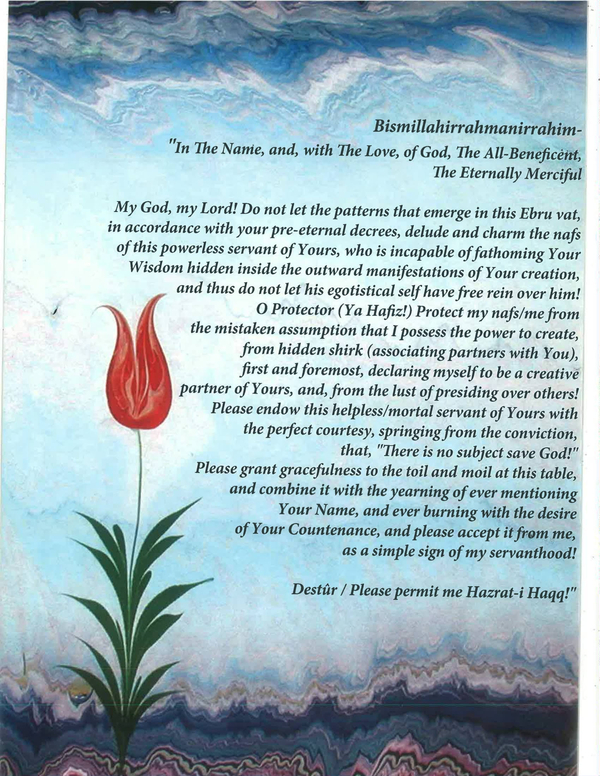
Barutçugil gives most of his students a color print-out of a du‘ā, a supplicatory prayer, with his ebru as the background. One side gives the original Turkish du‘ā, and the other side of the paper offers an English translation (see Fig. 2). Following the Muslim tradition of providing supplications for specific activities, Barutçugil instructs his students to recite this du‘ā before beginning their ebru practice, to center themselves spiritually, and to show respect for the art. The words of the du‘ā are reminiscent of Sufi prayers that ask God for guidance and support. This du‘ā guides the artist to ask God to ensure that their artistic output is not impacted by the nafs, or ego, as well as to grant grace to the work of the artist and ensure that the artist is engaged in the remembrance of and a desire for God. For Barutçugil, the du‘ā can be used by any artist involved in what he calls “Islamic” art or by anyone interested in leading a spiritual life. It helps the artist enter into a state of piety so that when they start painting, they are worshiping God at the same time, allowing the artist’s inner being to appear in their creation. Because of his public profile and interweaving of Sufism into discussions of ebru, ebru has gained an additional dimension of spirituality that was not previously present. Although some of the earlier ebru artistshad close associations to Sufism and Sufi lodges, their practice of ebru was not ordinarily informed by their spiritual inclinations and interests. 

  • 1"Ali Hüsrevoğlu,” accessed August 26, 2021, http://alihusrev.com/en/eserler.aspx.
  • 2“‘hüdayi Yolu’ Nedir?” Islam & Ihsan, November 18. 2015, https://www.islamveihsan.com/hudayi-yolu-nedir.html.
  • 3For more information on Ebristan, where Barutçugil conducts his ebru lessons, holds exhibitions, and hosts visitors from around the world, see: “Ebristan: İstanbul Ebru Evi,” Ebristan: İstanbul Ebru Evi, accessed August 26, 2021, http://www.ebristan.com.
  • 4“Ebristan Sanat Galerisi,” Ebristan: İstanbul Ebru Evi, accessed August 26, 2021, http://www.ebristan.com/?d=galeri.
  • 5Gavin D. Brockett, “When Ottomans Become Turks: Commemorating the Conquest of Constantinople and Its Contribution to World History,” The American Historical Review 119, no. 2 (2014): 407.
  • 6In 1953, not long after the establishment of the secular republic, on the 500-year anniversary of the Ottoman conquest of Constantinople, its commemoration resumed. May 29, 1453 to this day contributes to Istanbulites’ sense of national identity. Commemoration events every May 29th are highly ritualistic and meaningful for Turks.
  • 7For a comprehensive study on the phenomenon of neo-Ottoman in the contemporary Turkish state, see M. Hakan Yavuz, Nostalgia for the Empire: The Politics of Neo-Ottomanis (New York: Oxford University Press, 2020); also see Chien Yang Erdem, “Ottomentality: Neoliberal Governance of Culture and Neo-Ottoman Management of Diversity,” Turkish Studies 18, no. 4 (2017); Gabriela Özel Volfová, “Turkey’s Middle Eastern Endeavors: Discourses and Practices of Neo-Ottomanism under the AKP,” Die Welt Des Islams 56, no. 3–4 (2016): 489–510; Murat Ergin and Yağmur Karakaya, “Between Neo-Ottomanism and Ottomania: Navigating State-Led and Popular Cultural Representations of the Past,” New Perspectives on Turkey 56 (2017): 33–59.
  • 8Brockett, “When Ottomans Become Turks,” 247.; Heiko Henkel, “The Location of Islam: Inhabiting Istanbul in a Muslim Way,” American Ethologist 34, no. 1 (2007): 58. See also Courtney Michelle Dorroll, “The Spatial Politics of Turkey’s Justice and Development Party (AK Party): On Erdoganian Neo-Ottomanism,” Unpublished Ph.D. Dissertation, The University of Arizona, 2015.
  • 9Meena Sharify-Funk, William Rory Dickson, and Merin Shobhana Xavier, Contemporary Sufism: Piety, Politics, and Popular Culture (London, Routledge: 2017), 1.
  • 10Information about Hikmet Barutçugil is primarily based on interviews conducted during fieldwork conducted in Istanbul in June and July 2017.
  • 11This video from another Istanbul-based ebru artist, Kubilay Eralp Dinçer, lays out the basic tools, materials, and techniques of ebru: Kubilay Dincer, “Ebru Sanatı - Kubilay Eralp Dinçer,” YouTube video, 4:03, September 30, 2017, https://www.youtube.com/watch?v=40bCsMStnAA.
  • 12In this Turkish-language Ted Talk, Ay describes in detail how he creates the same effect that  Barutçugil produces in Barut ebru: Garip Ay, “Zuhurat,” TEDxBahcesehirUniversity, YouTube video, 12:37, May 19, 2017, https://www.youtube.com/watch?v=Tcch_9rF6KM.

Fig. 2. Hikmet Barutçugil, Color print-out of a du‘ā (supplicatory prayer), 1990s.

Hüdayi Yolu is representative of a flourishing modern art form in Turkey based on an older Turkish craft. In this piece, Barutçugil gives tribute to the glory and height of the Ottoman empire and its culture combined with the spirituality of Turkish-infused Sufism. On the ẓāhir, this piece is quite straightforward, but upon further inspection, it contains hidden symbols and histories that lay beneath its surface as bāṭin. It represents a modern artist’s loving depiction of his hometown and neighborhood, an homage to a local Sufi saint, the romanticized communal memory of Istanbul as an Ottoman metropolis, and Barutçugil’s approach to “Sufi” art.

About the Author

Rose Aslan, Ph.D., is an independent scholar based in Istanbul. From 2014-2022, she was an associate professor of global Islam in the Department of Religion and Theology at California Lutheran University. Her research focuses on the study of the material culture of religion and embodiment in Muslim communities.

Notes

    Imprint

    Author Rose Aslan
    Year 2022
    Volume Volume 6: Issue 2 Material Islam
    Copyright © Rose Aslan
    Licensing

    CC BY-NC

    Downloads PDF
    DOI

    10.22332/mav.obj.2022.5

    Citation Guide

    1. Rose Aslan, "Hikmet Barutçugil's Hüdayi Yolu," Object Narrative, MAVCOR Journal 6, no. 2 (2022), doi: 10.22332/mav.obj.2022.5.

    Aslan, Rose. "Hikmet Barutçugil's Hüdayi Yolu." Object Narrative. MAVCOR Journal 6, no. 2 (2022), doi: 10.22332/mav.obj.2022.5.

    Nathan Hofer
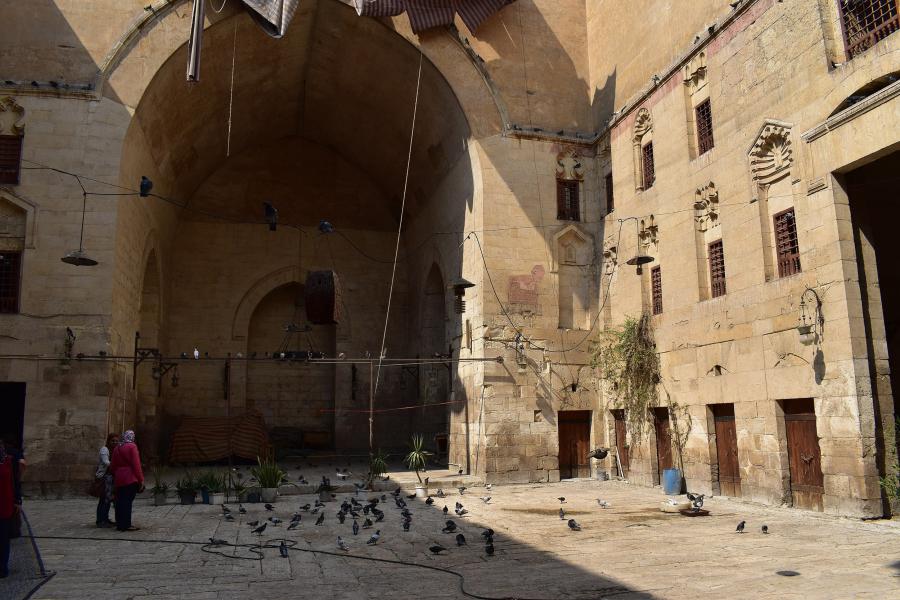
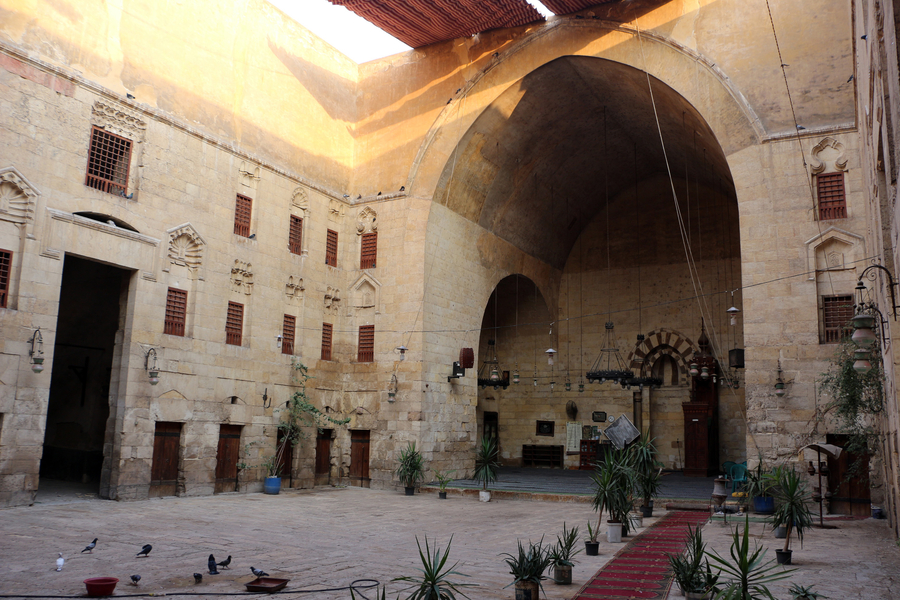
    In a view from within the courtyard of a khānqāh, the wood doors of khalwa cells are visible on the ground floor of the building. The windows of living quarters line the walls above them. The courtyard itself has a massive pointed arch on one end.

    Fig. 1 Courtyard of the khānqāh of the Mamluk sultan Baybars al-Jāshankīr (r. 1309-1310) in Cairo. Note the khalwa cells with wood doors that face the courtyard on the ground floor. Above the cells are living quarters for Sufis who lived in the khānqāh.

    Eyes Burning Like Embers

    Egyptian Sufis of the tenth/sixteenth and eleventh/seventeenth centuries recorded several extraordinary stories about a Kurdish émigré to Cairo, a Sufi master Yūsuf al-Kūrānī (d. 768/1367). Al-Kūrānī was famous for, among other things, his practice of khalwa: self-isolation, typically in a small cell, in order to focus on pious devotions. Sufi biographers recount how when al-Kūrānī would emerge from khalwa he was so powerful that his eyes, “burning like embers,” bestowed miraculous power and authority on other people just by looking at them. On two separate occasions his glance happened to fall upon a dog. So powerful was his gaze that in each case the local people and other canines sought the dogs out, followed them around, and mourned them when they died. In one case, the dogs developed a small shrine cult around the dog saint’s tomb.1 On one hand, these stories are clearly about the unique power and authority of al-Kūrānī as a Sufi master and his skill as a teacher. Indeed, his biographers remember him chiefly for his popular and effective training regimen for novices, a reputation supported by the number of texts he wrote devoted to explicating in clear and plain language both the practical and theoretical aspects of his approach to Sufism.2 On the other hand, these stories underscore the unique and powerful effects of the practice of khalwa. They demonstrate what happens to Sufis when they are properly trained, prepared, and then exposed for extended periods of time to the presence and power of the divine reality, al-Ḥaqq (The Real). Al-Kūrānī’s powerful gaze was produced by a combination of his own training regimen, his physical and mental discipline, the material conditions of the cell, proximity to divine power, and the expectations of his students. Furthermore, al-Kūrānī’s time in khalwa spent communing with The Real not only transformed him, intensifying and focusing his already potent powers, but in so doing transformed the material and social relations of those around him as well. In this particular case, that transformation is apparent in his flaming eyes, in his powerful gaze, and in the fact that a mere inadvertent glance could completely reconfigure the social order, even among canines.3

    The practice of khalwa is rooted in the late antique matrix of ascetic Christianity. But by the seventh/thirteenth century, Sufis had developed it into a distinctly Islamic practice that was ubiquitous across the medieval Islamic world. Muslim authors (as well as some Jews) produced a sizable body of literature devoted to explicating its function in both practical and theoretical terms.4 It is clear from these texts that khalwa consists of a demanding and difficult array of conceptions and practices that required a great deal of time, particular material and social conditions, and intense preparation and discipline. The latter were critical because khalwa was fantastically dangerous. The Andalusian Sufi Muḥyī al-Dīn Ibn al-ʿArabī (d. 638/1240) cautioned that one who undertakes khalwa “must be courageous and brave, not weak or cowardly” because of the devastating psychological and physical harms that may befall the unprepared practitioner.5 These dangers stemmed largely from the fact that khalwa left the mind particularly susceptible to the influence of passing thoughts (khawāṭir), the source of which were believed to be either divine or satanic, angelic or demonic. But other negative effects quickly rippled out beyond the psychological. The Central Asian Sufi master Najm al-Dīn Kubrā (d. 618/1221), wrote of a man who entered khalwa without proper guidance and quickly went mad; he became an unbeliever, cursed his mother, and ate his own feces.6 One of Kubrā’s students, Najm al-Dīn Dāya Rāzī (d. 654/1256), warned that a devotee in khalwa must be absolutely committed to his shaykh and to following his precise guidance. If not, Satan will appear to that devotee in the form of his shaykh and obliterate his confidence, mental stability, and physical ability to remain in the cell. However, when one is absolutely committed to one’s master (by having “tied his heart to the shaykh”), the disciple will be protected by the promise of the prophet Muhammad when he said, “One who sees me in a dream, has seen me. Satan cannot take my form.”7 So well-known and harrowing were these dangers that they even turn up in the encyclopedic treatise on Mālikī law and popular practice in Egypt by Ibn al-Ḥājj (d. 737/1336), who writes at great length about the dangers of entering khalwa unprepared and without the guidance of a qualified teacher.8 Ultimately, however, and despite all these risks, the rewards were well worth the effort. Only khalwacould produce such extended proximity to the divine Real, producing new insights about reality, inculcating new forms of knowledge, transmuting the Sufi’s body, and allowing him to live amidst the distractions of society without deleterious effect. There are so many wondrous benefits associated with khalwa that the Egyptian Sufi ʿAbd al-Wahhāb al-Shaʿrānī (d. 973/1565) devoted an entire book to recounting in great detail all the distinct forms of knowledge, esoteric and exoteric, God bestows upon the practitioner of khalwa.9 These texts also make clear that the psychological and spiritual benefits of khalwa are inseparable from the embodied practice and its material and social contexts. Rather than producing disembodied minds, stripped of corporeality and social consciousness, entering khalwa reconfigured the body and mind, opening up an entirely new sensorium and providing access to unseen realms. Rather than shutting off the senses, this reconfigured self was able to experience vivid sensory inputs—sounds, smells, lights, things, persons, animals. These phenomena were not psychic ephemera, symbolic representations, or projections of interior states. A khalwa cell was a vibrantly material place in which Sufis interacted with and produced affects in all manner of human and non-human things. Likewise, and even more importantly, all those vibrant things interacted with and produced noticeable and lasting affects in Sufis. Al-Kūrānī’s burning eyes are not merely symbolic. Nor are they simply charismatic proofs of his ascetic abilities or representations of his spiritual power. Al-Kūrānī’s eyes burned because the things he encountered in khalwa changed them and caused them to burn, an effect that persisted even after he left the cell, at least for a time. Khalwa was not simply being alone in a small room for a while. It was a process in which elements corporeal, material, spiritual, imaginal, and social were all entangled together, producing uniquely powerful affects in those who entangled themselves. A thorough description of the medieval practice of khalwa must account for all these elements—human, spiritual, material, and social—the ways they interact and the affects they produced. 

    This article offers one possible approach to theorizing the heterogenous elements of khalwa coherently by insisting that we take the material and the social as seriously as we do the human and the spiritual. My focus is on a number of Arabic treatises on khalwa most of which were written in the seventh/thirteenth and eighth/fourteenth centuries. Some of these texts are explicitly about khalwa, like Risāla fī l-khalwa (Treatise on Khalwa) by Najm al-Dīn Kubrā (d. 618/1221) and al-Khalwa al-muṭlaqa (The Ultimate Khalwa) by Ibn al-ʿArabī (d. 638/1240), while others treat khalwa as part of a larger exposition about Sufi devotions, like ʿAwārif al-maʿārif (The Gifts of Gnosis) by Abū Ḥafṣ ʿUmar al-Suhrawardī (d. 632/1234), Risālat al-anwār (Treatise of Lights) by Ibn al-ʿArabī, Manārat al-sāʾirīn (The Lighthouse for Travelers), by Najm al-Dīn Dāya Rāzī (d .654/1256), and Miftāḥ al-falāḥ (The Key to Happiness) by Ibn ʿAṭāʾ Allāh al-Iskandarī (d. 709/1309). Among the latter I draw heavily on one text in particular: al-Waḥīd fī sulūk ahl al-tawḥīd (The Unique Guide to the Comportment of the Sufis) by the Upper-Egyptian Sufi Ibn Nūḥ al-Qūṣī (d. 708/1308). Ibn Nūḥ’s al-Waḥīd is a free-wheeling and wide-ranging text on Sufism in Upper Egypt during the late Ayyubid and early Mamluk period.10 The text combines elements of the Sufi manual, doctrinal treatise, memoir, biographical dictionary, and hagiography in service of a detailed picture of the history, scope, and variety of Sufism in Mamluk Upper Egypt. In the course of his discussion, Ibn Nūḥ often includes detailed narratives and descriptions of various Sufi practices that illustrate his broader themes. Elaborate and fascinating stories involving khalwa occur frequently, a few of which I will relate here with an eye for what these stories might reveal about the material and social contexts of its practice. At the same time, I aim to formulate an approach to studying medieval Sufi texts that is informed by recent scholarship on religion and materiality. But I want to stress that what follows is not an attempt at a comprehensive explanation of khalwa. There are hundreds of Sufi texts from across the Muslim world which deal with khalwa in some way, revealing a wide variety of practices, attitudes, and spaces. It would be folly to attempt any general accounting of or definitive approach to khalwa, for, as Scott Kugle has shown, Sufis have theorized the relationship between the body, the self, and the social in a variety of complex ways, expressed in a variety of different media.11 Rather, my remarks here are preliminary and meant to be suggestive, the result of my narrow reading in the particular medieval Sufi milieu in which Ibn Nūḥ, whose al-Waḥīd first drew my attention to the critical social and material dimensions of khalwa, participated. My references to several other well-known texts on Sufi khalwa thus serve as reference points that have helped to explicate this milieu. Many of these texts were written prior to Ibn Nūḥ’s treatise and provide a solid grounding in the Sufi tradition he inherited and was familiar with. Most of these are normative texts containing prescriptive accounts of khalwa. Ibn Nūḥ’s accounts, while clearly indebted to this normative tradition, are much more descriptive in nature and thus offer an interesting window onto the practices surrounding khalwa. Occasionally I refer to texts written after Ibn Nūḥ’s demise when they elucidate a particularly ambiguous idea within the Sufi tradition to which Ibn Nūḥ contributed. 

    Readers should know that there are other important Sufi traditions of khalwa that fall outside of the purview of this article. For example, I do not discuss texts of the Khalwatī order, which is so named for the centrality of khalwa, but whose formation dates to a much later period.12 Nor do I discuss the Naqshbandī principle of khalvat dar anjuman, retreat in the midst of society, which is rooted in a different set of assumptions about the nature of the Sufi path and constitutes a Sufi milieu Ibn Nūḥ would have been unfamiliar with.13 What follows, then, is meant to be suggestive rather than exhaustive of the Sufi tradition as a whole. It is meant to draw attention to elements of khalwa which are often ignored in its explication as a spiritual retreat in scholarly writing on Sufism.

    Historians of Sufism have tended overwhelmingly to focus on the personal or spiritual function of khalwa rather than its material or social contexts.14 The following definition of khalwa is fairly representative of the scholarship: “a method of withdrawal or isolation from the world for mystical purposes.”15 Whether deliberately or not, these studies rely on a Weberian framework of mystical practice. They cast khalwa as a “flight from the world” in which Sufis use khalwa as means to separate themselves from society and to subdue and subjugate the body and ego-self (al-nafs) in order to achieve “a subjective condition of a distinct kind.”16 Theorized in this way, khalwa would seem to be the mystical technique par excellence for negating both the body and the world, leaving only the heart, the reflective site of maʿrifa (or gnosis), and producing a purely intellectual experience. However, such descriptions are contingent upon a Cartesian mind-body dualism that betrays a Christian-inflected bias against the body that Sufis would have found baffling.17 Sufis certainly developed complex techniques to exercise control over their unruly physical selves, but not to negate them. In his discussion of khalwa, for example, Abū Ḥafṣ ʿUmar al-Suhrawardī, explicitly links excessive mortification of the body with Christians and Buddhists.18 Rather than a mystical technique, it is perhaps more helpful to think about khalwa in terms of the Arabic concept of zuhd, which is not the asceticism of the spiritual athlete, but “rather a code of behavior that should be followed by any pious Muslim.”19 This approach to the body stands in stark contrast to the Christian ascetic heroes of the late antique Roman world. Narratives of these ascetics, drawing heavily on earlier martyrological narratives, valorized “in pornographic detail” the destruction, violation, and rupture of the body.20 Zuhd, by contrast, is an ethical disposition of detachment. It is an attitude of indifference to worldly trappings, not a categorical rejection of them.21 In other words, a zāhid (one who practices zuhd) could be wealthy or impoverished so long as they care nothing for wealth or poverty. This is precisely the sentiment we find in most descriptions of khalwa. In early Sufi literature, we find Sufis explicitly prioritizing an ethic of detachment over bodily mortification: Abū l-Qāsim al-Qushayrī (d. 465/1072-3) describes khalwa as a separation of character traits, good from bad, and not the separation or withdrawal of the body from society, citing a Sufi who charged his companions to “wear with people what they wear and eat what they eat, but separate yourself from them in your heart of hearts.”22 The fundamental issue at stake in these accounts is that the self, a complex whole comprised of heterogenous parts—primarily the body, soul, and ego—is simply not properly organized, oriented, and disciplined. The problem lies not in the parts themselves, but that they are collectively disorganized, undisciplined, and in disharmony with the environment. These Sufis inhabit what Talal Asad has called “untaught bodies.”23 The techniques involved in Sufi devotional exercises, including khalwa, were thus designed to teach those bodies some discipline. By entering khalwa and following the specific devotional instructions of his shaykh, a Sufi could reconstitute the self in such a way that it will function correctly, capable of interfacing directly with the realm of the unseen (al-ghayb), the hidden world beyond the senses, and ultimately gain access to the divine presence itself.24 In other words, a human being cannot access that realm of the unseen without a body and the material and social conditions required to discipline it. As Kugle puts it, for Sufis “[t]he body is a limitation that allows us to move beyond limitations.”25But, and this is critical to my understanding of khalwa, these useful limitations are inseparable from the material and social conditions in which they exist. The body of the Sufi, the material facts of the cell, and the guidance and expectations of other human beings are all irreducible and irreplaceable components of khalwa; we must account for all of them equally and holistically.

    To get a better sense of what I mean here, a brief examination of the word khalwa is in order. The word itself covers wide semantic ground, referring to the physical cell, to the devotional practice that took place therein, and to the social relationships that governed it all. In other words, khalwa is both a process and an entanglement of multiple elements. Describing khalwa this way has the advantage of not requiring us to pry these semantic fields apart, for medieval Islamic sources do not. In Arabic texts a typical locution for the practice is al-shaykh adkhala al-murīd fī l-khalwa, literally “the master placed the novice into khalwa,” a phrase that elegantly encompasses all these elements: the material space itself, the corporal practice within the cell, and the social relationship of master-disciple that governed the entire enterprise. It was a physical space, constructed of specific materials in a precise way, wherein the body, its components, and the environment were reconfigured into a properly functioning unit. But khalwa was much more than a room with a body in it. It was a space rendered extraordinarily powerful by socially constructed norms and expectations, and above all by the presence of The Real. It is significant that many Sufi authors insisted that the cell be located within a populated house; it was in dialogue with the master in the context of the collective expectations of fellow Sufis that rendered the experience intelligible for the adept. The process of khalwa entailed the formation of new selves which were reconstituted within new relationships to society—both narrowly construed as the society of local Sufis, and broadly construed as society outside the walls of the hospice.26

    In order to understand the complexity of Sufi khalwa, both holistically and historically, as the totality of its material, social, and human components, we must get away from the notion that Sufism is best understood as a form of mysticism, a framework that is too often rooted in what Elizabeth Spelman describes as “psychophilic somatophobia.”27 Studies of Sufism qua mysticism are underwritten by a mind-body dualism that privileges belief over practice, the spiritual over the physical, and the individual over the social. In certain comparative contexts, this analytical framework makes sense. Indeed, my argument is not that Sufism is not mysticism but rather that the kinds of questions such a framing elicits are not well suited to understanding khalwa. Centering questions about the corporality, materiality, and sociality of khalwa promises to provide a much clearer idea of what the practice involved and how it functioned within Sufi praxis more broadly. There are several trends in recent scholarship on religion that may be useful in that respect. Based in part on a dissatisfaction with the constructivism inherent in the linguistic turn in religious studies, there has been a marked shift towards the material.28 The last twenty years have seen a growing body of scholarship pushing historians and scholars of religion to include material culture and the body in their analyses.29 Sonia Hazard has described this scholarship as “the material turn” in religious studies, comprised of several distinct lines of inquiry and methodologies.30 Likewise, Thomas Tweed has described this larger shift from belief to practice, and especially the development of the concept of “lived religion,” as “the quotidian turn” in religious studies.31 However, as effective and salutary as this scholarship is, for my purposes it is hamstrung by an anthropocentric and instrumentalist approach to material culture that marks a sharp distinction between the human and non-human. Drawing on the work of Jeremy Stolow, Hazard argues that the material turn (and, I would add, the quotidian turn) is predicated on “the notion . . . that technologies serve as pliant tools to better fulfill prior religious intentions. . . . [This instrumentalism] is rooted in a false dichotomy in which religion is equated with human agency on the one hand, and technology with inert materiality on the other.”32 At the same time, Severin Fowles wonders if in the turn toward things “we have over-privileged a crude notion of presence linked to physicality and tangibility, as if the only meaningful relations were those between entities that can be seen, smelt or felt.”33 Fowles wants to take “absent objects” seriously, by which he means very specifically material objects that are not there (like a lost set of keys, or the absence of people on a normally busy street).

    I would add that much of the material/quotidian turn in religious studies is organized around an incoherent object of study. The history of religion, as category and field, is the history of its interiorization, privatization, and spiritualization, all predicated on a valorization of the primacy of belief over practice. In the pantheon of early comparativists of religion, William Robertson Smith (d. 1894) is the only scholar I am aware of who wrote about religion (or at least one form of religion) primarily in terms of ritual and practice and not belief: “Ritual and practical usage were, strictly speaking, the sum total of ancient religions.”34 Smith’s insistence on this point stands in stark contrast to the colonial anthropologists and sociologists of religion in the Anglophone and Francophone world and their near singular focus on animism.35 It is not that early scholars of religion simply ignored the material or the quotidian. They invented and constructed the category of religion itself as one predicated on the primacy of belief in spiritual beings; material or social concerns like the totem or the fetish were secondary effects of that bedrock belief. So, there is an inherent tension involved in the analytical construction of concepts like “lived religion,” “everyday religion,” or “material religion,” wherein the foundational a priori disciplinary distinction between sacred/profane that locates and authorizes the object of religion is erased by paradoxically locating the sacred within the profane. This paradox raises another question: What, exactly, are we studying?

    Is the object of our inquiry material religion or religion, studied materially? This distinction is subtle, but critical because the former assumes a stable and identifiable phenomenon. The latter, by contrast, is merely one approach to religion among many. In other words, there is a tendency in much of the work on material religion to assume and posit that the material analysis is itself only the product of a particular data set: material religion, which would appear to be a subset, perhaps, of material culture (chairs, books, houses = pews, gospels, synagogues). From this perspective, it would appear that the scholars of material religion have discovered a new, hitherto overlooked, stable object to study; the trick is simply to find it and describe it. But “material religion” is not analogous to “material culture,” at least not as typically construed, because the objects of analysis and their respective conceptual apparatuses are not the same (just as materiality and material culture are not the same).36 Material culture generally refers to the objects humans make, the meanings they ascribe to them, the ways they interact with them, and so on. Scholarship on material religion does all these things as well, of course. But it does so on the back of a kind of sui generis materiality that exists uniquely qua religious artifact before scholars interact with it.

    These are the two traps I would like to avoid in my description of khalwa: an a priori categorical distinction between the “material Islam” of the cell and the (non-material?) Islam of the Sufi; and an anthropocentric instrumentalism that amplifies that distinction by subordinating the socio-material elements of khalwa to its psycho-spiritual effects. One means to avoid these traps can be found in the body of scholarship generally described as the new materialism. While there are several distinct trajectories within this scholarship, “the general consensus seems to be that new materialism embraces a non-anthropocentric realism grounded in a shift from epistemology to ontology and the recognition of matter’s intrinsic activity.”37 In other words, matter has a vitality and agency that exists independently of human beings. Whether one is looking at stars, rocks, elbows, street trash, baptism, or complex societies, the new materialism insists that our knowledge about a phenomenon is provisional and incomplete, our experience of it partial and limited, unless we accept and account for the vitality and agency of all those things, human and nonhuman, that make it what it is.38 I take an expansive definition of non-human agents to include all manner of things which humans can become entangled with, from rugs, rocks, and snakes to cemeteries, voices, and jinn.39 But there is more! Discursive agents like stories and dhikr formulas also possess a vitality and the power to elicit affects in other agents.40 Likewise, we can think about the agency of institutions, or “social facts,” which have an existence apart from any individual person while possessing the ability to shape human behaviors and non-human processes.41 I would suggest, therefore (borrowing language from Jane Bennett) that all these non-human agents are “vivid entities not entirely reducible to the contexts in which (human) subjects set them, never entirely exhausted by their semiotics.”42

    But medieval khalwa was not simply a jumble of independent and free-wheeling human and non-human elements. As Karen Barad argues: “Existence is not an individual affair. Individuals do not preexist their interactions; rather, individuals emerge through and as part of their entangled intra-relating.”43 Barad’s philosophy of agential realism seeks to understand the role of “human and nonhuman, material and discursive, and natural and cultural factors in scientific and other social-material practices.”44 I propose, then, that we think about khalwa as an entanglement, a process of engagement between multiple agents that has profound effects for all parties involved. From one perspective, that of the Sufi undergoing khalwa, this entanglement is precisely the process of disciplining the self in order to produce yet more entanglements with the world of the unseen. Unlike the Deleuzian concept of assemblage, which similarly rejects a distinction between the human and the non-human, Barad’s entanglement places an ethical demand on the scholar herself as she becomes entangled in turn.45 Thus, not only do I argue that the entanglements of khalwa necessarily entailed an ethical response from the Sufi—described below as the reintegration into society through new entanglements with the social world—but I would also suggest reading these texts elicits an ethical response from the one entangled in these stories, namely me. Indeed, reading and engaging these narratives has had a profound effect on my understanding of the agential and vibrant nature of all matter and the implications of living in a world of human and non-human agents. There is much more that could be said here. But my goal is not a defense of new materialism or an explanation of agential realism, both of which can be found elsewhere.46 My goal is primarily to articulate the conceptual framework that emerged from my own entanglements with new materialist ontologies and medieval Sufi khalwa texts. In what follows I flesh out these entanglements using examples from Ibn Nūḥ and other Sufi authors, organized heuristically into three broad categories of agents with which a Sufi in khalwa was entangled: the material, the Real, and the social. But I have a secondary goal as well, to introduce some of these ideas into Sufi studies more broadly. This is not to say that Sufi studies are not already engaged with some of these ideas. As Sonia Hazard has noted, many fields have been engaged with and productive of many of the ideas associated with the new materialisms without being a product of this particular academic genealogy.47 For example, Shahzad Bashir’s Sufi Bodies is not explicitly a work of new materialist scholarship. But his work would nevertheless be at home within any number of new materialist discourses.48 Others are more directly engaged. Michael Muhammad Knight’s Muhammad’s Body takes up the Deleuzian notion of assemblage to trace the multiple networks that produced the prophetic body in multiple ways.49 And in his recent book, Islam and the Devotional Object, Richard McGregor brilliantly theorizes the ways that religious objects negotiate with and resist the creative ideas associated with them.50 But in general the new materialist ideas I discuss here have yet to appear in studies of medieval Sufism. What follows will, I hope, introduce a wider audience to the utility and value of this important body of work.

    • 1These accounts can be found in ʿAbd al-Wahhāb al-Shaʿrānī, al-Ṭabaqāt al-kubrā, vol. 2 (Cairo: Maktaba wa- Maṭbaʿat Muḥammad ʿAlī Ṣabīya, 1965), 2:59; ʿAbd al-Raʾūf al-Munāwī, al-Kawākib al-durrīya fī tarājim al-sādat al-sūfīya (Beirut: Dār Ṣādir, 1999), 3:111; Yūsuf ibn Ismāʿīl al-Nabhānī, Jāmiʿ karāmāt al-awliyāʾ, ed. Ibrāhīm ʿAṭwa ʿAwḍ (Porbandar, India: Markaz-e-Ahl-e-Sunnat Barakat-e-Raza, 2001), 2:535. Compare these accounts of dog saints and dog shrines to Devin DeWeese, “Dog Saints and Dog Shrines in Kubravī Tradition: Notes on a Hagiographical Motif of Khwārazm,” in Miracle et Karama. Hagiographies médiévales comparées, ed. Denise Aigle (Turnhout: Brepols, 2000), 459–97; Devin DeWeese, “Aḥmad Yasavī and the Dog-Men: Narratives of Hero and Saint at the Frontier of Orality and Textuality,” in Theoretical Approaches to the Transmission and Edition of Oriental Manuscripts: Proceedings of a Symposium Held in Istanbul, March 28–30, 2001 (Beirut: Orient-Institut, 2007), 147–73.
    • 2Ahmed El Shamsy, “Returning to God through His Names: Cosmology and Dhikr in a Fourteenth-Century Sufi Treatise,” in Essays in Islamic Philology, History, and Philosophy, ed. Alireza Korangy et al. (Berlin: De Gruyter, 2016).
    • 3The fact that the story involves dogs (and not some other animal) is important. Dogs appear quite often in medieval Sufi stories as the embodiment of ambiguity. They were ritually impure and maligned by the prophet in a number of ḥadīths. At the same time, they were prized by hunters in rural areas and were essential to public health in urban areas by keeping the streets clean of trash. This ambiguity provided Sufi biographers with a salient means of narrating the ways Sufis often worked within and on the margins. See Nathan Hofer, “Dogs in Medieval Egyptian Sufi Literature,” in Our Dogs, Our Selves: Dogs in Medieval and Early Modern Art, Literature, and Society, ed. Laura D. Gelfand (Leiden: Brill, 2016), 78–93; Jenny Berglund, “Princely Companion or Object of Offense? The Dog’s Ambiguous Status in Islam,” Society & Animals 22, no. 6 (2014): 545–59.
    • 4Paul Fenton, “La Pratique de la retraite spirituelle (Khalwa) chez les Judéo-Soufis d’Égypte,” in Le Développement du Soufisme en Égypte à l’époque Mamelouke, ed. Richard McGregor, Adam Sabra, and Mireille Loubet (Cairo: Institut Français d’Archéologie Orientale, 2006): 211-52.
    • 5Muḥyī l-Dīn Ibn al-ʿArabī, “Al-Khalwa al-muṭlaqa,” in Majmūʿat rasāʾil Ibn ʿArabī (Beirut: Dār al-Mahajja al-Bayḍāʾ, 2000), 1:423-54, quotation on 432. Ibn al-ʿArabī discussed khalwa in a wide variety of places across multiple works and Suʿād al-Ḥakīm has done a great service by collecting the references in Suʻād al-Ḥakīm, al- Muʿjam al-ṣūfī: al-ḥikma fī ḥudūd al-kalima (Beirut: Dandara, 1981), 433–38.
    • 6Kubrā, Risāla fī l-khalwa, published in Gerhard Böwering, “Kubrā’s Treatise on Spiritual Retreat, Risāla fīʾl-Khalwa,” Al-Abḥāth: Journal of the Faculty of Arts and Sciences, American University of Beirut 54 (2006). My thanks to the author for kindly sending me an offprint of this valuable article.
    • 7Najm al-Dīn Dāya Rāzī, Manārāt al-sāʾirīn wa-maqāmāt al-ṭāʾirīn (Cairo: Dār Suʿād al-Ṣabbāḥ, 1993), 412.
    • 8Muḥammad Ibn al-Ḥājj, al-Madkhal (Cairo: Dār Maktabat al-Turāth, 1960), 3:147-158.
    • 9ʿAbd al-Wahhāb al-Shaʿrānī, al-Jawhar al-muṣūn wa-l-sirr al-marqūm fīmā tantajih al-khalwa min al-asrār wa-l-ʿulūm, ed. Muṣṭafā Ḥanafī (Dār Jawāmiʿ al-Kalim, n.d.).
    • 10On Ibn Nūḥ and the still unpublished al-Waḥīd, see Denis Gril, “Une source inédite pour l’histoire du taṣawwuf en Égypte au viie/xiiie siècle,” in Livre du centenaire 1880–1980, ed. J. Vercoutter (Cairo: Institut Français d’Archéologie Orientale, 1980), 441–508; Denis Gril, “Une émeute antichrétienne à Qūṣ au début du VIIIe/XIVe siècle,” in Annales Islamologiques 16 (1980): 241–74; Denis Gril, “Le soufisme en Égypte au début de l’époque mamelouke d’après le Waḥīd fī sulūk ahl al-tawḥīd de ʿAbd al-Ghaffār Ibn Nūḥ al-Qūṣī (m. 708/1308),” in Le développement du soufisme en Égypte à l’époque mamelouke, ed. Richard McGregor and A. Sabra (Cairo: Institut Français d’Archéologie Orientale, 2010): 51–73; and Nathan Hofer, The Popularisation of Sufism in Ayyubid and Mamluk Egypt, 1173-1325 (Edinburgh: Edinburgh University Press, 2015), 181–249.
    • 11Scott Kugle, Sufis and Saints’ Bodies: Mysticism, Corporeality, and Sacred Power in Islam (Durham, NC: University of North Carolina Press, 2011).
    • 12Martin, “A Short History of The Khalwati Dervishes”; Rachida Chih, “Cheminements et situation actuelle d'un ordre mystique réformateur: la Khalwatiyya en Égypte (fin XVe siècle à nos jours)” Studia Islamica 88 (1998): 181-201; John Curry, The Transformation of Muslim Mystical Thought in the Ottoman Empire: The Rise of the Halveti Order, 1350-1650 (Edinburgh: Edinburgh University Press, 2010).
    • 13Jürgen Paul, Doctrine and Organization: The Khwājagān/Naqshbandīya in the First Generation after Bahā’uddīn (Berlin: Das Arabische Buch, 1998).
    • 14The only studies devoted explicitly (more or less) to the subject during this time period are Ernst Bannerth, “Dhikr et Khalwa d’après Ibn’Ata Allah,” Mideo 12 (1974): 65–90; Hermann Landolt, “Khalwa,” in Encyclopaedia of Islam, second edition; Jamal Elias, The Throne Carrier of God: The Life and Thought of ʿAlāʾ Ad-Dawla as-Simnānī (Albany: SUNY Press, 1995), 120–45; Bernd Radtke et al., “Two Sufi Treatises of Aḥmad Ibn Idrīs,” Oriens 35 (1996); Michel Chodkiewicz, “Les Quatre morts du Soufi,” Revue de l’histoire Des Religions 215, no. 1 (1998): 35–57; Muhammad Isa Waley, “Contemplative Disciplines in Early Persian Sufism,” in The Heritage of Sufism: Classical Persian Sufism from Its Origins to Rumi (700-1300, ed. L. Lewisohn (Oxford: Oneworld, 1999), 497–548; Muhammad Isa Waley, “ʿAziz al-Din Nasafi on Spiritual Retreat (Khalwa),” Sufi: A Journal of Sufism 17 (1993): 5–9; Hamid Algar, Čellā,” in Encyclopaedia Iranica; Alexander Knysh, Islamic Mysticism: A Short History (Leiden: Brill, 2010), 314–17; Nelly Amri, “Khalwa et bayt al-khalwa dans le soufisme Ifrîqiyen du IVe/Xe siècle au Xe/XVIe siècle: quelques remarques sur la pratique, ses lieux et sa diffusion »,” al-Sabîl: Revue d’histoire, d’archéologie et d’architecture Maghrébines [enligne], no. 4 (2017); Samir Staali, “La Retraite spirituelle *Khalwa* dans la pensée Arabo-Musulmane : origines, pratiques anciennes et actuelles, et dimensions mystiques” (Unpublished PhD thesis, Lyon 3, 2014); Böwering, “Kubrā’s Treatise on Spiritual Retreat;” ʿAlāʾ al-Dīn Bakrī, “Kitāb al-khalwa li-Ibn ʿArabī: dirāsa wa-taḥqīq,” Tasavvuf 37 (2016):1-44.
    • 15B. C. Martin, “A Short History of the Khalwati Dervishes,” in Scholars, Saints and Sufis Muslim Religious Institutions Since 1500, ed. Nikki R. Keddie (Berkeley: University of California Press, 1972), 275
    • 16Max Weber, Economy and Society: An Outline of Interpretive Sociology, ed. Guenther Roth and Claus Wittich (Berkeley: University of California Press, 1978), 544–45. Ironically, given the fact that Sufis are almost universally described as mystics, most were actually much closer to Weber’s ideal type of the inner-worldly ascetic who rejects the world but nevertheless continues to work within it to effect transformation.
    • 17Shahzad Bashir, Sufi Bodies: Religion and Society in Medieval Islam (New York: Columbia University Press, 2011).
    • 18Abū l-Ḥafṣ ʿUmar al-Suhrawardī, ʿAwārif al-maʿārif (Cairo: n.p., 2004), 197.
    • 19Leah Kinberg, “What is Meant by Zuhd’,” Studia Islamica 61 (1985): 40.
    • 20Thomas Sizgorich, Violence and Belief in Late Antiquity: Militant Devotion in Christianity and Islam (Philadelphia: University of Pennsylvania Press, 2014), 124–27.
    • 21We can contrast the forms of late antique Christian piety with the view promoted by Ibn al-Mubārak (d. 181/797) in his Kitāb al-zuhd. Feryal Salem describes Ibn al-Mubārak’s approach to zuhd as an example of a “sober and moderate trend of piety” that had nothing to do with wealth or possession, but rather someone who held that wealth was no problem so long as one loves poverty. Feryal Salem, The Emergence of Early Sufi Piety and Sunni Scholasticism: ʻAbdallah b. al-Mubarak and the Formation of Sunni Identity in the Second Islamic Century (Leiden: Brill 2016), 109, 112.
    • 22Alexander D. Knysh, trans., al-Qushayri’s Epistle on Sufism: al-Risala al-Qushayriyya fi ‘ilm al-Tasawwuf, (Reading, UK: Garnet Publishing, 2007), 123.
    • 23Talal Asad, Genealogies of Religion: Discipline and Reasons of Power in Christianity and Islam (Baltimore: John Hopkins University Press, 1993), 77.
    • 24For a general overview of the world of the unseen, see D. B. MacDonald L. Gardet, “al-G̲h̲ayb,” in the Encyclopaedia of Islam, 2nd ed., ed. P. Bearman et al (Leiden: Brill, 1991), 1025-1026.
    • 25Kugle, Sufis and Saints’ Bodies, xii.
    • 26Here I am drawing on Richard Valantasis, The Making of the Self: Ancient and Modern Asceticism (Eugene, OR: Cascade Books, 2008), 7: “At the center of ascetical activity is a self who, through behavioral changes, seeks to become a different person, a new self; to become a different person in new relationships; and to become a different person in a new society that forms a new culture.”
    • 27On “psychophilic somatophobia,” Elizabeth Spelman, “Woman as Body: Ancient and Contemporary Views,” Feminist Studies 8 (1982): 119.
    • 28Peter J. Bräunlein, “Thinking Religion Through Things,” Method & Theory in the Study of Religion 28, no. 4–5 (2016), 365–99.
    • 29Major achievements in this respect are Material Religion: The Journal of Objects, Art and Belief (2005 – present); Daniel Miller, ed. Materiality(Durham, NC: Duke University Press, 2005); David Morgan, ed. Religion and Material Culture: The Matter of Belief (London: Routledge, 2010); Manuel A. Vásquez, More than Belief: A Materialist Theory of Religion (Oxford: Oxford University Press on Demand, 2011); Dick Houtman and Birgit Meyer, eds., Things: Religion and the Question of Materiality (New York: Fordham University Press, 2012); Sally Promey, ed. Sensational Religion: Sensory Cultures in Material Practice (New Haven: Yale University Press, 2014); S. Brent Plate, Key Terms in Material Religion, (London: Bloomsbury Academic, 2015); Vasudha Narayanan, The Wiley Blackwell Companion to Religion and Materiality (Hoboken, NJ: John Wiley & Sons, 2020).
    • 30Sonia Hazard, “The Material Turn in the Study of Religion,” Religion and Society 4, no. 1 (2013), 58-78.
    • 31Thomas A. Tweed, “After the Quotidian Turn: Interpretive Categories and Scholarly Trajectories in the Study of Religion since the 1960s,” The Journal of Religion 95, no. 3 (2015): 361–85.
    • 32Hazard, “The Material Turn,” 68, citing Jeremy Stolow, Deus in Machina: Religion, Technology, and the Things in Between (New York: Fordham University Press, 2013).
    • 33Severin Fowles, “People Without Things,” in An Anthropology of Absence: Materializations of Transcendence and Loss, ed. Mikkel Bille, Frida Hastrup, and Tim Flohr Soerensen (New York, NY: Springer, 2010), 23–41, quotation on p. 25.
    • 34William Robertson Smith, Lectures on the Religion of the Semites: First Series. The Fundamental Institutions (New York: A. and C. Black, 1889), 20.
    • 35By colonial anthropologists of religion, I mean that they were part of the system of knowledge production described by David Chidester, Empire of Religion: Imperialism and Comparative Religion (Chicago: University of Chicago Press, 2014).
    • 36Fredrik Fahlander, “Differences that Matter: Materialities, Material Culture and Social Practice,” in Six Essays on the Materiality of Society and Culture (Gothenburg: Bricoleur Press, 2008), 127–54, esp. 129-131.
    • 37Christopher Gamble, Joshua S. Hanan, and Thomas Nail, “What Is New Materialism?” Angelaki 24, no. 6 (2019), 111–34, quotation on 118.
    • 38To offer some sense of the variety and applicability of this work, note its rapid proliferation across the humanities and social sciences. Jussi Parikka, “New Materialism as Media Theory: Medianatures and Dirty Matter,” Communication and Critical/Cultural Studies 9, no. 1 (2012): 95–100, quotation on 96. On digital materiality more broadly see Ramón Reichert and Annika Richterich, “Introduction: Digital Materialism,” Digital Culture and Society 1, no. 1 (2015): 5–17. On the new materialism in archeology, see Christopher Witmore, “Archaeology and the New Materialisms,” Journal of Contemporary Archaeology 1, no. 2 (2014): 203–46; in religion, see Hazard, “The Material Turn”; Tamsin Jones, “New Materialism and the Study of Religion,” in Religious Experience and New Materialism: Movement Matters, eds. Joerg Rieger and Edward Waggoner, Radical Theologies (New York: Palgrave Macmillan US, 2016), 1–23; in sociology, see Nick J. Fox and Pam Alldred, Sociology and the New Materialism: Theory, Research, Action (London: SAGE, 2016); in history, see Anne Gerritsen and Giorgio Riello, eds., in Writing Material Culture History (London: Bloomsbury Academic, 2015).
    • 39George Ioannides, “Vibrant Sacralities and Nonhuman Animacies: The Matter of New Materialism and Material Religion,” Journal for the Academic Study of Religion 26, no. 3 (2013): 234-253. See also Anna L. Peterson, “Material Religion, Materialism, and Non-human Animals” in The Wiley Blackwell Companion to Religion and Materiality, eds. Vasudha Narayanan (Hoboken, NJ: John Wiley and Sons, 2020), 274–89.
    • 40Jerry Lee Rosiek and Jimmy Snyder, “Narrative Inquiry and New Materialism: Stories as (Not Necessarily Benign”) Agents,” Qualitative Inquiry 26, no. 10 (2018): 1-12.
    • 41Ian Lowrie, “What Sort of Thing is the Social? Or, Durkheim and Deleuze on Organization and Infrastructure,” in The New Politics of Materialism: History, Philosophy, Science, eds. Sarah Ellenzweig and John Zammito (London: Routledge, 2017), 154-177.
    • 42Jane Bennett, Vibrant Matter: A Political Ecology of Things (Durham, NC: Duke University Press, 2010), 5.
    • 43Karen Barad, Meeting the Universe Halfway: Quantum Physics and the Entanglement of Matter and Meaning (Durham, NC: Duke University Press, 2007), ix.
    • 44Ibid., 26.
    • 45On the assemblage, see Thomas Nail, “What is an Assemblage?” Substance 46 (2017): 21-37. On the ethics of agential realism, see (in addition to Karen Barad’s work), Jerry Lee Rosiek, Jimmy Snyder, and Scott L. Pratt, “The New Materialisms and Indigenous Theories of Non-Human Agency: Making the Case for Respectful Anti-Colonial Engagement,” Qualitative Inquiry 26, no. 3–4 (2020): 331–46.
    • 46In addition to the texts I have already cited, I have found the following particularly helpful: Tamsin Jones, “New Materialism and the Study of Religion,” in Religious Experience and New Materialism: Movement Matters, eds. Joerg Rieger and Edward Waggoner (New York: Palgrave Macmillan, 2016), 1–23; Catherine Keller and Mary-Jane Rubenstein, “Introduction: Tangled Matters,” in Entangled Worlds: Religion, Science, and New Materialisms, ed. Catherine Keller and Mary-Jane Rubenstein (New York: Fordham University Press, 2018), 1- 18; Ulrike Tikvah Kissman and Joost van Loon, eds. Discussing New Materialism: Methodological Implications for the Study of Materialities. (Wiesbaden: Springer Fachmedien Wiesbaden, 2019); Beatriz Revelles, Waltraud Ernst, and Monika Rogowska-Stangret, eds., Feminist New Materialisms: Activating Ethico-Politics Through Genealogies in Social Sciences – Special Issue of Social Sciences (Multidisciplinary Digital Publishing Institute, 2020); Diana Coole and Samantha Frost, New Materialisms: Ontology, Agency, and Politics (Durham, NC: Duke University Press, 2013). Rick Dolphijn and Iris van der Tuin, New Materialism: Interviews & Cartographies (Ann Arbor, MI: Open Humanities Press, 2012).
    • 47Sonia Hazard, “Two Ways of Thinking About New Materialism,” Material Religion 15, no. 5 (2019): 629–31.
    • 48Bashir, Sufi Bodies.
    • 49Michael Muhammad Knight, Muhammad’s Body: Baraka Networks and the Prophetic Assemblage (Chapel Hill, NC: University of North Carolina Press, 2020).
    • 50Richard McGregor, Islam and the Devotional Object: Seeing Religion in Egpt and Syria (Cambridge: Cambridge University Press, 2020).

    The Material

    In a section of his treatise devoted to the Sufi practice of dhikr (the mindful recitation of litanies), Ibn Nūḥ al-Qūṣī describes how dhikr should be performed in the khalwa cell:

    And these cells are famous and well known. They should be just tall enough to stand up and just wide enough to sit down. They should not have any kind of window because a window will attract the eye’s inclination for light and separation (tafriqa) occurs in the light. But there is unification (jamʿiya) in darkness. And the entire purpose [of dhikr] is unification of the heart.1

    This brief passage encapsulates how most Sufis in this milieu understood the basic purpose and function of khalwa: to eliminate all distractions and focus the mind and body on a singular goal. And while Ibn Nūḥ does not provide much detail about the cell itself we can deduce a great deal about the general conditions of physical spaces of khalwa from other sources. It is not always entirely clear what earlier Sufi authors meant by khalwa, other than that they often stress practicing devotions away from habituated areas. But with the institutionalization of Sufi thought and practice during the late-tenth and early-eleventh century, we see the standardization of the practice across a wide swath of territory.2 The evidence suggests that the development of khalwa, as Ibn Nūḥ would have known it, does not predate the mid-twelfth century. For example, when Abū Ḥāmid al-Ghazālī (d. 505/1111) writes about khalwa he is still concerned with the earlier debates about the merits of isolation vs. companionship, arguing that an absolute preference for either one is a mistake.3 Elsewhere, al-Ghazālī describes his own isolated devotions (al-ʿuzla, al-khalwa) that took place not in cells but within locked rooms in the Umayyad mosque in Damascus and the Dome of the Rock in Jerusalem.4 The earliest text in which it is absolutely clear that khalwa has become standardized as a distinct practice that involves retreating into a cell is in the writings of Abū Ḥafṣ al-Suhrawardī (d. 632/1234).5 As Michel Chodkiewicz has shown, most everything that al-Suhrawardī describes here is scattered across earlier sources, but al-Suhrawardī was the first to systematically arrange it and provide concrete instructions.6 After al-Suhrawardī there is a certain uniformity in the descriptions of the practice that indicate a high degree of institutionalization and underscores how important the physical space was for Sufi practitioners. The khalwa cell was a small room within the house of the master, or multiple cells within a larger hospice. Ibn al-ʿArabī insists that while the space should be quiet, the cell itself should be located within a house full of people.7 The cell was just tall enough to stand, just wide enough to sit, and just long enough to prostrate in prayer. The only aperture was a lockable door. As Ibn Nūḥ stressed, there should be no windows because no light whatsoever should enter the cell.8 The cells were constructed of brick or stone with a wooden door. The only sounds in the cell would be that of gently murmured chanting and breathing. In the early stages of research for this article I suspected the cell must have smelled a bit of unwashed human and sweaty laundry given how long the Sufi spent in there, but this was certainly not the case. The cells would have smelled of perfume or incense; as a place of dhikr, the cell would have been immaculately cleaned and perfumed prior to habitation and regularly thereafter.9 Cleanliness, daily ablutions, and immaculately clean clothing were fundamental requirements for practitioners of khalwa.10 Ibn al-ʿArabī suggests that those prone to lice should shave off every bit of their hair so as not to be distracted by all the creeping and crawling around.11

    Contrary to what one might expect, the Sufis were very pragmatic about food, drink, and comfort while involved in khalwa. The object was to maintain a precisely neutral corporeal equilibrium. This equilibrium meant nourishment to keep the body alive, functioning well, and to prevent it from becoming a distraction. Najm al-Dīn Kubrā recommends that “nourishment should not be too much or too little, but just enough to keep the ego self (nafs) quiet.”12 Our authors insist that intake be precisely calibrated to each individual by the master (often framed in medical terms) so that one will neither be excessively hungry nor excessively full. Ibn al-ʿArabī is quite detailed on this point. He instructs his reader to prepare his own food in order to suit his own disposition (mizāj). If one does not know one’s disposition, he should consult a doctor for a diagnosis and for the proper diet. The main rule is that one should eat “light food, which reproaches nature, is slow to digest, satiates, but does not require frequent trips to the bathroom.”13 In his discussion of food, al-Suhrawardī’s focus is on paring down one’s food intake to that which is ḍarūra, or “necessary.” For some, such necessity may amount to eating nothing for days at a time, but he concedes that when it becomes a distraction it would be better to eat every day than attempt such feats of fasting.14 Some of the authors outline a strictly vegetarian diet. Ibn al-ʿArabī counsels to “pay close attention to your nourishment, it should be something fatty but not from an animal.”15 Dāya Rāzī (d. 654/1256) also has a quite detailed discussion of the relationship between nourishment and the proper constitution (or lack thereof) of the body, going even into the difference between a carnivorous and herbivorous diet.16 Ibn Nūḥ marvels at a man who undertook forty-day stretches of khalwa and ate only raisins.17 Aḥmad al-Ṣayyād (d. 670/1271-2), an early Rifāʿī master, advises eating a very specific diet exactly twice a day: barley bread, sweet water, and almonds every morning and evening.18 Sleep should be kept to a minimum, but one should not be too tired either. Najm al-Dīn Kubrā recommends that one only sleep when absolutely necessary.19 Al-Suhrawardī suggests the same.20 Aḥmad al-Ṣayyād,is more specific, noting that sleep should occur at night, for not less than two but not more than four hours.21 The Kubrawī master ʿAzīz al-Dīn Nasafī, who lived in the seventh/thirteenth century, went so far as to articulate that the cell should be neither too hot nor too cold.22

    As for the body itself, it should also be properly prepared and precisely arrayed within the space of the cell. There were a number of physical preparations that precede entry to the cell. Al-Suhrawardī encouraged a healthy preliminary regime of weeping, for example.23 The ideal comportment was to sit cross-legged, straight-backed, with hands on knees, facing Mecca. Najm al-Dīn Kubrā commends sitting cross-legged, although he does allow sitting on the heels or squatting if necessary.24 ʿAziz al-Dīn Nasafī, describes several different bodily postures.25 Most texts prescribe a series of vocal litanies (adhkār, awrād, etc.) that, over time, will become internalized, or “implanted in the heart,” so that vocalization is no longer necessary.26 Each particular master had his or her own idiosyncratic program of recitation. Al-Kūrānī describes the precise way in which the embodied practice of dhikr constituted the practical bridge connecting the realms of material existence and divine existence.27 Nasafī, for example, advocated a fully embodied dhikr that involved striking the body with the fist; while this would be painful “at first,” the practice would eventually become fully integrated and interiorized, and the pain would disappear.28 Ibn ʿAṭāʾ Allāḥ al-Iskandarī (d. 709/1309) explains how the different names of god produce specific emotional effects and healing benefits depending upon which name is chanted.29 Ibn al-ʿArabī also describes different types of devotions within the cell and the different forms of enlightenment that will result from each type.30 Al-Kūrānī has a similar discussion.81 Al-Suhrawardī adds a temporal component as well, stressing that khalwa requires “structuring one’s moments and disciplining the limbs away from forbidden activity.”82

     It should be clear at this point that the physical space of the cell acts in concert with all these other elements to structure and discipline a Sufi’s body. It is not that a Sufi uses the space instrumentally, as some kind of simple technology, but that all these agents within and around the body are intra-acting together. A fascinating example of what I mean here is the description by ʿAbd al-Wahhāb al-Shaʿrānī of a rope that helped him stay awake during khalwa:

    One of the things I worked out by myself, without the direction of a shaykh, was to attach a piece of rope to the ceiling of the khalwa cell and tie the other end around my neck while seated. It didn’t reach the ground and thus prevented me from lying down. So, I would place [the rope] around my neck from the evening prayer until the morning prayer. I did this for years.83

    A truly holistic account of khalwa, must pay attention to the ways these non-human agents participate alongside the human Sufi to produce very specific phenomenal results.84

    The sources repeatedly stress the importance of following all the aforementioned requirements quite strictly. Every single element—the physical dimensions of the cell, the clothing worn, specific types of food and drink, the activities of the limbs and tongue, insects, and weather—they are all intra-acting and entangled elements of a phenomenal process in which the body of the Sufi is transformed (as are the other elements). Ibn Nūḥ provides us with one of the clearest descriptions of how this entanglement transforms the body in the process:

    This is the fastest way to enlightenment of the heart (fatḥan li-l-qalb) and proximity to the Lord (qurban min al-rabb), which is to say the dhikr aloud, continuously, so that the heart and tongue are united and the light of the heart rends the heavens and rends Satan. At that point the light of the heart will strengthen and take over his dhikr. Then the dhikr of the tongue will weaken and the limbs will fill with light. The heart will be purified of anything else (al-aghyār), whisperings will be cut off, and the devil will not dwell in his courtyard. He will become receptive to divine onrushes and a polished mirror for manifestations and divine gnoses.85

    As I noted at the beginning of this section, the goal of the material-physical practice of khalwa is to effect what Ibn Nūḥ calls jamʿīyat al-qalb (unification of the heart), a unification that would be fractured and disrupted by mundane sensory distractions (light, sound, body aches, temperature fluctuation, etc.).86 The material constraints of the cell and its various components act on the body to facilitate a kind of centripetal bodily flow that creates a unified self. Ultimately, the intra-action of this careful orchestration and entanglement of space, place, time, body, and matter produces a newly articulated self, which is then capable of a new entanglement with the divine presence of The Real.

    • 1Ibn Nūḥ al-Qūṣī, al-Waḥīd fī sulūk ahl al-tawḥīd (Cairo: al-Maktaba al-Markazīya li-l-Makhṭūṭāt al-Islāmīya. MS #3182), 1:30a.
    • 2On the institutionalization of Sufism, see Hofer, The Popularisation of Sufism, 14–23.
    • 3Abū Ḥāmid al-Ghazālī, Iḥyāʾ ʿulūm al-dīn (Beirut: Dār Ṣādir, 2000), 2:278–304.
    • 4al-Munqidh min al-ḍalāl (Beirut: Dār al-Andalus, 1967), 105–6.
    • 5al-Suhrawardī, ʿAwārif al-maʿārif, 190-208 (chs. 26–28).
    • 6Chodkiewicz, “Les Quatre Morts,” 43.
    • 7Ibn al-ʿArabī, “al-Khalwa al-muṭlaqa,” 447.
    • 8Böwering, “Kubrā’s Treatise,” 27–28; M. Molé, “Traités mineurs de Najm al-Dīn Kubrā,” Annales islamologiques 4 (1963): 25; Ibn al-ʿArabī, al-Khalwa al-muṭlaqa, 447; Elias, The Throne Carrier of God, 120; Ibn-ʿAṭāʾ Allāh al-Iskandarī, Miftāḥ Al-Falāḥ Wa-Miṣbāḥ al-Arwāḥ, ed. Muḥammad Abd-as-Salām Ibrāhīm (Dār al-kutub al-ʿilmīya, 2001), 38.
    • 9Most texts do not make this explicit. Rather, in separate discussions Sufi authors write of perfuming the place of dhikr, and then commend khalwa as a site of dhikr elsewhere. However, the perfuming of the cell is made explicit in the Miftāḥ al-falāḥ, 21 (where he says it is for the benefit of angels and jinn who accompany the Sufi in the cell), as well as in a late text by Aḥmad ibn Idrīs (d. 1837), Nubdha fī ṣifat dukhūl al-khalwa, which draws on many of these earlier texts; see Radtke, O’Fahey, and O’Kane, “Two Sufi Treatises,” 166.
    • 10Al-Suhrawardī, ʿAwārif al-maʿārif, 203; Waley, “ʿAziz al-Din Nasafi,” 7; al-Iskandarī, Miftāḥ al-falāḥ, 21.
    • 11Ibn al-ʿArabī, “al-Khalwa al-muṭlaqa,” 437-9.
    • 12Böwering, “Kubrā’s Treatise,” 287.
    • 13Ibn al-ʿArabī, “al-Khalwa al-muṭlaqa,” 442–45.
    • 14al-Suhrawardī, ʿAwārif al-maʿārif, 205 and 208.
    • 15Ibn-al-ʿArabī, “Risālat al-anwār,” in Majmūʿat rasāʾil Ibn Al-ʿArabī (Beirut: Dār al-Mahajja al-Bayḍāʾ, 2003), 1:252.
    • 16Dāya Rāzī, Manārāt al-sāʾirīn, 407–9.
    • 17Al-Qūṣī, al-Waḥīd fī sulūk ahl al-tawḥīd, 1:153a.
    • 18Aḥmad al-Ṣayyād, al-Maʿārif al-Muḥammadīya fī l-waẓāʾif al-aḥmadīya (Damascus: Dār al-Farqad, 2011), 475.
    • 19Böwering, “Kubrā’s Treatise, 28.
    • 20al-Suhrawardī, ʿAwārif al-maʿārif, 204.
    • 21al-Ṣayyād, al-Maʿārif al-Muḥammadīya, 475.
    • 22Waley, “ʿAziz al-Din Nasafi,” 6–7.
    • 23al-Suhrawardī, ʿAwārif al-maʿārif, 203.
    • 24Böwering, “Kubrā’s Treatise,” p. 277-8; Ibn al-ʿArabī, al-Khalwa al-muṭlaqa, p. 448 (face the qibla); al-Iskandarī, Miftāḥ al-falāḥ, 21.
    • 25Waley, “ʿAziz Al-Din Nasafi,” 8.
    • 26For more on this particular notion, see El Shamsy, “Returning to God;” and Elisha Russ-Fishbane, “Physical Embodiment and Spiritual Rapture in Thirteenth-Century Sufi Mysticism,” in Les mystiques juives, chrétiennes et musulmanes dans l’Égypte médiévale. Interculturalités et contextes historiques, eds. Giuseppe Cecere, Mireille Loubet, and Samuela Pagani (Cairo: Institut Française d’Archéologie Oriental du Caire, 2013), 305–332.
    • 27El Shamsy, “Returning to God.”
    • 28Waley, “ʿAziz al-Din Nasafi,” 8.
    • 29Al-Iskandarī, Miftāḥ al-falāḥ, 26–30.
    • 30Ibn al-ʿArabī, al-Khalwa al-muṭlaqa, 450–54.
    • 81El Shamsy, “Returning to God.”
    • 82Al-Suhrawardī, ʿAwārif al-maʿārif, 202.
    • 83ʿAbd al-Wahhāb al-Shaʿrānī, Laṭāʼif al-minan wa-l-akhlāq fī wujūb al-taḥadduth bi-niʻmat Allāh ʻalā l-iṭlāq : al-Maʻrūf bi-l-minan al-kubrā(Damascus: Dār Al-Taqwaʹ, 2004), 101.
    • 84Bruno Latour famously described actants like al-Shaʿrānī’s rope as “delegated nonhuman characters,” in “Where are the Missing Masses? The Sociology of a Few Mundane Artifacts,” in Shaping Technology/Building Society, eds. Wiebe Bijker and John Law (Cambridge: MIT Press, 1992): 225–58.
    • 85al-Qūṣī, al-Waḥīd fī sulūk ahl al-tawḥīd, 1:30a.
    • 86Ibid.

    The Real

    Ibn Nūḥ recounts an utterly fantastic tale of a wandering Sufi and his recently converted friend who encounter a group of Sufis on the road led by a mysterious master. They decide to follow the group back to the master’s home for refreshments. There the Sufi falls into a kind of trance (ghayba aw-bahta) after seeing the beauty of a young servant boy and eating some marvelous apricots. The story is worth quoting at length:

    Suddenly [my friend] placed his hand on me and I noticed that everyone had finished eating. The shaykh said, ‘Bring the Sufi newly arrived among you.’ They took my hand as they might take the hand of one who has an audience with a king.

    When they had placed me in front of him, he said to me: Muhammad!

    I said: Yes?

    [He said]: The apricots pleased you! The young man pleased you!

    I replied: My lord, you are one of the spiers of hearts (jawāsīs al-qulūb)!

    The shaykh said to one of the Sufis: Take this plate of apricots, the young man, and this Sufi and place them all in this khalwa – and he pointed to a khalwa cell—and lock them in without the key.

    So, they placed me and the apricots and the young man in the cell and locked the door. No sooner had I sat down then the apricots had become snakes and were circling all around me. And the young man had turned into a pig and was baring its tusks as it turned to me. I was struck with indescribable fear, pain, and weeping. I pleaded for someone to help me, but none came. All the other Sufis uncovered their heads and began crying. But they knew better than to ask the shaykh to intercede.

    I continued in this condition until [my friend] threw himself against the door of the cell saying: ‘Master I beg you in the name of God to take mercy on him, for he is the reason I became a Muslim and entered this noble [Sufi] path!’

    This entreaty does the trick and the master releases our Sufi and asks him: “How was it in the cell with your beloveds?” Muhammad does not answer but simply asks permission to leave. “But,” his friend objects, “where will you find another [master] like this? Or training like this?” To which poor Muhammad can only respond, “I am not able to handle his method.”1

    Severin Fowles writes that the goal of a materialist analysis should “be to draw the immaterial into the field of encounter and expose the ability of non-things no less than things, immateriality no less than materiality, and absence no less than presence to intrude upon human lives and stand, object-like, before perceiving subjects.”2 While taking seriously the presence of non-human agents is one of the hallmarks of the new materialism, there is also good precedent for this analytical stance from the sociology of Islam, Bryan Turner’s discussion of Max Weber specifically. It is well known that Weber’s verstehende sociology involved a two-part stance: first to interpret the precise ways in which actors themselves make sense of their motives, actions, and social relations; and second to place these emic interpretations into an etic/comparative explanatory framework. In other words, verstehende sociology depends upon the double move, from interpretation to explanation. However, Turner criticizes Weber on one hand for not following his own method when he wrote of the prophet Muhammad and Islam (he ignored Muslim interpretations). On the other hand he critiques Weberian sociology as fundamentally predicated on a definition of the social that “explicitly excludes the subjective behaviour of a solitary actor and the subjective behaviour of individuals or an individual to animals and to inanimate objects.”3Turner’s critique extends not only to Weber’s exclusion of animals and objects, but also  “interactional dilemmas which arise from their commitment to superhuman or supernatural actors, so too it precludes the analysis of social orientation to sacred objects or sacred places.”4 Following Fowles and Turner, in this section I ask what khalwa looks like if we take seriously the presence of such superhuman actors.

    Ibn al-ʿArabī characterizes the nature of khalwa broadly as one’s “innermost secret speaking with the Real [in a place] where there is no other thing or person but him.” ʿAbd al-Razzāq al-Kāshānī (d. 730-6/1329-35) glosses this statement: “This is the reality of khalwa and its true meaning. As for its form, it is comprised of any regimen of piety that leads to this result.”5 The “innermost secret,” of course, being precisely the reconstituted and centripetally interiorized self in khalwa. ʿAmmār al-Bidlīsī (d. between 590/1194 and 604/1207–8) contends that khalwa leads to “witnessing” (mushāhada), which is “the end of the stations,”6 and then actually equates the station of “perfect/complete witnessing” (al-mushāhada al-kāmila) with divine disclosure: “sometimes [the devotee] is witnessed and sometimes he witnesses.”7 Najm al-Dīn Kubrā portrays this transformation as “closing off the paths of the [external] senses,” which leads to “opening the senses of the heart.”8 In fact, the auditory and the visual were linked synesthetically for Kubrā and those who trained in the Kubrawī tradition.9 Others describe this process as polishing the mirror of the heart to the point that it becomes reflective of The Real.10 But Kubrā, Ibn al-ʿArabī, and the others do not mean the elimination of the sensing body in favor of pure cogito, but a rearrangement of the self in such a way that it can ignore one kind of sensory data in order to accommodate another. To return to our hydraulic terms, we might say that most of the Sufis of this period theorized the self as a complex system of flows (physical, sensory, emotional, psychical) that functioned together to facilitate mundane social intercourse. What the Sufis describe in khalwa is, in effect, the employment of a technology to reconstitute these pathways and reroute these energies in ways that are both traditional and novel; khalwa is a means to perform the ambiguity of the self, “to reverse the flow of the body” as Gavin Flood has suggested in his discussion of asceticism.11

    This new self, an entanglement of multiple elements reconstituted as an interiorized unity, will then have access to and intra-act with an entirely new realm of sensory input, a presence from the realm of the unseen. Some of this input was auditory. During one of his experiences in khalwa, Najm al-Dīn Kubrā was able to hear the devotions of the angels and noted that at a certain point they began speeding through their devotions as a child who fears his father.12 A few pages later he writes of being able to communicate with his master al-Bidlīsī telepathically from the cell and hear his master’s voice. Later, when Kubrā hears music during his devotions, al-Bidlīsī tells him it is a bad sign and to exit the khalwa or he will either go crazy or perhaps even die.13 Al-Suhrawardī relates the story of a man in khalwa who intuits that his son is about to fall off a ship and drown, so he is able to project his voice from within the cell so that his son heard it and did not fall in.14 Aḥmad al-Ṣayyād relates a story about Aḥmad al-Rifāʿī hearing a voice in the cell telling him that god will grant him three wishes.15 There are many other such examples.

    Other forms of input were explicitly visual. While al-Suhrawardī cautions that the purpose of khalwa is not to have visions, he nevertheless acknowledges that the sincere practice of khalwa and dhikr will result in a state in which certain forms and imaginings will appear that are revelatory.16 Ibn al-ʿArabī claims that one will see wondrous things when practicing what he called khalwat al-hudhud, which involved crushing the hearts of hoopoe birds (al-hudhud) into a powder and eating it.17 Similar to visions experienced in dreams, these visions also require the help of one’s master to decipher. Indeed, ʿIzz al-Dīn al-Kāshānī for example, describes visions of the unseen that occur during khalwa as functionally similar to those seen in a dream; they may be true or false. At the same time, he differentiates these visions from the unveilings of the unseen realm experienced by a Sufi in khalwa who is fully awake and present; the latter are always true.18

     Ibn Nūḥ tells of an Upper-Egyptian Sufi who, upon placing a disciple into khalwa, casually mentions “a reciting cat and lamb” whom he’ll meet in the cell. The story continues in the Sufi’s own words:

    So I entered the cell reciting sūrat Yāsīn [from the Qurʾān]. Suddenly a cat appeared, sat in front of me, and recited Yāsīn with me from its beginning to its end. I sat in a state of alarm because of it. On the second day I was reciting and performing dhikr and suddenly a lamb entered before me, placed its mouth upon my mouth, and recited Yāsīn from its beginning to its end. And on the third day I left the door of the cell open so that if something appeared I could get out. But a huge serpent descended from the door and began to grow larger until it completely filled up the cell around me. I recited the name of God until it departed.19

    Ibn Nūḥ’s account here makes it clear that the Sufi would have been unable to complete his devotions as intended without the quite material ways in which these superhuman agents kept him in the cell and focused him on his task. Najm al-Dīn Kubrā recounts fighting with “the accursed one” by using the sword of focused intention—sayf al-himma—which quite literally has the name of God written down the length of it, to vanquish distracting thoughts.20 Najm al-Dīn Kubrā travelled outside his cell and entered the sun.21 He even received a text message once: in his cell Kubrā sees a piece of paper with a string of letters written on it, which he proceeds to write down for himself. Later, a man sees the string of letters and reveals that it is actually the greatest name of God.22 One practitioner fasted so intensely that God made an apple appear to him. When he cut the apple open a ḥawrāʾ (one of the beautiful-eyed women of paradise) popped out, which pleased him greatly and negated his hunger.23 In a remarkable passage, the typically sour Ibn al-Ḥājj writes: “It is related about one of them that an intense hunger and need struck him so he implored God in his khalwa and requested support (al-ʿaṭāʾ) from him. Then he heard a voice saying: Do you desire food or silver? He said, silver, absolutely, and quick as a flash he held 400 dirhams.”24

    These are all forms of sensory input involving either the presence of non-human actors or scenes playing out within the realm of the unseen. Unlike the intra-actions described in the previous section that were intended to produce entanglements of a newly reconstituted self, in this case, Sufi authors are describing intra-actions with superhuman agents that are only possible given the newly disciplined and reconfigured self. Ibn al-ʿArabī describes how one must have already become able to spend extended periods of time alone, in silence, eating and drinking very little prior to any subsequent activity. “So when your nafs becomes comfortable with withdrawal and isolation, you are ready to enter khalwa,” which I take to mean a secondary state of entanglement with the realm of the unseen.25 Sufi authors described the entanglement of this newly constituted self in different ways. Ibn Nūḥ uses a compelling graphological metaphor to describe this process, explaining that one must erase what is written on a tablet before writing something new “because writing atop writing obliterates both writings altogether.”26 In other words, the purpose of khalwa is not an erasure of the self but rather the creation of a self that is capable of intra-acting with input from the realm of the unseen. One of the most explicit descriptions of this process is in a short treatise by Ibn al-ʿArabī. In his Risālat al-anwār (Treatise on Lights), he describes time spent in khalwa as a progression of unveilings of The Real. If at any of these unveilings one is satisfied with the progress made, unveilings will cease. But for those who press on, the unveilings will continue until the Active Intellect (al-ʿaql al-awwal) is unveiled, and ultimately that which moves the Active Intellect itself (al-muḥarrik) will be unveiled.27 And if you proceed beyond that point,

    you will be erased, then removed, then annihilated, then pulverized, then eradicated, to the point that the effects of the erasing and its companions are completed in you. Then you will be established, then made present, then made to persist, then joined together, then appointed. You will be clothed in the appropriate robes and you will return to your level (madraja) and you should examine all the forms that you saw, until you return to the world of your senses, which is tied to the earth.28

    Again, the apparent annihilation of the self is not the end game here. Rather, annihilation describes the process in which the previous entanglement of the Sufi in the cell gives way to an intra-action with elements from the realm of the unseen and, ultimately, the Real. Note in particular that Ibn al-ʿArabī charges his reader here to “examine all the forms that you saw” before returning to mundane sensory perceptions. Elsewhere, in his much more complicated Meccan Openings, Ibn al-ʿArabī situates khalwa within his complex metaphysics that link the senses to multiple modes of divine knowledge.29

    This intra-action with the Real produced significant material and social affects in a Sufi entangled in khalwa. The significance and permanence of these affects (not the affects themselves) are often marked by the metaphor of death in these texts. While many of these texts speak of entering the cell as a form of death, as a body being interred in a crypt, or as a body being prepared for burial, this does not mean the end of that body. Rather, this death is processual, a way of creating a new (in a sense, resurrected) self within a new relationship to society. ʿAmmār al-Bidlīsī, has a fantastic exposition of this idea in which he refers to devotees as martyrs because they have killed their former selves, passions, and desires “with the swords of strenuous practice and piety . . . sticking to the Sufi hospices as if they were in the graves of the people of destiny.”30 Elsewhere, al-Bidlīsī tells Kubrā that he should not intend to stay in the cell for forty days, for that will surely end in disappointment. Rather, he should intend to enter the cell as though he is entering the grave until the day of resurrection. This attitude will ensure success.31 Kubrā himself had his initiates who intended to enter khalwa washed in the manner of a corpse being prepared for burial (ghusl al-mayyit).32 The post-death reintegration into society is made absolutely explicit when Ibn Nūḥ recounts that when one Sufi exited the cell after his devotions, the assembled Sufis celebrated his emergence by holding an ʿurs, a term referring both to a wedding feast and to the anniversary of a saint’s death.33 Not surprisingly, then, the term for the end of khalwa is jalwa, which generally refers to the presentation of the bride to the groom before the wedding ceremony, but here it clearly means exiting the cell and reintegrating the Sufi into the social body. This is an important point because it indicates that the entire process of khalwa does not end with the exit from the cell but with a new entanglement, a new intra-action within the realm of the social. 

    • 1Ibid., 1:47a.
    • 2Fowles, “People without Things,” 29.
    • 3Bryan Turner, Weber and Islam: A Critical Study (London: Routledge and Kegan Paul, 1974), 41.
    • 4Ibid., 42. Of course, as Turner points out, Weber did not have a problem taking seriously the motivations and explanations of Calvinists who would describe their actions in terms of their relationship with a distant and predetermining God. Or, likewise, he took seriously the different kinds of social action produced by an ascetic orientation (transcendent deity) versus a mystical orientation (immanent deity).
    • 5ʿAbd al-Razzāq al-Kāshānī, Iṣṭilāḥāt al-ṣūfīyah (Cairo: Dār al-Manār, 1992), 180.
    • 6Edward Badeen, ed., Zwei mystische Schriften des ʻAmmār al-Bidlīsī Bahǧat al-ṭāʼifat wa ṣawm al-qalb (Beirut: Orient-Institut, 1999), 43.
    • 7Badeen, Zwei mystische Schriften, 73.
    • 8Molé, “Traités mineurs de Najm al-Dīn Kubrā,” 25.
    • 9Eyad Abuali, “Words Clothed in Light: Dhikr (Recollection), Colour and Synaesthesia in Early Kubrawi Sufism,” Iran 58, no. 2 (2019): 1–14.
    • 10The first to speak of using dhikr and khalwa to polish the heart (as far as I know) was Najm al-Dīn Kubrā, Fawāʾiḥ al-jamāl wa-fawātiḥ al-jalāl, ed. Fritz Meier (Wiesbaden: Franz Steiner Verlang, 1957). It is also mentioned by Simnānī (Elias, The Throne Carrier, 119), al-Iskandarī, Miftāḥ al-falāḥ, 35, and by Ibn Nūḥ, al-Waḥīd, 1:30a.
    • 11Gavin Flood, The Ascetic Self: Subjectivity, Memory and Tradition (Cambridge: Cambridge University Press, 2004), 4.
    • 12Kubrā  Fawāʾiḥ al-jamāl, 10–11.
    • 13Ibid., 21–22.
    • 14al-Suhrawardī, ʿAwārif al-maʿārif, 201.
    • 15al-Ṣayyād, al-Maʿārif al-Muḥammadīya, 479–80.
    • 16al-Suhrawardī, ʿAwārif al-maʿārif, 200.
    • 17Ibn al-ʿArabī, “al-Khalwa al-muṭlaqa,” 450.
    • 18Marcia Hermansen, “Dreams and Dreaming in Islam,” in Dreams: A Reader on Religious, Cultural, and Psychological Dimensions of Dreaming, ed. Kelly Bulkeley (New York: Palgrave Macmillan, 2001), 90–91. Hermansen also draws attention to a similar distinction made by Ibn al-ʿArabī; see William C. Chittick, The Sufi Path of Knowledge: Ibn al-ʻArabi’s Metaphysics of Imagination (Albany: State University of New York Press, 1989), 404n24.
    • 19Ibn Nūḥ, al-Waḥīd, 113a.
    • 20Kubrā  Fawāʾiḥ al-jamāl, 15–16.
    • 21Ibid., 27.
    • 22Ibid., 84.
    • 23al-Suhrawardī, ʿAwārif al-maʿārif, 207.
    • 24Ibn al-Ḥājj, al-Madkhal, 3:186.
    • 25Ibn al-ʿArabī, “al-Khalwa al-muṭlaqa,” 433 and 438. Elsewhere, Ibn al-ʿArabī, “Risālat al-anwār,” 1:272, and al-Iskandarī, Miftāḥ al-falāḥ, 36, likewise insist that one must first train oneself to be alone by avoiding all people before engaging in khalwa.
    • 26Al-Qūṣī, al-Waḥīd, 1:70a ff.
    • 27The text of the “Risālat al-anwār” published in the Rasāʾil of Ibn al-ʿArabī (see above, n. 66) seems to me to be defective here. So, for this particular section, I follow the text published in ʿAbd al-Karīm al-Jīlī’s commentary, al-Isfār ʿan risālat al-anwār fīmā yatajallā li-ahl al-dhikr min al-anwār, ed. ʿĀṣim Ibrāhīm al-Kayyālī (Beirut: Dār al-Kutub al-ʿIlmīya, 2004), 182-183. There is an excellent English translation of the text as well as selections from al-Jīlī’s commentary by Rabia Terri Harris, Journey of the Lord of Power: A Sufi Manual on Retreat by Muhyiddin ibn ʿArabi (Rochester, VT: Inner Traditions International, 1981).
    • 28Ibn al-ʿArabī, “Riṣālat al-anwār”, 1:283; al-Jīlī, al-Isfār, 184.
    • 29Ibn al-ʿArabī, al-Futūḥāt al-makkiyya (Beirut: Dār al-Kutub al-ʿIlmiyya, n.d.), 3:225-229.
    • 30Badeen, Zwei mystische Schriften, 61.
    • 31Meier, Fawāʾiḥ al-jamāl, 59-60.
    • 32On this theme of death see Najm al-Dīn Kubrā, al-Uṣūl al-ʿashara, in Molé, “Traités mineurs de Najm al-Dīn Kubrā,” 17, 21; Cyrus Ali Zargar, “The Ten Principles: Theoretical Implications of Volitional Death in Najm al-Dīn Kubrā’s al-Uṣūl al-ʿAshara (A Study and Translation): The Ten Principles.” The Muslim World 103, no. 1 (January 2013): 107–30; al-Isfarāyinī, Fī kayfīyat al-taslīk wa-l-ijlās fī l-khalwa, apud Nûruddîn Abdurrahmân-I Isfarâyinî, Le Révélateur des mystères: Kâshif al-Asrâr, ed. and transl. Hermann Landolt (Lagrasse: Verdier, 1986), 123; Waley, “ʿAziz al-Din Nasafi,” 8.
    • 33Al-Qūṣī, al-Waḥīd, 1:70a.

    The Social

    We can get a sense of the often quite social nature of khalwa from an account that Ibn Nūḥ relates about a young novice undergoing khalwa under the watchful eye of his Sufi master. “[The shaykh] took my hand and placed me in a cell, gave me a dhikr to chant and stipulated that I must not sleep at night and that I must remain ritually pure (ʿalā l-wuḍūʾ).” Critically, the master does not just leave him in the cell alone to fend for himself, lest he misunderstand the experiences that occur therein. “[The shaykh] came to see me every three days, and when he would enter [the cell] he would explain to me what had happened to me [during the previous days].” After a period of time, the shaykh “smiled in my face and told me that my enlightenment (fatḥī) was imminent and left.” True enough, his master was correct:

    Then the enlightenment from God came. I experienced something I am not able to describe and my spirit constricted dramatically.

    [The shaykh] said to one of his servants: Take him out [of the cell] for he is no longer able to bear it, lest his spirit leave [his body].

    He brought me out of the cell and [I found that] Sufi masters from all over had come to see my master. For it is their custom that when a Sufi exits khalwa they come and gather baraka [from him], for such a person has come from the presence of God.”1

    It should be clear by this point that despite all the talk of isolation and solitude in modern scholarship, medieval khalwa cells were chock-full of all kinds of human and non-human beings involved in all kinds of ways. These intra-actions range from simple one-on-one diagnostic sessions with a Sufi master, to socializing with human and non-human beings within the cell, including Sufis outside the cell. Khalwa was not nearly as disconnected from the material and social world as we often imagine. In fact Ibn al-ʿArabī is quite explicit on this point, noting that “the purpose of removing oneself from the company of others is not to be removed from them physically, but rather that your heart and ears not be a container for the useless speech they bring.”2 Accounts of Sufi novices consulting with their mentors during the process of khalwa are an integral part of the literature. Indeed, “tying one’s heart to the shaykh” is one of the fundamental rules of the practice.3 This was because of the unpredictable and often confusing nature of the experience; only the master could properly parse the significance of what happened, as Ibn Nūḥ described in the anecdote above. Najm al-Dīn Kubrā writes that the shaykh is there for the purpose of “solving difficult problems and interpreting experiences.4 Al-Suhrawardī insists that the visionary experiences of the true devotee require explanation, either from the Sufi master or directly from God.5 Ibn al-ʿArabī notes that only a truly gifted shaykh can help one who is unprepared for khalwa.6 In his commentary on this statement, ʿAbd al-Karīm al-Jīlī (d. 832/1428) observes that one will hear and see all manner of remarkable and terrifying things in the cell and it is only the shaykh who can help the novice understand what these are all about.7 ʿAzīz al-Dīn Nasafī claimed that merely gazing upon the face of the master every seven to ten  days during khalwa would strengthen the disciple’s resolve.8 ʿAlāʾ al-Dawla Simnānī (d. 736/1336) describes how the novice should attempt to communicate with the master intra-mentally from within the cell; one should only leave the cell to consult face-to-face in the event that one lacks such a telepathic ability.9 In all these cases, the master and disciple must work together whether in order to complete khalwa successfully. We could add here that the different types of dhikr performed within khalwa not only produced unique intra-actions within the cell, but they marked and contributed to the social differentiation of Sufi communities from each other in the world outside the cell.10

    But as interesting as these conventions with the shaykh are, what are most fascinating to me are accounts in which large numbers of Sufis are seen in and around the practice of khalwa. Al-Suhrawardī grants a dispensation to those who are too weak to leave the cell for communal prayers and admits that it is okay if someone comes into the cell to pray alongside them.11 In Ibn Nūḥ’s account of the Sufi and his “beloveds”—the apricots and young servant boy recounted above—note that the other Sufis are all gathered outside the cell and are active participants in the events unfolding within. And while Ibn al-ʿArabī recommends that one keep their practice of khalwa a secret from others, he still advises novices to post someone outside the door of the cell, just in case things get a little too Real.12 There are also accounts of mass khalwa, that is to say multiple people undergoing khalwa together at the same time. Aḥmad al-Ṣayyād describes a Rifāʿī ritual known as the khalwa muḥarramīya, which was, as its name implies, a special khalwa begun on the second day of ʿĀshūrāʾ during the month of Muḥarram. This khalwa lasted for seven days and involved all the brothers entering khalwa at the same time together, presumably each in his own cell. Note the overlapping entanglements of all the Sufi brothers involved in this practice: they were to fast for seven days on a strictly vegetarian diet, stay awake for seven days, remain in a state of ritual purity for seven days, change their clothes every day, and chant a set of prescribed litanies together after each prayer.13 ʿAbd al-Raʾuf al-Munāwī (d. 1031/1621) tells of a Shādhilī Sufi who heard a voice in the midst of khalwa telling him to go out and talk to people. When he exits the cell he finds that he can now see what is in the hearts of other people, which manifests as the people appearing to him as monkeys, dogs, pigs, and rabbits. This was all too much for him to handle and he asked to be veiled again.14

    In all these cases, the Sufi is fundamentally changed by the process of khalwa. Not surprisingly, then, emerging from khalwa could mark one’s authority or indicate a chain of charismatic succession.15 This was clearly the case for the Sufis of medieval Upper Egypt, who used khalwa to indicate or determine leadership of a group. For example, after the well-known master Abū l-Ḥasan Ibn al-Ṣabbāgh (d. 612/1215) died, there was some confusion about who would succeed him. Should it be his son Ḥasan (d. 655/1257) or his prized pupil Abū Yaḥyā ibn Shāfiʿ (d. 647/1249)? The matter was definitively resolved when Ibn al-Ṣabbāgh’s son Ḥasan submitted to and entered khalwa under the guidance of Abū Yaḥyā. This was a definitive and socially marked sign that the son deferred to the authority of Abū Yaḥyā.16

    • 1Ibid, 70a–70b.
    • 2Ibn-al-ʿArabī, “Risālat al-anwār,” 1:272.
    • 3This is one of the so-called “eight rules of Junayd.” Najm al-Dīn Kubrā was almost certainly the author of these eight (sometimes ten) rules, as they appear nowhere before this point. Further, the sayings attributed to al-Junayd in earlier sources reveal a decidedly communalist bent. See Bernd Radtke, “The Eight Rules of Junayd: A General Overview of the Genesis and Development of Islamic Dervish Orders” in Reason and Inspiration in Islam: Essays in Honour of Hermann Landolt, ed. Todd Lawson (London: I. B. Taurus, 2005), 490-502, esp. 492.
    • 4Böwering, “Kubrā’s Treatise, 287.
    • 5al-Suhrawardī, ʿAwārif al-maʿārif, 198–99.
    • 6Ibn-al-ʿArabī, “Risālat al-anwār,” 1:271.
    • 7al-Jīlī, al-Isfār, 94.
    • 8Waley, “‘Aziz al-Din Nasafi,” 6.
    • 9Elias, The Throne Carrier, 122.
    • 10Devin Deweese, “Ahmed Yasavi in the Work of Burhan al-Din Qilich,” Asiatische Studien 66, no. 3 (2014): 837–879.
    • 11al-Suhrawardī, ʿAwārif al-maʿārif, 203.
    • 12Ibn al-ʿArabī, “al-Khalwa al-muṭlaqa,” 447–8.
    • 13al-Ṣayyād, al-Maʿārif al-Muḥammadīya, 478.
    • 14al-Munāwī, al-Kawākib, 3:229.
    • 15Jean-Louis Triaud, “Khalwa and the Career of Sainthood: An Interpretative Essay,” in Charisma and Brotherhood in African Islam, eds. Donal Cruise O’Brien and Christian Coulon (Oxford: Clarendon Press, 1988), 53–66.
    • 16Al-Qūṣī, al-Waḥīd, 1:105b. See also the accounts in al-Udfuwī, al-Ṭāliʿ, p. 743, and Ṣafī l-Dīn ibn Abī l-Manṣūr in Gril, Risāla, p. 49. Ṣafī al-Dīn’s account is pretty straightforward, noting merely that Ibn Shāfiʿ “will inherit the maqām” of Ibn al-Ṣabbāgh.

    Conclusion

    A view from within the courtyard of a khānqāh looks toward a massive pointed arch and low platform on one end. The wooden doors of khalwa cells line the ground floor of the building with the windows of living quarters up above looking onto the courtyard.

    Fig. 2 Another view of the khānqāh of sultan al-Jāshankīr.

    I hope to have shown here the utility of a new materialist framework to analyze these medieval accounts in order to understand khalwa holistically, taking into account the myriad social and material elements that made the practice effective. At the most basic level of description, the purpose of khalwa was to allow communion with The Real, an encounter that not only transformed individual Sufis, intensifying and focusing their spiritual energies, but in so doing transformed the material and social relations of those around them as well. But access to the divine realm of the unseen and the presence of The Real required a disciplined and properly organized self. This disciplined or reconstituted self was achieved through the intra-action of the body with a diverse host of agents. Simply put, access to The Real would be impossible without the aid of all those non-human agents inside the cell and the human agents outside the cell. Furthermore, the affects generated by these entanglements produced lasting effects in the social world that rippled out from the cell as well. The significance and power of khalwa is thus only truly generated in the collective effervescence of a community of Sufis and non-human agents, the seen and the unseen. It is only in and through the interconnected nodes of the material, the practical, and the social that khalwa becomes efficacious. This, again, is why so many of these authors insist that the cell be built within the confines of a populated space. The large state-sponsored khanqah of the Mamlūk Sultan Baybars al-Jāshankīr (r. 708/1308 – 709/1309) in Cairo illustrates this quite well. The accompanying image shows the courtyard of the khanqah and the large number of khalwa cells built around it on the ground floor, the entrance to each marked by a simple wooden door.1 For Ibn Nūḥ and the milieu of Sufism he represents, khalwa was never simply a private, spiritual, or mystical affair. It was an ethical entanglement with all these elements that produced new selves and new relationships to society. Likewise, my entanglement with these narratives and some of the new materialist scholarship has fundamentally changed my own conception of self and my ethical responsibility to all those human and non-human agents with whom I intra-act on a continual basis. 


    • 1Above the khalwa cells are the living quarters for the Sufis, which are indicated by the windows on the second and third floors around the courtyard. For more on this khanqah, see Leonor Fernandes, “The Foundation of Baybars al-Jashankir: Its waqf, History, and Architecture,” in Muqarnas 4 (1987): 21–42. On the nature of state-sponsored Sufism in Mamlūk Egypt, see Nathan Hofer, The Popularisation of Sufism, 35-60.

    My thanks to the presenters and participants in the first material Islam seminar at the AAR, where I presented the initial, very different, version of this article. Their helpful comments and suggestions proved invaluable as I continued to work on this piece in the intervening years. Likewise, my thanks to this journal’s anonymous reviewers who provided many pages of critical feedback on the subsequent iterations of the article. And finally, my eternal gratitude to Anna Bigelow and Kambiz GhaneaBassiri, who kindly hosted me at that first material Islam seminar, encouraged me to pick this piece up again after several years of neglect, pushed me to clarify my ideas and straighten out my prose in various drafts, and in general shepherded it to publication as only the best editors can; it would never have seen the light of day without their generous and expert guidance. 

    About the Author

    Nathan Hofer is associate professor of religion in the department of Classics, Archeology, and Religion at the University of Missouri. He is interested in materialist perspectives on the history and historiography of Sufism during the Ayyubid and Mamluk sultanates. His first book, The Popularisation of Sufism in Ayyubid and Mamluk Egypt (Edinburgh University Press, 2015) describes the social and material conditions that led to the mass popularization of Sufism in Egypt during the twelfth and thirteenth centuries. More recently, he has been working on the political economy of Ayyubid- and Mamluk-era Sufism and the critical role that pious endowments played in producing the variety of Sufi social formations we find during this period.

    Notes

      Imprint

      Author Nathan Hofer
      Year 2022
      Type Essays
      Volume Volume 6: Issue 2 Material Islam
      Copyright © Nathan Hofer
      Licensing

      CC BY

      Downloads PDF
      DOI

      10.22332/mav.ess.2022.2

      Citation Guide

      1. Nathan Hofer, "On the Material and Social Conditions of Khalwa in Medieval Sufism," Essay, MAVCOR Journal 6, no. 2 (2022), doi: 10.22332/mav.ess.2022.2.

      Hofer, Nathan. "On the Material and Social Conditions of Khalwa in Medieval Sufism." Essay. MAVCOR Journal 6, no. 2 (2022), doi: 10.22332/mav.ess.2022.2.

      Rebecca S. Hall
      A golden prasat sop with open-sides is built atop a decorative plinth for the body. It has bright hanging curtains and a layered roof on top that culminates in a gold spire. The roof eaves are adorned with flames.

      Fig. 1 Prasat sop for high-ranking monk, Saraphi, Chiang Mai Province, Thailand, 2013. Photo by the author.

      Cremation structures serve the utilitarian purpose of incinerating a corpse to aid transition from life to death, but in contemporary practice in Northern Thailand, opulent, golden-colored cremation structures also create a stunning sight that give local viewers a deeper understanding of all sentient beings’ connection to death (Fig. 1). The structures, called prasat sop or, literally translated, “corpse palace,” are common throughout Northern Thailand, a region culturally distinct from the rest of the country. This essay focuses on prasat sop structures built for Buddhist monks, based on interviews and observations from fieldwork in and around the regional capital of Chiang Mai. In this area, devoted Buddhist monks are accorded high social status due to their religious dedication and their role as protectors of regional traditions. When a monk dies, his community honors his life by having a large prasat sop built for the monk’s funeral, which can last from three to five days. Throughout this time, the prasat sop houses the corpse, displayed at the center of all funerary activities. The golden-hued brilliance and mountain-like shape of the prasat sop combine to evoke Buddhist teachings of impermanence, rebirth, and spiritual perfection, as well as referencing regional and broader shared Buddhist conceptualizations of the sacrality of mountains. This essay explores these material properties of the prasat sop within the specific regional cultural context of Northern Thailand.

      The research presented here developed over a series of visits to Chiang Mai, from 2011 through 2017. Scheduled and spontaneous interviews with monks, funeral specialists, and laity together with funeral attendance and observation provide this context and analysis of prasat sop. The openness, kindness, and generosity of the people in and around Chiang Mai are the reasons an enthusiastic farang from the U.S. had any chance of attending funerals and gaining lots of rich and insightful answers to her questions.1

      Prasat sop are colorful, four-sided open pavilions with elaborate stacked roofs and a tall base, mimicking the architecture of Buddhist wat buildings. Their form also resembles the palaces where celestial beings reside in heaven, as seen in paintings and described in texts. Prasat sop often feature figural details such as naga (serpents), thewada (celestial beings), and hong (swan-like bird). But most eye catching of all is the yellow-gold color that shimmers in the sunlight throughout a funeral ceremony. Not actual gold, the color comes from materials that include foil, paper, and paint applied to the surface of the built structure. The enormous prasat sop built to commemorate powerful and honorable monks draw many visitors from the surrounding area who pose for photos and make merit at their base in the days and hours leading up to the cremation event.

      Prasat sop function as an expression of the intention of the living to successfully aid the transition of the dead from one life to the next, one realm to another. The beauty of cremation structures exudes a kind of “visual splendor” that captures the attention of funeral-goers and creates an environment that invites joy and relief rather than sorrow and pain. These objects give form to the funeral context and help to reassure the living as an accompaniment to the words and actions of the monks and ritual specialists who lead the ceremony.2

      The practice of building and burning a prasat sop is unique to Northern Thailand and surrounding areas. In neighboring areas of Myanmar and in the province of Ubon Ratchathani in Northeastern Thailand similar structures are central to funeral ceremonies. By contrast, in other parts of Thailand and much of Buddhist Southeast Asia, cremation ceremonies utilize communal structures and only the corpse is burned.3

      Northern Thailand is part of a larger cultural area with roots in the historic Lanna kingdom (1292–1775/1873), which had its capital at Chiang Mai. The Lanna kingdom, like many in mainland Southeast Asia, changed in size and influence over its many centuries, surviving as a vassal of Burma before absorption into Siam, now the Kingdom of Thailand. To create a unified national culture in the late nineteenth century and into the twentieth, the Thai government exerted tight control over regional languages, religion, and other cultural practices. In the 1990s, however, regionalism was promoted across Thailand for purposes of tourism and fostering local pride. Local practices once again began to flourish. Since then, Lanna has been central to the revitalization of Northern Thai culture as communities embrace their heritage and strategize ways to build from the past to draw attention to their unique culture on both local and global levels.

      • 1Support for this research came from a variety of sources, including the Asian Arts Council, the Andrew W. Mellon Fellowship at the Walters Art Museum, and the VCU Department of Art History.
      • 2Rebecca S. Hall, “Materiality and Death: Visual arts and Northern Thai funerals,” Journal of Southeast Asian Studies 46 (2015): 346-367.
      • 3For a larger discussion of regional connections, see Rebecca S. Hall, “Onward to Heaven: Burning the Nok Hatsadiling,” Ars Orientalis 44 (2014): 184-188.
      At the center of a shrine sits a golden sculpture of a monk. He wears flowing robes and holds a fan. Necklaces have been draped over his neck and flowers left on his lap as offerings. Sculptures of cross-legged gold monks are sit behind him.

      Fig. 2 Shrine to the monk Khruba Sriwichai, Wat Phra Thai Doi Suthep, Chiang Mai Province, Thailand. Photo by the author.

      An exploration of the relationship between prasat sop and Buddhist monks reveals the lofty status of dedicated monks in the eyes of residents of Northern Thailand. Once specifically associated with the Lanna royal family, these costly and eye-catching structures are closely tied to power in both a material and spiritual sense, as described in Lanna royal chronicles as far back as the sixteenth century.1 As the Lanna royal family lost influence and power due to nationalization efforts from Bangkok, charismatic and high ranking monks dedicated themselves not just to pursuing perfection, but also protecting the Buddhist religion, creating space for the exchange of actions for merit, and guiding followers through secular initiatives. They became central to maintaining Lanna cultural connections and practice. Local monks oversaw regional religious rituals, passed down the knowledge of the Lanna written script, and fostered community in their temple compounds. The contribution of monks to retaining Northern Thai identity and beliefs cannot be overstated. Their dedication to upholding cultural traditions, together with their commitment to the Vinaya (the Buddhist code of monastic discipline), means that monks have maintained their high status in Northern Thai culture through active efforts that ensure the survival of this regional culture for many generations. 

      Specific to the discussion of prasat sop, monks pursue and preserve knowledge related to the forms of these cremation structures. The majority of workshops overseeing the construction and ritual use of prasat sop in and around Chiang Mai are monks or former monks, with the knowledge and training of how to create the structures and oversee the cremation passed down from elder monks to novices.

      Community veneration of monks culminates in hagiographic narratives of “charismatic” monks whose good deeds in and for their communities manifest in material ways. The great respect and fervent adoration given to these monks is expressed in the production and circulation of their portraits in amulets, photographs, sculptures, and paintings (Fig. 2). Perhaps best known is the monk Kruba Siwichai (1878–­­1939), whose dedication to the people and sangha of Northern Thailand continues to be held with the highest appreciation, with his image and impact being celebrated to this day at temples large and small in the Chiang Mai and Lamphun area.2 Prasat sop funeral structures and the cremation events that accompany them are tied into the deep bond Northern Thai Buddhists have with these holy men.3

      • 1Sommai Premchit and Pierre Doré, The Lan Na Twelve-Month Traditions: An Ethno-historic and Comparative Approach (Chiang Mai: Faculty of Social Sciences, Chiang Mai University, 1991), 93.
      • 2Katherine Bowie, “The Saint with Indra's Sword: Khruubaa Srivichai and Buddhist Millenarianism in Northern Thailand,” Comparative Studies in Society and History 56, no. 3 (2014): 681-713
      • 3See Paul T. Cohen, ed., Charismatic Monks of Lanna Buddhism (Copenhagen: NIAS Press, 2017).
      A golden prasat is a highly decorated, open-sided structure built atop a plinth. It has a rounded roof topped by multiple gold roof spires. A red tarp is suspended above it.

      Fig. 3 Prasat sop. Note the open sides and roof spires. Wat Chang Khian, Chiang Mai Province, Thailand, 2016. Photo by Bonnie Pacala Brereton.

      Although prasat sop are made individually for each funeral and their style varies depending on factors such as region, ethnicity, and the deceased monk’s status, they share important characteristics. They are open-sided structures built on top of a plinth with a layered roof that comes together in a tall spire, puncturing the sky (Fig. 3). Often quite colorful with a mixture of green, yellow, white, red, and blue, prasat sop structures are created using a combination of wood, bamboo, foam, paper mâché, paint, and colored paper. Rich yellow- and orange-gold colored materials that include foil, paper, and paint applied to the surface of the built structure shimmer in the sunlight throughout the funeral ceremony (Fig. 4). These materials give monks’ prasat sop their characteristic golden hue; cremation structures for the laity by contrast might be colorful and beautifully decorated, but they are not built at the same scale or eye-catching golden color. 

      Some monks’ prasat sop are built on top of mythical animals. Perhaps the grandest and most sought-after structure for a monk’s cremation is the prasat nok hatsadiling, a towering construction of a prasat sop with the upper palace structure sitting atop a nok hatsadiling, a colorful, elephant-headed mythical bird the size of a small house, which has the unique ability to fly directly to heaven (Fig. 5).1 Built so that the bird’s head and wings move, the prasat nok hatsadilinggives the impression that it is ready to take flight once the cremation is complete. These particular prasat are built only for those who have achieved particularly high status through dedication to the ten Buddhist perfections;2 they are associated with royalty and important monks—men who have lived as monks for over ten years. Such unique people are said to possess barami, the spiritual perfection or supreme moral virtues a being can attain through the accumulation of merit over a series of lives.3

      • 1Hall, “Onward to Heaven,” 190-192.
      • 2The ten perfections are (1) generosity, (2) virtue or morality, (3) renunciation, (4) wisdom, (5) perseverance, (6) patience, (7) truthfulness, (8) resolution, (9) loving kindness, and (10) equanimity.
      • 3Patrick Jory, Thailand’s Theory of Monarchy: The Vessantara Jātaka and the Idea of the Perfect Man (Albany: State University of New York Press, 2017), 58.
      A detail of a cremation structure focuses on its embellished surface. Colorful paint and foil applied in geometric and floral patterns give it a shiny, decorative surface.

      Fig. 4 Detail of embellished surface of monk’s prasat sop, 2017. Chiang Mai Province, Thailand. Photo by the author.

      In an elaborate cremation construction, a gold, open-sided structure with a round roof and towering spires sits atop a massive and colorful, elephant-headed bird.

      Fig. 5 Prasat nok hatsadiling, San Pa Tong District, Chiang Mai Province, Thailand, 2012. Photo by the author.

      Baskets of colored papers and other craft items are arrayed on tables under a pavilion. A bright red prasat sop structure in the process of being assembled is visible in the background.

      Fig. 6 Prasat nok hatsadiling workshop at Wat Koh Klang, Chiang Mai Province, Thailand, 2017. Photo by the author.

      Monks’ prasat sop structures take between one and three months to build. Craftspeople construct them in pieces at the workshop and then assemble the structures at the cremation site, usually next to the deceased monk’s wat. One prasat sop workshop specializing in prasat nok hatsadiling, located at Wat Koh Klang south of Chiang Mai city, functions for only part of the year during the cool season after the end of the rains retreat and ending before the Thai New Year in April (Fig. 6). The workshop attracts villagers, who can earn money through work, and students focused on learning traditional art forms, both in embellishment and process of creation. Each component of the prasat sop, from the delicately created papier mâché form to the detailed cut and collaged paper and the shaped pieces of foam are carefully created by a team of villagers at small work areas or stations around the space of the workshop area, an open-sided shed-like area located outside the walls of the temple. Specially trained monks oversee the production at Wat Koh Klang. At other regional workshops the methods and breakdown of production are similar, with lay specialists overseeing the work. In the days leading up to the funeral, all the different pieces are transported by truck to the cremation site, then assembled with great care over several days into the completed prasat sop form. A phachiwon or monk’s outer robe is one of the final elements to be added to the cremation site, erected on four tall bamboo poles directly above the prasat sop. From a distance, this cloth marks the cremation site as it draws community members to pay their respects, make merit, and participate in the ongoing funeral event.
      On the first day of the funeral, the corpse is transported in a procession from inside the wihan (image hall) at the wat to its final resting place inside the prasat sop (Fig. 7). Designated members of the temple community raise the coffin into its resting place in the prasat, and then the final days of the funeral can begin, with a steady stream of both laity and monks visiting the site to pay respects, make merit, deliver sermons, and oversee the event. Visitors come from throughout the surrounding area, many of whom pose for photos and nearly all of whom make merit through offerings of incense, flowers, and candles at the of the prasat sop base in the days leading up to the cremation event. Monks’ funerals are multi-day events, lasting up to a week, focused on merit-making opportunities. Monks from other wats will come to give sermons that celebrate the Buddha’s lives and tell attendees stories that emphasize the benefits of dedicating themselves to the ten perfections. Monks also actively participate by chanting sections of the Abhidhamma. These ceremonies often take place in the evenings in front of small groups of dedicated laity. 

      Thai people of different genders and ages accompany a massive gold prasat sop cremation structure as it processes down a street. The people are largely outfitted in white.

      Fig. 7 Funeral procession to deliver corpse to resting place in prasat sop. Wat Kiew Lae Luang, San Pa Tong District, Chiang Mai Province, Thailand, 2016. Photo by the author.

      A large, bright frame engulfs a massive, open-sided prasat sop. The prasat sop sits upon a red platform with smaller shrine-like structures at its corners.

      Fig. 8 Burning prasat sop in the cremation fire. Wat Kiew Lae Luang, San Pa Tong District, Chiang Mai Province, Thailand, 2016. Photo by the author.

      On the final day, the festivities culminate in several major events. Many monks and novices gather for the cremation day and the community comes together to feed the sangha first and then the funeral attendees. Following the meal, attendees gather facing the prasat sop and the final funeral events begin. A bangsakun ceremony transpires, in which groups of monks receive new robes at the base of the structure, ending with the most senior monk receiving robes from the highest ranking donor. Attendees are then invited to place dok mai jan, handmade sandalwood flowers, at the prasat sop. As the excitement builds, the men who oversaw the construction of the prasat sop prepare the structure to burn. Flowers and extra decorative elements, such as the deceased monk’s portrait, are removed. Bamboo devices intertwined with fireworks are placed around the structure, then a small smoldering stick is used to ignite the pyrotechnic display that precedes the cremation fire. Awe-inspiring, the fireworks emphasize color, light, and sound to build up the suspense of the eventual destruction of the cremation and with it, the corpse (Fig. 8). The fire first burns bright and large and it is attended to for hours, smoldering until the next morning when remaining pieces of bone are removed and washed.

      Dependent on the decisions made by the authorities at the wat hosting the event, the cremation may take place in the afternoon or evening once the sun has set. The event with the fireworks and burning of the prasat sop is well attended by a variety of people, including: members of the sangha and religious laity, the local community, documenters of Lanna culture, and curious bystanders. The shimmering beauty of the prasat sop, the opportunity to have a final send off for a beloved monk, and the performance art-like spectacle of the cremation offers a great deal of solace and contemplation for most, if not all, attendees.

      Rapid destruction of the elaborate, carefully constructed, costly, and visually opulent prasat sop reminds viewers of the Buddhist teaching of impermanence (anicca), the idea that nothing is permanent and attachments to both mental and physical objects result in suffering. One of the three marks of existence (the other two are suffering or dukkha and the non-self or anatta), Buddhists must understand impermanence before they can confront more complex Buddhist concepts. The act of cremation itself makes the ever-changing nature of existence clear as it destroys the earthly remains of an individual. The public burning of a costly and carefully built prasat sop, together with the coffin and corpse, inspires contemplation of the inevitability of death and encourages reflection on opportunities for living a more complete, fulfilling life.1

      If one function of the prasat sop is to remind the viewer of the ever-present nature of impermanence, the visual qualities of the structure also evoke the sumptuousness of heaven. The tall spire of the prasat sop recalls the shape of Mount Meru, the cosmic mountain that connects heavens with earth and is home to many celestial beings, mythological animals, the god Indra, and the Chulamani Stupa, a relic site for continued merit making during one’s time in heaven. Tavatimsa heaven (Daowadeung in Thai), an ideal and attainable location for rebirth, sits at the very top of the mountain. Described as a shaft connecting the world of the gods to the world of humans, Meru is visualized in Thai paintings as a pillar with Indra’s palace on top. Tall structures mimicking mountain peaks are popular religious forms across Buddhist Southeast Asia, rooted largely in Buddhist cosmology but also related to the landscape of areas like Northern Thailand, home of the tallest mountain in the country.2 Architectural forms that refer to Meru are consistently a conical pyramidal shape piercing the heavens with its pointed peak. In Northern Thailand, local narratives make use of mountains to tell the history of the region.3

      Northern Thai Buddhists live along rivers in valleys but locate their most sacred sites atop nearby mountains. The mountains offer a connection to the past and a prelude to heaven. With a Buddhist cosmology that centers on the great Mount Meru, the presence of local mountains reaching into the clouds inspires visions of heavenly rewards. The mountains of Northern Thailand provide a strong personal connection to Mount Meru and sacred mountain forms, including the prasat sop. This connection is encouraged by the sangha of Northern Thailand, as the monks have been instrumental finding ways to adapt Buddhism into continued practices of local belief systems and cultural landscapes.

      In evoking Mount Meru, the shape of the prasat sop visualizes heavenly glamour, as the heavens are filled with golden palaces with the same peaked shape. The high piercing roof of a monk’s prasat sop expresses both this heavenly sumptuousness and the funeral ceremony’s intention of successfully aiding the transition of the dead from one life to the next, one realm to another. Funeral attendees, monks, and artists interviewed for this study all underscored the connection of the prasat structure to heaven, as do announcements made during the funeral ceremony. Rebirth in heaven is a common goal for Thai Buddhists whose cosmological universe contains thirty-one realms including various heavens and hells, divided into three worlds.4 In the world of desire, which contains the human realm, there are six heavens, including the Tusita and Tavatimsa heavens visualized in Buddhist narratives. These are usually the focus of discussions of rebirth in “heaven” in Northern Thailand, where impermanence continues to impact life as time in heaven is limited and its extension depends on how much merit one accrued on earth. The realm is a reward for people who have made merit throughout their lives and approached existence with the intention to do well for others. Families of deceased Buddhists take responsibility for their deceased loved ones’ rebirth in heaven and make merit on their behalf in hopes that they will reside there. But for monks, whose higher status and accumulation of merit and power is not disputed, the general assumption is that they will proceed directly to heaven once their spirit has been released from earth. 

      If the mountain-like shape of the prasat sop evokes heaven’s palaces and Mount Meru itself, the golden color of the prasat sop also mimics the magnificence of heaven. In the Traiphum or “Three Worlds” text popular in Thai Buddhist worldview and visual arts, heaven is described as a city filled with golden buildings covered with gems and with the melodious sounds of musical instruments and the scent of perfume filling the air: 

      There is a golden wall covered with gems surrounding the city that has one thousand gates at various points; and there are peaks in the form of turrets made of gold and decorated with the seven kinds of gems . . . Outside of the city on the northeastern side, there is a large park; it has a gold wall surrounding it with gem turrets on top of each of its gates. In this park are one thousand gold castles decorated with the seven kinds of gems.5

      The idea of living a life of luxury and free of worry is very appealing. The opulence of heaven is regularly represented in paintings and sculpture in the form of golden palaces, golden and gem-encrusted adornment on figures, and beautiful flowers and trees. In these images, gold is consistently used as a central feature to depict the unique splendor of heaven. When Buddhists go to the monastery for merit-making activities or to hear sermons, they see these images, which create a tangible association of gold and palaces with heaven. Monks’ palace-like cremation structures similarly reinforce this link. The shimmering gold that covers the funeral prasat’s surface visually conveys the belief that heaven is filled with wealth and luxury and underscores the understanding that the monk’s path is rebirth in that realm. 

       Gold reminds viewers and funeral attendees of their goals for life and death: to earn enough merit to be reborn in heaven and to become a more perfect, enlightened being following the example of Prince Siddhartha Gautama, the historical Buddha. These two goals as practiced in Northern Thailand, are closely connected to the principle of barami. By gaining merit through the ten ideal actions, practitioners evolve towards Buddhahood. Not only do monks provide a living example of this belief, but they also provide laity with the opportunity to improve their merit. The laity practice merit making activities throughout a high-ranking monk’s multiday funeral and listen to sermons, recitation and chanting of Buddhist texts, and the reading of the deceased monk’s biography, all of which reiterate the importance of making merit. 

      • 1The incorporation of impermanence into Buddhist arts is a subject in need of further exploration. As varied as the cultures are that have adopted Buddhism, many have developed arts that have made the intangible concept of impermanence more accessible. For example, painted depiction of corpses experiencing decomposition serve as unambiguous reminders of impermanence. Some nineteenth century Thai manuscripts have portrayals of monks meditating on corpses. These images accompany Abhidhamma texts that comment on impermanence and teach monks how to detach from corporeal existence. Kosōzu paintings and illustrations from Japan also depict the decomposition of corpses, intended for devotional practice following a variety of Buddhist sutras. As with the Thai imagery, these depictions are not meant to be sensational but rather helpful for recognizing the transient nature of existence. See Henry Ginsburg, “Thai Painting in the Walters Art Museum,” The Journal of the Walters Art Museum 64/65 (2009): 135; Fusae Kanda, “Behind the Sensationalism: Images of a Decaying Corpse in Japanese Buddhist Art,” The Art Bulletin 87, no. 1 (2005): 42. Perhaps the best-known example of visual arts that emphasize impermanence are the sand mandalas of Tibet, whose days-long, meticulous process of creation is erased from the material world within minutes and dispersed into a river.
      • 2Doi Inthanon is 2,565 meters (8,415 ft) tall and is located about 109 kilometers or 67.5 miles from Chiang Mai.
      • 3See Angela S. Chiu, The Buddha in Lanna: Art, Lineage, Power, and Place in Northern Thailand (Honolulu: University of Hawai‛i Press, 2017); Donald K. Swearer, Sommai Premchit, and Phaithoon Dokbuakaew, SacredMountains of Northern Thailand and their Legends (Chiang Mai: Silkworm Books, 2004).
      • 4Frank E. Reynolds and Mani B. Reynolds, Three Worlds According to King Ruang: A Thai Buddhist Cosmology(Berkeley: Center for South and Southeast Asian Studies, University of California, 1982).
      • 5Reynolds, Three Worlds, 224-5.
      The Buddha sits cross-legged in a massive sculpture. He has bright gold skin, red lips, elongated earlobes, and a gold topknot. Framed images of monks and flower offerings have been left in front of him.

      Fig. 9 Golden Buddha image, San Pa Tong District, Chiang Mai Province, Thailand. Photo by the author.

      Merit-making and barami also influence the use of gold in the monk’s funeral, both on the structure and in a less obvious location: on the corpse of a deceased monk, if it is understood that his practice, dedication, merit, and perfection have brought him to the cusp of enlightenment. After such a monk dies, the corpse is treated with utmost care. Other monks and novices attend to the body, using embalming techniques to keep the body in a preserved state, giving the body a ritual cleansing, and then covering it in its entirety with gold leaf. The gold leaf is evidence of the monk’s high status and accumulated barami. This is reminiscent of the great historic Buddha himself, whose golden skin created a radiance from his body in a physical manifestation of his achievement of nirvana. The Buddha’s golden complexion is described in many parts of the Lalitavistara sutra which chronicles the early life of the Buddha. In one example, the sutra states that golden light shone forth from his mother’s womb as divine visitors came to be in his pre-natal presence. His golden hue was one of his thirty-two auspicious marks that set him apart as a great being (Fig. 9). This connection between the gold of the monks and that of the historical Buddha is important because monks seek enlightenment through the vows and words that the Buddha taught.

      Northern Thai written chronicles called tamnan, dating as far back as the fifteenth century, present the religious and political history of Lanna through a tangled approach that conflates legend and historical truth.1 Tamnan make direct connections between the Buddha and gold, further linking the Buddha’s golden hue with local communities. The Tamnan Ang Salung, or Legend of Water Basin Mountain, which tells about the Buddha’s travels in Northern Thailand, links following Buddhist precepts with gold. This story tells of the Buddha’s visit to a Lawa village, where King Ashoka (who is traveling with the Buddha in this narrative), tells villagers that if they take the Buddha’s precepts and follow his teachings, their fields will prosper.2 After the villagers took the precepts, they returned home to find that everything inside and outside of their house had turned to gold. The sudden manifestation of gold demonstrates that taking the Buddha’s precepts and finding refuge in the Buddha brings wealth and good luck, as the Buddha’s power radiates through his dedicated followers.3 For devotees of deceased monks, the golden skin of the corpse, and perhaps the radiating prasat sop, have a similar effect of spreading the power of the Buddha.

      • 1Chiu, The Buddha in Lanna, 9-13.
      • 2Lawa are the Indigenous, pre-Thai residents of Northern Thailand.
      • 3Swearer, et al, Sacred Mountains of Northern Thailand, 25-6.
      Thai people of different ages and genders gather around a brightly colored prasat nok hatsadiling structure. It has a blue elephant head atop a bird. An image of a monk framed by flowers stands next to the structure.

      Fig. 10 The golden prasat sop surrounded by merit-making laity. Wat Kiew Lae Luang, San Pa Tong District, Chiang Mai Province, Thailand, 2016. Photo by the author.

      Once prepared with gold leaf, a deceased monk’s golden corpse remains on display in the main audience hall of the Buddhist temple for a period of time, from several months to several years, for members of the community to pay respects and make merit. The corpse, connected to the main Buddha image with white string (sai sin), is often housed in a gilded wooden coffin, hidden from sight yet still present. On occasion the corpse is fully visible in a glass coffin and for a period of time the gilded corpse is set out in the open air of the image hall. While the treatment of the corpse and the building of the structure differ in that one uses gold leaf and the other is golden paper, together they utilize gold to evoke ideas of spiritual achievement and its rewards. Everyone in attendance at the funeral is aware of the physical presence of the golden corpse. The golden color of the prasat sop in turn evokes the hidden golden hue of the corpse, linking deceased monk and funerary structure in the minds of attendees.

      Because the gold corpse is housed in the cremation structure, its radiating hue is implied without necessarily being seen during the funeral and cremation (Fig. 10). The connection between the golden cremation structure and the deceased monk’s barami is inherent in the same way: the structure’s coloration evokes the golden hue of perfection and enlightenment and adds an important layer of meaning to the prasat sop. And yet neither the gold of the corpse nor the golden color of the structure is around for long. In the matter of less than an hour after being lit aflame, the entire construction is gone, smoldering in the ashes on the ground.

      While any cremation makes the ever-changing aspect of existence clear, the public burning, together with the coffin and corpse, of a golden palace that took a significant amount of time and money to create makes it very clear. The simultaneous thrill and shock of seeing it burn commands attention and inspires contemplation about the inevitability of death and the opportunities for living a more complete, fulfilling life. The quick destruction of something so grand and golden and costly to produce reinforces the message of impermanence that runs throughout a Northern Thai Buddhist funeral. Yet a more in-depth examination into the cultural and religious context reveals a deeper connection between the use of gold and the structure’s richer meaning.

      Smoke floats up from the pile of burning materials left behind on a platform following the burning of a prasat sop cremation structure.

      Fig. 11 The prasat sop in its final stages of burning. San Pa Tong District, Chiang Mai Province, Thailand, 2012. Photo by the author.

      Examining the context and construction of many examples of monks’ prasat sop gives evidence that the inclusion of the color gold in the decoration of the monks’ funeral structures goes beyond its mere aesthetic value. The messages embedded in the decoration of the monks’ prasat sop is commensurate to their unique status and accumulation of barami. Gold enhances and highlights the spiritual power of the structure and deceased. It also visually manifests the opulent rewards of heaven. But the most important and integral function of the gold on the structures is in its inevitable destruction as it disappears completely, reduced to a pile of ash on the ground (Fig. 11). The use of gold sets the prasatapart as something connected to spiritual perfection, dedication to Buddhism, and heavenly rewards. But all of these things are impermanent. Working towards perfection in this life to achieve heavenly riches in the next can inspire Buddhists and funeral attendees to be more kind, generous, virtuous, wise, and honest.

      The sight of a golden funeral structure is awe-inspiring, but the use of the golden hue becomes more meaningful with added understanding of the religious and social meaning and context. Because it commemorates the death of a high status and inspiring member of society, a monk’s funeral brings attention to the essence of Buddhist perfection, evokes idealized visions of a heavenly afterlife, and emphasizes the core Buddhist teaching of impermanence. Each of these Buddhist elements present in the structure’s coloration and form are of equal importance and tie into other visual representations of the same themes. Thus, the Northern Thai monk’s funeral prasat is simultaneously part of a larger use of gold to illustrate and communicate Buddhist ideals and a very local means of applying these ideals in a very specific and unique context.

      About the Author

      Rebecca Hall received her PhD from UCLA in Southeast Asian art history and focuses her research on the relationship between Buddhist art, practice, and belief in Thailand, Laos, and Cambodia. Before UCLA, Rebecca focused her attention on textiles: a BFA in Fiber art from the Kansas City Art Institute and an MS in Historic Costume and Textiles from the University of Rhode Island. Rebecca taught Asian Art History at Virginia Commonwealth University and many other places and had a postdoctoral curatorial fellowship curating the Southeast Asian collection at the Walters Art Museum in Baltimore. She has been Curator at the USC Pacific Asia Museum since 2018 where she has curated exhibitions on Asian textiles and contemporary art with specific attention paid to expanding the museum’s relationship with LA’s Asian diasporic communities.

      Notes

        Imprint

        Author Rebecca S. Hall
        Year 2021
        Type Essays
        Volume Volume 5: Issue 2 Material Religion of High Altitude Ecologies
        Copyright © Rebecca S. Hall
        Downloads PDF
        DOI

        10.22332/mav.ess.2021.8

        Citation Guide

        1. Rebecca S. Hall, "Gold Palaces: Merit, Beauty, and Perfection in the Cremation Structures of Monks in Northern Thailand," Essay, MAVCOR Journal 5, no. 2 (2021), doi: 10.22332/mav.ess.2021.8.

        Hall, Rebecca S. "Gold Palaces: Merit, Beauty, and Perfection in the Cremation Structures of Monks in Northern Thailand." Essay. MAVCOR Journal 5, no. 2 (2021), doi: 10.22332/mav.ess.2021.8.

        Raúl Montero Quispe

        An artist’s statement accompanying the photographic project Qoyllur rit’i: The Lord of the Snow Star. Translated from the original Spanish by Emily C. Floyd. Versión en español disponible aquí.

        Photographed at a distance, five figures are visible climbing over a mountain range covered with snow. Their backs are to the camera, and they wear embroidered packs as they trek.
        4972 meters above sea level

        The festival of the Lord of Qoyllur rit’i, the “Lord of the Snow Star” in Quechua, is an important pilgrimage in the southern Peruvian Andes to the sanctuary of the same name at the base of the snow-capped mountain Sinakara, more than 4600 meters above sea level in the Cuzco region. Every year in the months of May and June, depending on the date of Lent, thousands of pilgrims from the most remote regions of the southern Peruvian Andes congregate at the site. Fortified by their devotion and faith, they confront high altitudes and extreme temperatures in a steep upward climb of more than eight kilometers.

        The origins of the festival may extend back to before the arrival of Europeans in the region, but it is with the coming of the Spaniards and syncretic Catholicism that Qoyllur rit’i acquired the form and scale of today’s event. In the pilgrimage, ancestral rites converge and often overlap with Catholic traditions centered on a rock displaying a miraculous painting of the crucified Christ. The festival and sanctuary were declared Patrimonio Cultural de la Nación (National Cultural Heritage) in 2004 by the Peruvian state. In 2011 UNESCO listed the pilgrimage as Intangible Cultural Heritage of Humanity.

        The first time I went to the sanctuary was in 2001, when the paved highway that now connects the Cuzco region with the Peruvian jungle was not yet in existence. My memory is of a long, cold, and dusty journey by truck with a group of dancers who sang songs in Quechua and Spanish throughout the trip. Back then I was part of the Catholic school that organized the excursion, and I didn’t understand much of what was going on. On my second visit in 2006, I went with devout family members, a few days after the main festival. I found the route and sanctuary practically empty and for the first time I had the opportunity to approach the miraculous rock. From then on, until 2018, I returned to the sanctuary on various occasions. On each trip, I was fascinated by the spectacle, the rituals, and everything related to this festival, a festival which I was only beginning to understand.

        In 2012, I began to make a graphic record of the pilgrimage, which little by little evolved into a photographic project. In this project, my interest in the complexity of the festival, beyond its veil of Christianity, increased, and I began to investigate beyond what my Catholic beliefs had taught me. In attempting to comprehend the syncretic world of the festival, photography allowed me to capture and narrate what I saw.

        In 2018 I made my most recent visit to the sanctuary, a visit which in some ways represented the culmination of my modest photographic project. On this occasion, I traveled with “Hermanos Qapac Qolla del Cusco,” a comparsa or group of dancers who wear regional costumes and dance as a form of devotion in honor of a specific image of the Virgin, Christ, or a saint. In contrast to my previous trips, I was able to experience the traditional three days of the pilgrimage together with the comparsa, as just another member of the group. The photographs I took on this pilgrimage accompany this text. These written reflections convey what I have learned and observed in my repeated visits to the Sanctuary of the Lord of Qoyllur rit’i.

        A dance troupe assembles for a group photo on a mountain. The men kneel in the first row. They wear fringed costumes and ski masks with pencil mustaches and thin eyebrows. The women stand behind them and wear large, flat hats with fringe on the brim.
        Dance Troupe “Brothers Qapac Qolla of Cuzco”

        Origin of the Tradition

        The tradition as it is known today has its origins in a miraculous story, which the more experienced pilgrims relay to the newer ones, a story based in accounts from the mid-twentieth century, but with the earliest sources dating the miracle to between 1780 and 1783.1 A mysterious “white” child appeared to Marianito Mayta, the young son of a shepherd from the town of Mahuayani, near the present location of the sanctuary of Qoyllur rit’i, and the starting point for the modern pilgrimage. The child played with Marianito and helped him care for the flock he was herding in the valley of Sinakara. After days of playing together, Marianito grew curious about his friend’s clothing, which never aged or got dirty, only to have his friend appear the next day with his clothing threadbare and torn. Marianito offered to travel to Cuzco to look for the necessary fabric to repair his new friend’s tunic, but when he went to the city he discovered that the cloth was of a kind reserved for the exclusive use of bishops. As such, according to the story, Marianito sought out the then bishop, Juan Manuel Moscoso y Peralta (1723-1811), to beg him for some fabric for his friend’s tunic. This petition caught the prelate’s attention. He accepted the child’s petition and sent a letter to the parish priest of the neighboring town of Ocongate asking him to investigate the matter.

        According to the accounts, on June 12, 1783 the parish priest of Ocongate convinced Marianito to bring him to meet his friend. On reaching the valley, the priest was startled to see a child dressed in a tunic tending to the flock, but when he tried to approach him, the child began to emit a radiant light, hiding the child and forcing the priest to desist in his efforts. A few days later, this time accompanied by communal authorities, the priest returned to the place and tried again to approach the mysterious child, who once again emitted the radiant light. This time, however, the parish priest did not desist in his effort to capture the child, leading the child to flee to a pinnacle of rock, pursued by the priest and his party. Reaching the rock, they found that the light and the child had disappeared. In their place, the priest and the communal authorities discovered, in a tayanka bush, a shrub that grows at high altitude and is used for firewood by local inhabitants, a figure of the crucified Christ with blood in his wounds. According to the story, Marianito collapsed and died in the resulting commotion and was buried at the base of the rock. Later, the priest ordered that the miraculous apparition be excised from the tayanka bush and sent to the Church of Tayankani.2 A chapel was built around the pinnacle of rock where the child disappeared, upon which, according to the miracle accounts, an image of Christ Crucified had also appeared, which the parish priest subsequently contracted a painter from Cuzco to “touch up.” As the news of the miraculous apparition of the image spread, the first pilgrims began to come to the site. This chapel would become what we know today as the Temple of the Lord of Qoyllur rit’i, a holy place and central focal point of the pilgrimage.

        • 1Imelda Vega-Centeno B., “Relatos sobre el origen de los cultos del período interequinoccial en la región del Cuzco,” Revista andina 47 (2018): 83-115.
        • 2In the church of Tayankani, close to the town of Ocongate, and itself the starting point of “the 24-Hour Procession” that forms part of the pilgrimage, there is a carving of the crucified Christ. According to the faithful, this image is a copy of the one that the parish priest found. The mobile image of the Lord of Qoyllur rit’i that goes out in processions from the sanctuary is likewise understood to be a copy of the original found in the tayanka bush. The legend says that the bishop sent the image of Christ found in the tayanka bush to Spain to a king generally identified (anachronistically) as Charles V in order to verify the miracle, but that the tayanka image was never returned to the Andes, and so a copy was made for the church. The name of the church, Tayankani, is Quechua for “I am from tayanka.”

        Sacred Space

        A photo looks out over a sanctuary nestled in the shadow of a mountain. Pilgrims are visible massing around the Catholic church at the site.  They have set up tents and makeshift, flat-roofed structures all around the sanctuary.
        The Sanctuary during the festival

        Like many sacred spaces in the Andes, the sanctuary is situated near one of the Apus or sacred mountains of the city of Cuzco, in this case Mt. Ausangate. The sanctuary is located in a narrow glacial valley at the foot of the snow-capped peak called Sinakara. The modern construction that houses the rock of the apparition is located at 4700 meters above sea level; nothing remains of the original building. The modern building is a cement structure with a tin roof. An enormous stairway at its entrance leads to an atrium of generous dimensions, in which various comparsas dance day and night for the three days of the celebration. In the surrounding area of the valley, pilgrims set up plastic tents to pass the night, although the majority prefer to sleep in the open air, wrapped in sleeping bags or traditional regional woven blankets, just as the generations that preceded them did. At the entrance of the sanctuary and in the lower part of the temple, vendors in multicolored plastic stalls offer a wide range of religious products together with alasitas, miniature objects whose ritual purpose is to convert wishes in reality. It is also possible to find stands where all kinds of food and beverage are sold, with the exception of alcoholic beverages, which are not offered, at least officially.

        A black and white photo captures a group of pilgrims collapsed in exhaustion under a small, roofed stand. An older woman passes a plate to one of the gathered. A mother and small child sit off to the side eating.
        The reststop at Cinajara

        The Route

        There are two pilgrimage routes: the first, which may preserve traces of a pre-contact route predecessor to the modern Catholic one, is called the “24-Hour Procession.” It begins at the Church of Tayankani, in Ocongate, and winds along a path of gullies and plateaus. According to Constanza Ceruti, there is evident syncretism in the rituals practiced at specific geographic points.1 The second route, which is shorter and more trafficked in the present day, is the route I took in all my visits to the sanctuary. This route begins at the town of Mahuayani, following a steep road of more than 8 kilometers divided into a via crucis of fourteen stops, which are used as places of rest and prayer. The route starts out narrow at the beginning and widens as it enters the valley, following the sinuous curve of the stream that emerges from the glacier. This path can be taken on foot or by horse, although in recent years, as I was able to observe in my last visit, the horses are being replaced by motorcycles. The two potential starting points can be reached via bus and truck from the city of Cuzco, a 150-kilometer trip that lasts 5-6 hours along the interoceanic highway that unites the region of Cuzco with the Peruvian jungle.

        • 1María Constanza Ceruti, “Qoyllur Riti: etnografia de un peregrinaje ritual de raiz incaica por las altas montañas del Sur de Peru,” Scripta Ethnologica 29 (2007): 9-35.
        A group of men in ski masks, scarves, and flat, wide-brimmed hats with fringe gather on a mountain. They approach a cross planted in the ground that has been draped with textiles.
        Qapac Qollas render homage to the cross and the mountain
        In a black and white photo, a Peruvian pilgrim sits on a rock on a mountainside. She wears a lacy blouse and a striped skirt. She looks pensively up the mountain in front of her.
        Rest on the ascent to Sinaqara

        The Pilgrims

        The pilgrims hail from many places, but the majority are Indigenous Quechuas and mestizos from the valleys of the region of Cuzco, although there is also an important presence of Aymara peoples from the Lake Titicaca basin, as well as residents of the city of Lima. More recently, there has also been a confluence of foreign pilgrims coming from Argentina, Chile, and Bolivia, as well as a smaller number of Europeans and North Americans motivated by adventure and “mystic” tourism. Mystic and adventure tours to Qollyur rit’i are marketed in Cuzco as packages to tourists.

        A black and white photo shows three Peruvian women sitting on a mountainside overlooking a large camp of pilgrims. Only one of the women turns around to face the camera. They all are dressed in skirts and woven shawls.
        Pasñas of Ausangate

        The vast majority of the pilgrims are part of a comparsa, which can be small or large. These comparsas are integrated into the eight “nations” of the Lord of Qoyllur rit’i. The word “nation” refers to groupings of comparsas representing one of the regions of Cuzco. The comparsa Hermanos Qhapaq Qolla del Cusco (Brothers Qhapaq Qolla of Cuzco), for instance, belongs to the nation of Tahuantisuyo, representing the city of Cuzco. Each comparsa has a carguyoq, called “mayordomos” in Spanish, who are the organizers and managers responsible for all the preparations for the pilgrimage, as well as the comfort and well-being of the pilgrims during the festival. They cover the costs demanded by the pilgrimage in exchange for celestial favors, and generally march at the front of their respective groups carrying the apuyaya, a kind of relic or standard with the image of the Lord of Qoyllur rit’i. The election of the carguyoc takes place annually from among the most influential of the pilgrims in a solemn ceremony at the base of Sinakara. Additionally, each comparsa has a quimichu or guardian of traditions. In the comparsa that I accompanied, our quimichu was responsible for making the stops and offerings along the path. One of the rituals that the quimichu oversaw consisted of carrying a rock of the size that we considered equivalent to our sins from one station of the via crucis to the next, until we reached Cruzpata, the last station of the via crucis. This final station is a very emotional, because it is from there that one can first see the sanctuary.

        A group of male Peruvian pilgrims of different ages gather outside. They wear fringed costumes and hold embroidered banners with imagery of Christ, crosses, and flames.
        Waiting for the others

        The social status of the pilgrims is very diverse, but the majority are low- and middle-class peasants, businesspeople, and entrepreneurs. Such was the case with the comparsa Hermanos Qhapaq Qolla del Cusco, the majority of whom were businesspeople from the city of Cuzco.1 Members of comparsas are easy to recognize at the site as, in contrast with spontaneous pilgrims, or “visitors” as they are called, members of comparsas wear traditional regional costumes, and make the ascent carrying everything the need for the three days of the celebration on their backs, including blankets, foodstuffs, and firewood. In my case, I helped out by carrying some pieces of firewood.

        • 1The name of the comparsa also alludes to the occupation of its members, because in Andean tradition the Qhapaq Qolla were businesspeople from the Andean high plateau (altiplano).
        In a black and white photo, a Peruvian family sits outside on rocky ground. The father wears casual clothes, and the mother wears an embroidered skirt and a hat. Between them is a young girl in a Hello Kitty sweater and skirt. They smile at the camera.
        Family from Ausangate

        The Development of Ritual in the Sacred Space

        Like all the pilgrims arriving at the sanctuary, even before setting up camp we went immediately to visit the church and offer homage to the crucified Christ of the rock with a few brief songs and dances. This was the preface to three days of continual celebration whose mystic essence was the invocation of the Christ of brilliant snow, pagos (payments) or offerings to the Apus, various signs of respect towards the sacred rock in the church, and processions to a small chapel dedicated to the Virgin Mary. All of these rituals are accompanied by the continuous dances performed by the comparsas of the various nations.

        Inside a church, people wait in line to kneel and pray before an image of Christ as Lord of Qoyllur rit’i . Flowers decorate the altar and some of the pilgrims bring more flowers as offerings.
        The Sanctuary and the Guardian

        At daybreak, in a ritual thought to preserve some link to the pre-contact sun cult of the Incas, the comparsas form lines, waiting for the emergence of the sun.1 The quimichu, lifting his arms towards the east, makes supplication in Quechua and Spanish, a mix of Christian prayers and petitions to the Apus, while the rest of the members of the comparsa kneel as a sign of respect. This act tends to be accompanied by the playing of pututus, large marine conch shells known as “Andean trumpets.” As our comparsa was small we did not have pututus in our ceremony, but we heard the sound of the Andean trumpets of the other comparsas. Following the prayers of the quimichu, we paused silently out of respect for those who are no longer among us, before wishing each other mutually “Wataskama” (“until next year”).

        • 1The sun was one of the Incas’ principal deities, to whom they particularly dedicated rituals at the time of year coinciding with the winter equinox in the southern hemisphere, the same period as the festival of Qoyllur rit’i.
        A black and white photo taken at daybreak captures pilgrims kneeling at the base of a mountain. They assemble in lines and are costumed in fringed or lacy outfits with embroidered hats on their backs. The sun shines through the mountain on the gathered.
        Waiting for the first rays of the sun
        In a black and white photo, Peruvian pilgrims of different ages and genders kneel on the ground in prayer. They wear embroidered clothes and scarves. One pilgrim holds an embroidered banner standard.
        First prayer of the day
        A black and white photo shows Peruvian men dressed in fringed costumes and woven scarves kneeling in lines on the ground outside a church.
        Prayer for those who are not among us

        Once the sun begins to radiate across the sanctuary, the unending dances begin, as do the processions to various religious objects and sites scattered throughout the sacred space, including crosses, niches, altars, or spaces that house a devotional object. But the principle place for offering devotion is always the temple, where the comparsas, including Hermanos Qhapaq Qolla del Cusco take turns parading and dancing before the sacred image of the rock. From what I observed, and later confirmed in research, dance is the principal form of devotion that the devotees offer, alongside ritual flagellation and exhaustion.1

        • 1Ceruti, “Qoyllur Riti.” This pattern mirrors that of other Christian devotions in the Andes.

        The sacred space of the Lord of Qoyllur rit’i is also the setting for offerings or pagos made to the Apus or mountain spirits. Within Andean cosmovision, nature, and runas, or people, are complementary and constitute a whole. Entities like the Pachamama (mother earth) are considered ensouled and spirited living beings. Andean people do not dominate the natural environment, but rather live and coexist with her. The ritual of the pago symbolically returns in an act of reciprocity all that has been produced in collaboration with the earth, invoking at the same time blessings for future harvests.

        A black and white photo shows Peruvian pilgrims of all ages and genders travelling through the snow on a mountainside. A young girl laughs and lays down in the whiteness. She wears a striped skirt and lacy top.
        Finally the Snow!

        The pinnacle of these celebrations takes place when the ukukus, personages dressed in warm black tunics of wool with long a fringe and a waqollo or ski mask on their head that mimics the appearance of Andean bears, climb up to the glacier. There they perform rituals in honor of the mountain, including initiation rites which consist of the flagellation of new members. Until 2001, the ukukus returned carrying enormous blocks of ice as offerings, which were blessed in the temple to then be carried back to the ukukus’ communities so that they could water their fields and animals with the blessed water. Due to global warming, however, the Confraternity of the Lord of Qoyllur rit’i prohibited this ritual. Today the ukukus return only with small bottles of water from the glacier. On a symbolic level, the ukukus are the mediators between humans and the sacred world of the high mountain peaks.

        Among other rituals that accompany the celebrations is the ludic, fictitious purchase and sale of alasitas. These are sold in the place known as Pukllanapata, or place of play, located close to the chapel of the Virgin. Devotees also collect wax from the candles of the Lord of Qoyllur rit’i as a kind of relic. The festival ends with a great mass of blessing, and the devotees return from there to Cuzco, to join the city’s great festival of Corpus Christi.

        In a black and white photo, Peruvian men costumed in fringed tunics and ski masks approach a cross planted on a rocky mountain. The cross is dressed with a billowing cloth.
        Ukukus rendering tribute to the cross and the mountain

        A Photographer’s Perspective

        As a photographer, I normally prefer to present my photographs in color, but, on this occasion, I chose to have the final images printed in black and white when the project was exhibited in 2020-2021 as part of the Religion in the Andes exhibition at the Institute of Sacred Music, Yale University. In addition to honoring the solemnity that is part of the traditional photographic process, I also wanted to convey the sacred atmosphere that is pervasive in everything that surrounds this festival and in the physical space of the pilgrimage, without the distraction of color. From my perspective, the colors of the original images intoxicate the gaze, pulling the viewer’s attention away from the sense of the sacred that draws thousands of people each year from the most diverse regions of the Andes, to brave the high altitudes and extreme temperatures in a pilgrimage as unique as the landscapes that serve as its backdrop.

        Through the photographic project, as well as this text that now accompanies it, I wish to leave a testimony of my lived experience and of the small changes I have witnessed over time. I hope I have conveyed what I have learned and come to understand in visits to the Sanctuary of the Lord of Qoyllur rit’i over the past decade.

        A black and white photo records a tender scene of a Peruvian father sitting on a craggy mountain with his young son. He points off into the distance up the mountain. They are bundled up in scarves, and the child wears a fuzzy hat.
        From father to son . . .

        About the Author

        Raúl Montero Quispe is a professional photographer and graphic designer in Cuzco who has studied History at the National University of San Antonio Abad of Cuzco. He worked for more than five years as collections photographer for the Archbishopric of Cuzco. He has won various awards for his photography. His work has been included in numerous research publications about Peruvian material and immaterial cultural heritage. He is currently Digital Content Developer for MAVCOR.

        Notes

          Suggestions for Further Reading

          Ceruti, Constanza María. “Qoyllur Riti: etnografía de un peregrinaje ritual de raiz incaica por las altas montañas del Sur de Peru.” Scripta Ethnologica 29 (9-35): 2007.

          Flores Lizana, J. Carlos. “El Santuario de Qoyllur- Rit’i (una peregrinación andina). Expresión y germen de organización campesina.” Anthropologica del Departamento de Ciencias Sociales 5, no. 5 (1987): 127–54.

          Mendoza, Zoila. Qoyllur Rit’i. Crónica de una peregrinación cusqueña. Lima: Siniestra Ensayos, 2021.

          _______. The Pilgrimage to the Sanctuary of the Lord of Qoyllur Rit’i: The Walk Experience. Documentary. Berkeley Media, 2015.

          Molero, Javier Ávila, and Erica Oshier. “Worshipping the Señor de Qoyllur Ritti in New York: A Transnational Andean Ethnography.” Latin American Perspectives 32, no. 1 (2005): 174–92. doi: 10.1177/0094582X04271877.

          Paisley, Susanna, and Nicholas J. Saunders. “A God Forsaken: The Sacred Bear in Andean Iconography and Cosmology.” World Archaeology 42, no. 2 (2010): 245–60. doi: 10.1080/00438241003672880.

          Sallnow, Michael J. Pilgrims of the Andes: Regional Cults in Cusco. Washington, D.C: Smithsonian Institution Press, 1987.

          Schäfer, Axel. “Pilgrimage to the Qoyllur Rit’i and the Feast of Corpus Christi. The Relationship of Local to Regional Ritual in Cuzco.” In Approaching the Sacred: Pilgrimage in Historical and Intercultural Perspective, edited by Ute Luig, 201–37. Berlin: Edition Topoi, 2018.

          Imprint

          Author Raúl Montero Quispe
          Year 2021
          Volume Volume 5: Issue 2 Material Religion of High Altitude Ecologies
          Copyright © Raúl Montero Quispe
          Downloads PDF
          DOI

          10.22332/mav.con.2021.1

          Citation Guide

          1. Raúl Montero Quispe, "Qoyllur rit’i: The Lord of the Snow Star," Constellation, MAVCOR Journal 5, no. 2 (2021), doi: 10.22332/mav.con.2021.1

          Montero Quispe, Raúl. "Qoyllur rit’i: The Lord of the Snow Star." Constellation. MAVCOR Journal 5, no. 2 (2021), doi: 10.22332/mav.con.2021.1

          Helen Hills

          The implications for non-Western societies and for subaltern and excluded subjects around the world would be quite different if colonialism, imperialism, racism, and sexism were thought of not as regretful by-products of modern Europe, but as part of the conditions that made the modern West possible. 

          Edgardo Lander, “Eurocentrism and Colonialism in Latin American Thought”1

          For without exception, the cultural treasures he surveys have an origin which he cannot contemplate without horror. They owe their existence not only to the efforts of the great minds and talents of those who created them, but also to the anonymous toil of their contemporaries. And just as such a document is not free of barbarisms, barbarism taints also the manner in which it was transmitted from owner to owner.

          Walter Benjamin, Theses on the Philosophy of History

          • 1Edgardo Lander, “Eurocentrism and Colonialism in Latin American Thought,” Nepantla. Views from the South 1, no. 3 (2000): 525.
          An oil painting depicts a light-skinned Queen Margaret in an elaborate silver dress decorated with lace, jewels, and embroidery. She stares out at the viewer and reaches down to stroke the head of a dog beside her.

          Fig. 1 Bartolomé González y Serrano, Queen Margaret of Austria, 1609, oil on canvas, 116 x 100 cm, Museo del Prado.

          Silver is a strange and paradoxical material, endowed with peculiarly transformative capacities in the early modern world. Brutally extracted from the earth in the Andes, it fed Spain’s imperial war machine, fired the engine of capitalism with coins, currency and chance of profit, redefined commodity frontiers and fueled global trade.1 But at the same time, in Europe it was associated with purity and refinement of all kinds. The silver sword and the silver-tipped cane designated political prowess and distinction; silver thread in a gown (Fig.1), silver épargnes (multi-armed display stands), and silver teapots shimmered with social sophistication; and silver reliquaries, carte di gloria (mass cards), pyx, chalice, and “plate,” communicated the divine to humankind (Fig. 2). Politically, socially, and spiritually silver bestowed and conveyed immaculacy and polished sophistication. Its sheen promised elevation and was a guarantor of success. Yet silver also marked the ruthless plunder of European colonialism, the genocidal degradation of native workers, and ecological ruination (Fig. 3).2 Brutal conquest; remorseless exploitation; social, political, and religious luster. Was one somehow necessary for the other, threaded through the dark machinations of European power? Silver is a particularly fraught, agile, and transformative material. Embedded in power relations, coloniality, and matters of purification, early modern silver was a particularly generative site. Might its peculiar paradoxes be usefully thought in terms of a materiality of trauma? This essay is a first step in this direction, focusing on the fate of silver in Naples, as capital of the colonized. Naples, in its position as viceregal capital of the Spanish empire in Europe was a key site in which, through which, and by which brute colonialism was transformed into elite culture whereby, in turn, that colonialism was justified, upheld, and extended. 

           
          • 1Most of that silver came first from the Viceroyalty of Peru, and specifically from Potosí, home of the fabulous silver mountain, where the discovery of vast silver reserves by the Spanish in 1545 was of global consequence. Later Mexico became Spain’s silver engine. On Mexico, see D. A. Brading, Miners and Merchants in Bourbon Mexico 1763-1810 (Cambridge: Cambridge University Press, 1971), 6-7. On Potosí, see Kris Lane, Potosí: The Silver City that Changed the World (Berkeley: University of California Press, 2019).
          • 2About 65 million inhabitants of the Aztec-Maya-Caribbean and Inka areas were exterminated in a period of less than 50 years after the Spanish conquest in a demographic catastrophe and the pulverization of societies and cultures. Aníbal Quijano, “Coloniality and Modernity / Rationality,” Cultural Studies 21 nos. 2-3 (2007): 170. The issue of names is embroiled in colonial politics. The name the Inka gave to their own realm of culture was Tawantinsuyu, a vast geographic area stretching along the Andes from central Chile to southern Colombia under Inka control. Tawantinsuyu was an ordered universe of sacred dimensions. Textiles, goldwork, and silverwork were imbued with a sacred aura. Wakas, manifestations of the sacred, which included natural features, buildings, textiles, bodies of venerated ancestors, and silver sculptures, marked its landscape. Tom Cummins, “Silver Thread and Golden Needles: The Inca, the Spanish, and the Sacred World of Humanity,” in The Colonial Andes: Tapestries and Silverwork 1530-1830, eds. Elena Phipps, Johanna Hecht, and Cristina Esteras Martín (New Haven: Yale University Press, 2004), 5
          A composite image shows a glass cabinet with shelves of silver chalices beside one chalice in detail. This chalice has a round node at the middle with six stamped protrusions. The base of the cup is star-shaped and decorated with a leaf pattern.

          Fig. 2 Chalices, silver, ca. 16th-18th centuries. Museo Nicolaiano, Bari. Photo: Helen Hills by permission of the Museo Nicolaiano.

          While scholarship on the historical extraction and working of silver in the so-called “New World” is anthropologically informed, politically attuned, and attentive to historical and ecological issues, when it comes to silver artifacts in Europe, scholarship and gallery displays are overwhelmingly connoisseurial, drily technical, narrowly specialist, and aridly drained of political engagement (Fig. 4).1 In a parallel and related bifurcation, while scholars have engaged energetically with the politics of colonialism in Andean silver production, they have all but ignored the politics of colonialism in Europe, especially in the Italian peninsula, whose way was paved in silver. These bifurcations are not the result of mere oversight. Issues that are materially and politically conjoined have been kept apart by European scholarship overwhelmingly driven by a point of view over-identified with the European elites.2 While scholars have been alert to silver’s economic role in Spanish rule, they have been slow to recognize its cultural role as an intrinsic part of imperialism­­­­—especially within Europe. Existing art historical studies fall prey to or collude in the glamor (at once superficial, material, profound) of colonialist effects. This is particularly marked with regard to the study of precious metals, although it extends way beyond them. Jennifer Montagu, one of the few art historians to engage with silver baroque artifacts, approaches them as “objects for the display of virtuoso silversmithing” and “symbols of their owners’ wealth.”3 What is now urgently required is art historical analysis that goes beyond conjugating colonial history and the isolated study of fine objects.

          • 1For a range of positions, see L. David Boylan, Spanish Colonial Silver (Santa Fe: Museum of New Mexico Press, 1974); Jason Moore, “‘Amsterdam is standing on Norway,’ Part I: The Alchemy of Capital, Empire and Nature in the Diaspora of Silver, 1545-1648,” Journal of Agrarian Change 10, no. 1 (2010): 33-68; Jason Moore, “‘This lofty mountain of silver could conquer the whole world’: Potosí and the political ecology of underdevelopment, 1545-1800,” Journal of Philosophical Economics 4, no. 1 (2010): 58-103; Allison M. Bigelow, “Women, Men, and the Legal Language of Mining in the Colonial Andes,” Ethnohistory 63, no. 2 (2016), 351-365; Rossana Barragán, “Working Silver for the World: Mining Labor and Popular Economy in Colonial Potosí,” Hispanic American Historical Review 97, no. 2 (2017): 193-210.
          • 2In its persistently empiricist—­even positivist—approach, reliant on archival documents without subjecting the archive itself to critical scrutiny, too much art history tends uncritically to echo the voices of the powerful.
          • 3These claims occur in a single sentence in Jennifer Montagu’s Gold, Silver and Bronze: Metal Sculpture of the Roman Baroque (Princeton: Princeton University Press, 1996), 94. The two claims are bundled together, although their relationship is far from straightforward.
          An engraving shows a cutaway of a silver mine. Naked, muscular men within labor by candlelight with picks and shovels. They are shown entering and exiting the mine on a long ladder.

          Fig. 3 Theodor de Bry, Wie die Indianer das Goldt aus den Bergen graben (detail), engraving, Image: 14.8 x 19 cm, page: 35.3 x 23.3 cm, from Theodor de Bry, America, part 9 (Frankfurt am Main: Bey Wolffgang Richter, 1601). Although not an accurate depiction, this image evidences awareness in European circles of the deplorable conditions in Andean silver mines. John Carter Brown Library.

          Glass cases of silver are on display in an ornate museum gallery. The room has gold moldings and a painted ceiling. More silver works line its shelves and walls.

          Fig. 4 Silver Gallery of the V&A Museum. Tellingly, the V&A continues to prohibit the publication of any images of its silver galleries that are not its own.

          Spanish rule in the so-called “New World” and Spanish rule in Europe—specifically the Kingdom of Naples—were joined and enabled by the flow of silver.1 The vast quantities of silver and gold from the New World supported Spanish imperialism within Europe.2 If the crucial role of silver in conjoining these two forms of colonialism is recognized, it becomes impossible to sustain the dichotomies of current scholarship. 

          The disjunctive abyss and hiatuses in the scholarship on silver are themselves revealing. Something untoward takes place in the discursive production of silver as it traverses the Atlantic, from raw material, recognized as enmeshed in exploitation and colonialism, to refined elegant object, produced as if by magic by mostly anonymous silversmiths, celebrated as virtuosic and sophisticated, a splendid marker of the exquisite taste of the elites. This prompts the question: in what ways might the conventional interpretation of silver in Europe have to be overturned for its politics to be exposed? Are the conventional taxonomies in fact ways to avoid engagement with material trauma or even its effects? 

          • 1“An excess of confidence has spread all over the world regarding the ontology of continental divides,” writes Walter Mignolo. “An excavation of the imperial / colonial foundation of the ‘idea’ of Latin America . . . will help us unravel the geo-politics of knowledge from the perspective of coloniality, the untold and unrecognized historical counterpart of modernity.” Walter D. Mignolo,The Idea of Latin America(Malden: Blackwell, 2005), x-xi. For critique of Mignolo, see Silvia Rivera Cusicanqui, “Ch'ixinakax utxiwa: A Reflection of the Practice and Discourse of Decolonization,”The South Atlantic Quarterly 111, no. 1 (2012): 95-109.
          • 2Silver and gold charged the course of European politics both directly and indirectly. The windfall of the Indies was celebrated repeatedly in imperial discourse marveling at the treasures granted by Providence to support Charles V's endeavors from the arrival in 1519 of Mexican gold which saved him from bankruptcy at about the time that his election as Holy Roman Emperor was announced in Barcelona. See Roger Merriman, The Rise of the Spanish Empire in the Old World and the New, vol. 3 (New York: Macmillan, 1934), 45; Elvira Vilches, New World Gold: Cultural Anxiety and Monetary Disorder in Early Modern Spain (Chicago: The University of Chicago Press, 2010), 26

          By thinking of silver in relation to coloniality, its peculiar capacities to interfuse discourses of exploitation and redemption, refinement and salvation come into focus, which in turn helps us to see silver otherwise.1 Walter Mignolo argues that coloniality refers to the logic of domination and exploitation veiled under the language of redemption, and the idioms of modernization and progress. This is not to be confused with colonialism, which refers to specific historical periods of imperial domination, whereas coloniality refers to the logical structure of colonial domination and emerges in the discovery and conquest of the Americas by Europeans.2 To date, decolonial critique focuses on a critique of eurocentricism in relation to subalternized and silenced knowledges. This model occludes recognition that colonization took places also within Europe and—crucially—the degree to which elite culture in Europe was constructed directly or indirectly through discourses of coloniality.3

          What interests me here is silver’s enmeshment in the double helix of power systems of court and colonialism on both sides of the Atlantic and the ways in which silver was wrought to endow rich Europeans with glittering allure and shiny irreproachability beyond the display of something already given or simple economic value. In other words, the culturaleffects of silver.4

          Baroque silver held peculiar significance as material of sacred and liturgical objects, marker of social niceties and refinement, as engine of the commodity frontier of the Spanish empire, and as justification for calculated exploitation and cruelty.5 If early modern silver was marked materially by trauma, how, if at all, did it efface its own traumatic history through discourses of holiness, brightness, and refinement? Hence is there a material affect, a materiality of trauma, or its effacement? This essay considers specific objects made in colonial Naples in relation to the atrocities of empire, not in order to expose one literally represented in the other—in a sense, their relationship depends on a refusal of any direct representation or acknowledgement—but to discern traces, draw connections, and see one in light of the other. 

          • 1“What are the differences between existing critical projects and de-colonization of knowledge?” Walter D. Mignolo, “Introduction: Coloniality of power and de-colonial thinking,” Cultural Studies 21 nos. 2-3 (2007): 155. See also Quijano, “Coloniality and Modernity / Rationality.”
          • 2Mignolo, The Idea of Latin America, 6-8. Aníbal Quijano locates the coloniality of power as emerging in discussions about whether or not Indians had souls. See Aníbal Quijano, “Raza, etnia y naciòn: cuestiones abiertas,” in José Carlos Maritegui y Europa: la otra cara del descubrimiento, ed. Roland Forgues (Lima, Peru: Amauta, 1992), np.
          • 3“Spanish dominion” has, however, been long recognized: a series of distinguished historians, including Geoffrey Parker, C. R. Boxer, Anthony Pagden, has plotted its course. But “Spanish dominion” is a polite way to miss the point when territory was governed by military occupation. That is colonialism and that occurred within Europe by Spain.
          • 4Strikingly neglected is a critical address of the role of art and culture as part of the nexus of coloniality and Spanish rule across its dominions particularly within Europe. A more or less Spenglerian model dependent on a homogenizing view of “Europe” dotted across with specialist studies of specific localities remains the default. The challenge is to forge critical interpretations of the wider dynamics without resorting to mere periodization or outworn formulae, such as “Counter Reformation” and “centers and peripheries,” while also paying close attention to specificity and differences across those different localities. There remains within art historical practice an urgent need to be more alert to power and its operations: not to think of power as something that pre-exists subsequent representation in art and architecture, festival apparati, or processions, but rather of it as always being produced, reproduced, renegotiated and resisted and in which art and architecture play a central role. Those operations of visual culture demand careful analysis in relation to the complex currents of Spanish monarchical dominion and empire, and to what Enrique Dussel calls “geopolitics of knowledge” and what Fanon and Anzaldúa term “body politics of knowledge.” Enrique Dussel, Filosofía de Liberación (México: Edicol, 1977); Frantz Fanon, Black Skin, White Masks (New York: Grove Press, 1967); Gloria Anzaldúa, Borderlands / La Frontera: The New Mestiza (San Francisco: Spinsters/Aunt Lute, 1987).
          • 5Spaniards were also concerned with the just basis for governing their overseas territory and with the nature of the Indians whom they were attempting to Christianize. Francisco de Vitoria, Dominican professor at the University of Salamanca remarked in his treatise Concerning the Indies, “The Indians are stupid only because they are uneducated and, if they live like beasts, so for the same reason do many Spanish peasants.” The determination of the Spanish Crown and Church to Christianize the Indians together with their imperious demands for labor to exploit land and mines produced “a very remarkable complex of relations, laws, and institutions.” Lewis Hanke, “The Other Treasure from the Indies: The Histories written by Spaniards on their New World,” in Bartolomé Arzáns de Orsúa y Vela's History of Potosí, ed. Lewis Hanke (Providence: Brown University Press, 1965), 3, 7.

          “Vale un Potosí”

          The conquest of societies and cultures of what today is called Latin America was part of a constitution of a new world order, a process in which the world’s resources were violently seized and concentrated under the control and for the benefit of a small European minority. I turn now to explore how the lustrous surfaces of silver may be seen as tarnished by the violences silver demanded, made possible, concealed, betrayed, and outshone. I ask whether in some dark way European socio-political charisma actually depended on those very brutalities and their obnubilation. What was it about silver that allowed it to foment, whet, and yet also occlude opportunistic appetites and vicious desires?1

          Spanish rule was dealt in silver. Silver was mined in far greater quantities than gold. It spread further (in particular to China and the Far East) and was more widely used in a greater variety of commodities than gold. While gold was king of metals and most prized, the vast bulk of treasure from the Spanish Americas came to Europe in the form of silver. Indeed, the expressions “vale un Perú” (“it’s worth a Peru”) and “vale un Potosí” (“it’s worth a Potosi”) demonstrate that entire histories and geographies of the Indies were reduced to silver. 

          Early modern silver was saturated in the politics of conquest, but it was acclaimed as a reward to the Spanish monarchy for its defense of Christianity. In his Historia natural y moral de las Indias (1590), Father José de Acosta claimed the discovery of Potosí, “the greatest treasure known to exist in the world,” was destined by Divine Providence for “the time when Emperor Charles V, of glorious fame, held the reins of empire and the realm of Spain and the seigniory of the Indies.”2 He calculated that Potosí produced “year after year” a million pesos for the quinto royal (the 20% tax leveled by the crown on precious metals) and in 1585 alone the fleet carried 111 million silver pesos, and that these sums allowed his readers to:

          understand how great is the power that the Divine Majesty has graciously placed in the hands of the kings of Spain . . . since it has been ordained by the lord on high, who both gives and takes away kingdoms from whomever and in whatsoever way he wishes . . . we must humbly petition him to graciously favor the pious zeal of the Catholic king, granting him good fortune and victory over the enemies of his Holy Faith, for it is in this cause that he pours out the treasure of the Indies that God has given him and still has need of much more.3

          The discovery of silver in Spain’s new lands and its astonishing treasures was assumed by Spain’s apologists as an indication of divine justice, providence, and fortune. Hence silver was the indelible link between divine will and Spanish worldly power. If silver was a blessing, then the ends to which it was put might also be assumed to be blessed.

          • 1“European culture was made seductive: it gave access to power. After all, beyond repression, the main instrument of all power is its seduction. Cultural Europeanization as transformed into an aspiration. It was a way of participating and later to reach the same material benefits and the same power as the Europeans: viz, to conquer nature—in short for ‘development.’ European culture became a universal cultural model.” Quijano, “Coloniality and Modernity / Rationality,” 169.
          • 2José de Acosta, Natural and Moral History of the Indies, ed. Jane Mangan, trans. Frances M. López-Morillas (Durham: Duke University Press, 2002), 175.
          • 3“He querido dar esta relación tan particular para que se entienda la potencia que la Divin Majestad ha sido servida de dar a los reyes de España . . . Y pues el señor de los cielos que da y quita los reinos a quien quiere y como quiere así lo ha ordenado . . . debemos suplicarle con humildad, se digne de favorecer el celo tan pío del Rey Católico, dándole próspero suceso y victoria contra los enemigos de su Santa Fe, pues en esta causa gasta el tesoro de Indias que la ha dado, y aun ha menester mucho más.”
          The front and back of a silver Spanish reale are shown side by side. One side depicts a shield surmounted by a crown. The other side has a shield divided into four quadrants with lions and castles.

          Fig. 5 Reales, minted in Potosí, 1650. American Numismatic Society, New York City. Reales (worth one-eighth of a peso) bore the Spanish monarchy and emblems of empire as far as the silver circulated.

          It has been estimated that the Spanish monarchy minted about 4.55 million kilograms of silver and 2,800 kilograms of gold in the years between 1600 and 1639.1 Outputs during the early-seventeenth century of the gold and silver mints owned by the Spanish monarchy were considerably greater than in the later sixteenth century and were certainly much higher than that in England or France.2 The Spanish inspector in Concolorcorvo’s late-eighteenth-century Lazarillo de ciegos caminantes confronts an Indigenous person: 

          The Spaniards extracted more silver and gold from the entrails of this land in ten years than your countrymen did in the more than two thousand in which they were established here, according to the calculations of the most judicious men.3

          Malleable, soft, ready to be of service, the substance from which other objects had already been made; already passed on, refashioned, reformed, and melted into liquid. It was the preferred medium of valuation and exchange. The value of coins lay in their metal, not in the mint, silver could be assayed for purity, while copper could not. Price was set in silver.4 Reales (worth one-eighth of a peso) bore the Spanish monarchy and emblems of empire as far as the silver circulated (Fig. 5). Reproductive, metamorphic, the material of value itself, silver was coins and profit, the gain of flesh through the material that it imitates. The most mobile of currencies, silver gained charisma from and was equivalent to exchange. 

          • 1Akira Motomura, “New Data on Minting, Seigniorage, and the Money Supply in Spain (Castile) 1597-1663,” Explorations in Economic History 34 no. 3 (1997): 332. After 1624 Spanish output and market share declined sharply, partly due to the cost of Spain’s war against the Dutch Republic.
          • 2Moore, “Amsterdam is standing on Norway,” 35. Relative, not absolute, exhaustion was what really mattered, and this relative exhaustion was a product of the contradictory relations of markets, states, and social classes in Central Europe and the capitalist world-ecology. Large-scale mining did not disappear in Central Europe; its centrality was merely displaced through global expansion. Moore, “This lofty mountain of silver,” 61.
          • 3El Lazarillo: A Guide for Inexperienced Travelers between Buenos Aires and Lima, 1773, trans. Walter D. Kline (Bloomington; Indiana University Press, 1965), 165.
          • 4Dennis O. Flynn and Arturo Giráldez, “Born with a ‘Silver Spoon’: The Origin of World Trade in 1571,” Journal of World History 6, no. 2 (1995): 207-208.

          Silver’s heavenly imbrication

          A silver reliquary depicts a bust of Saint Clare holding a monstrance. Her cloak is engraved with flowers and she has a wimple and round halo. She gazes up with bright open eyes.

          Fig. 6 Unknown Neapolitan silversmith, perhaps Sebastiano Mosca, also attributed to Lorenzo Vaccaro, Reliquary of St. Clare, silver, ca. 1652-1689 Museo del Tesoro di San Gennaro, Naples.

          In a silver reliquary bust, San Giovanni da Capistrano is depicted with a stern expression and raised hand as if orating. He holds a pennant in the other hand. The saint is dressed in Franciscan robes and has a helmet-like cap and halo on his head.

          Fig. 7 Francesco D’Angelo, San Giovanni da Capistrano, silver, 1698, Naples, Santa Maria la Nova, sacristy.

          Silver became material to other processes of refinement: political, social, and spiritual. Though gold and silver share many qualities, silver, far more than gold, was analogous to profit, currency, exchange, and transformation, the capacity to exchange something for another and to profit from it, materially, socially, and even spiritually. These qualities were not limited to Spanish colonialism, but they served it well and were well served by it. 

          Silver to the Spanish was a sign of God’s approval of their American adventures, and it also sparkled with associations of purification, purity, and the highly wrought. While gold was found in a pure state, most silver had to be smelted, refined, assayed, purified, and wrought. In the Andes, the Indigenous peoples’ monopoly on smelting held until the discovery and implementation in 1571 of the amalgamation process of extraction, a technique that pulverized ore with mercury to extract silver on an industrial scale.1

          Silver formed particularly close connectivity between the divine and humanity. “This cup is the new testament in my blood, which is shed for you” (Luke 22:20): it was silver that conveyed the divine to humanity in the miracle of transubstantiation in the Mass (Fig. 2). Likewise, silver assumed a close analogous relation with sanctity. Like silver, saints had to be assayed, their purity put to the test. Reliquaries were more often made from silver than from any other material (Fig. 6). Silver encased bones and transformed them into relics. And, as relics, they became capable of bestowing miracles and effecting conversions.2 Silver encapsulated the ability to shift one material into another, to cross continents and traverse cultures, to slip from one form to another, to exchange earth for heaven, and back again. Silver and relics imbricated together could deliver miracles, conduct messages to and from the divine, elevate bones into saints, and transport worshippers to heaven.

          Silver caught the eye from afar and materially metaphorized the effulgent saints in God’s glory. Mere wood was systematically replaced by silver in baroque Naples for its protector saints. For the first procession to honor Giovanni da Capistrano on May 13, 1691, the Franciscan fathers replaced their old wooden statue with a new one of silver, better able to catch light and draw attention in a procession through the city (Fig. 7).3 It is documented as finished in 1698 and assayed (stamped) by Antonio Cangiani in the presence of its maker, Francesco D’Angelo, in the Royal Mint.4 It was silver that flowed in processions of amassed protector saints, binding churches, chapels, confraternities, convents, and monasteries to what is still too often assumed to be secular and separate from them: the city, the streets, aristocratic palaces, and the city Seggi (site of local aristocratic governance) (Fig. 8). 

          Silver slides along, sundering and sealing its beneficiaries, its debtors and those who pay its price. In its face shines a brilliant allure, while behind it trail mayhem, devastation, and despair. Yet silver slips through, passes this by, guileless and pure. The saints guaranteed the silver, just as it guaranteed them, whose relation with matter depended on extraction, refinement, assaying, transportation across the known world, betrayal and disguise. Just as the saints required their work to be done in silver, so it was silver, with its long and bloody trail of expropriation, exploitation, and destruction, that required the saints.

          • 1On the amalgamation method, see Alan Probert, “Bartolomé de Medina: The patio process and the sixteenth-century crisis,” Journal of the West 8 (1969): 90-124. The Inkas knew quicksilver, but prohibited its mining because of its toxicity and avoided its name and use. El Inka Garcilaso de la Vega argued that the absence of mercury processing was prompted not by ignorance, but by aversion of the Inka kings to the poisonous effects of mercury; and that in deference to Inka law, Indigenous peoples had suppressed and forgotten this knowledge. The Spanish insisted on using mercury. R. C. Padden, “Editor’s Introduction” to Bartolomé Arzáns de Orsúa y Vela, Tales of Potosí, ed. R. C. Padden, trans. Frances M. López-Morillas (Brown University Press: Providence, 1975), xx. See also Allison Bigelow, Mining Language. Racial Thinking, Indigenous Knowledge, and Colonial Metallurgy in the Early Modern Iberian World (Omohundro Institute: Williamsburg, 2021), 248n31.
          • 2On relics, see Peter Dinzelbacher and Dieter R. Bauer, Heilgen Verehrung in Geschichte und Gegenwart (Ostfildern: Schwabenverlag, 1990); Caroline Walker Bynum, The Resurrection of the Body in Western Christianity, 200-1336 (New York: Columbia University Press, 1995); Patrick Geary, Furta Sacra: Theft of Relics in the Central Middle Ages (Princeton: Princeton University Press, 1978); Jean Claude Schmitt, “Le reliques et les images” in  Les reliques: objets, cultes, symbols, eds. E. Bozóky and A.M. Helvétius (Turnhout: Brepols, 1999), 145-168; Helen Hills, The Matter of Miracles: Architecture and Sanctity in Baroque Naples (Manchester University Press: Manchester, 2016), 39-62.
          • 3Antonio Bulifon, Compendio istorico degl'incendi del monte Vesuvio fino all' ultima eruzione accaduto nel mese di giugno 1698 (Naples: Antonio Bulifon, 1701), 34; Corrado Catello and Elio Catello, Argenti napoletani dal XVI al XIX secolo (Naples: Banco di Napoli, 1972).
          • 4Catello and Catello, Argenti napoletani, 184.
          A silver bust of St. Patricia is processed through the street on a litter held aloft by Italian men of different ages. People of different ages and genders process behind them. More litters with busts are also visible among the crowd.

          Fig. 8 Silver reliquary bust of St. Patricia in the procession of silver saints in honor of San Gennaro (2013), Naples. Photo: Helen Hills.

          Thus silver, even as it shone triumphant and redemptive in the faces of the saints, even as it proclaimed the vast wealth of the Spanish Crown and Neapolitan religious institutions, dragged in its wake exploitation and destruction, human and ecological. Profit for some, silver already owed an unpayable debt, was the blood of others. Its brilliant allure, which charged up desire, was fed by loss and mourning.

          Noble Silver and the Silverizing of Naples

          The walls of a lavishly decorated chapel are lined with silver reliquary busts of saints. The works glint in the candlelight.

          Fig. 9 Treasury Chapel of San Gennaro with silver saints and silver splendori, chapel ca. 1608, reliquary bust of San Gennaro ca. 1304-5, most reliquaries are 17th century. Photo: Helen Hills.

          More silver reliquary statues were made in Naples than anywhere else in the world.1 From the early-seventeenth century, Naples’s protector saints were concentrated in the gleaming Treasury Chapel of San Gennaro in Naples Cathedral (Fig.9). I have argued elsewhere that this chapel was at once a treasury, bank, and conversion chamber for Spanish silver, and, as such, activated by the liquefying blood miracle of San Gennaro, it worked to secure Spanish domination, co-opt the local aristocracy, and deliver spiritual salvation to dutiful subjects.2

          • 1Elio Catello and Corrado Catello, Scultura in Argento nel Sei e Settecento a Napoli (Naples: Franco Di Mauro Editore, 2000), 28.
          • 2Hills, The Matter of Miracles.
          A detail of silver reliquary of Saint Clare focuses on her expertly formed hands. She has slender fingers with incised nails. She grasps a monstance in one hand that glints in the light.

          Fig. 10 Reliquary of St. Clare (detail), Museo del Tesoro di San Gennaro, Naples. Photo: Marina Cotugno.

          Wrested from the earth by the blood of conquest and the savagery of colonial mining, refined Spanish silver was beaten by Neapolitan silversmiths into beneficence. Wrought, chased, engraved, repoussaged, damascened, embossed, silver metal was transformed into accoutrements of political distinction, niceties of social refinement, and necessities of spiritual communion (Fig. 10).1 Silver was naturalized through artifice, rendered an apparently intrinsic part of “Neapolitan culture,” and it led people closer to God. 

          The concentration of silver in Naples was not coincidental. The city of Naples was the principal seat of the Spanish viceregency in Europe. Springboard and showcase for Spanish rule in Europe, it was its glittering epicenter, a turning point in silver’s artful trail, where silver as product of Spain’s New World empire, sign of divine approbation and the monarchy’s all-encompassing powers coalesced in a dazzling dominion greedily gazing further afield. 

          • 1The principal techniques were embossing, chasing, and engraving. Embossing is carried out from the reverse or inside of the object to raise the surfaces of the vessel in low relief. Engraving is incising of lines with a very sharp point to scrape away the surface of the silver. Chasing, unlike engraving, means the design can be seen on the reverse or inside of the piece. See Richard Came, Silver (New York: G. P. Putnam & Sons, 1961), 12-14.
          A silver sculpture depicts a bare-chested female allegorical figure sitting atop a globe engraved with a map of the Americas. She holds up an arrow and wears a gem-studded belt, headpiece, and sandals. The globe is held aloft on the backs of alligators.

          Fig. 11 Silver sculpture of “America,” one of four silver sculptures of the Four Continents, made to models by Lorenzo Vaccaro, commissioned for King Charles II by Fernando de Benavides, count of Esteban, viceroy of Naples 1687-95, and completed in 1695 (now in the Treasury of Toledo cathedral). © Cabildo Catedral Primada de Toledo. Photo: David Blàzquez.

          An oil painting shows Saturn in the process of devouring his son. He is depicted old and naked and with his young son cradled in one arm. He sinks his teeth into the chest of the writhing child, who looks out at the viewer in pain.

          Fig. 12 Peter Paul Rubens, Saturn Devours a Son, oil on canvas, 1636-38, 182.5 x 87 cm, Museo del Prado.

          More than 350 workshops were based in the Orefici quarter, in each of which worked mostly family groups of several artisans.1 Entire generations of silversmiths included the Maiorani, Porzio, Treglia, Avitabile, Buonacquisto, Carpentiero, d’Aula, Guarniello, and Del Giudice families of great prestige in the seventeenth century. They produced vast quantities of silverware for churches, convents, monasteries, aristocrats, and rich merchants in Naples, its Kingdom, and beyond.2 Thus Aniello Treglia, who specialized in large works, made the marvelous altar frontal for the Jesuit Colegio Imperial in Madrid.3 Many of these magnificent silver works were bound for the Spanish court, the viceregency, and its entourage in Naples and Madrid. These are forms of mimetic capital par excellence.4 Silver sculptures of the Four Continents, made to models by Lorenzo Vaccaro, were commissioned for King Charles II by Fernando de Benavides, count of Esteban, viceroy of Naples 1687-95, and completed in 1695 (now in the Treasury of Toledo Cathedral) (Fig. 11).5 Female allegorical figures of the Continents, studded with precious stones, sit on a globe displaying a map of their respective continent: a celebration of world power in the material that enabled it. Viceroy Duke de los Arcos commissioned from maestro Cornelio Spinola in July 1647 a silver statue for the Virgin of the Carmine in thanks for the death of Tommaso Masaniello, the popular leader of the anti-Spanish rebellion of 1647.6 Mercurial silver thus transformed bloody political triumph into religious piety. In these ways silver, taken from Latin America, wrought by Neapolitan silversmiths in Spanish-occupied Naples, was twisted to celebrate the defeat of Neapolitan resistance to that same Spanish occupation, to glorify Spain’s colonial rule, and shore up its religious collaborators. Silver fortified Spain’s global imperial ambitions culturally at least as much as economically. Palaces glittered in what were known as “noble” metals (unlike base metals, gold and silver did not merge with lead during assaying). Saturn, unable to digest gold and silver, vomited them up, purified, the noblest of his children (Fig. 12). Pure but intolerable, disgorged from the earth’s dark entrails, silver’s shine belied its murky origins to lend its glamor to the beneficiaries of pillage and conquest.

          Silver’s capacity to be melted down, transformed and traded resulted in very little surviving of the innumerable silver objects manufactured in Naples. Changes in fashion and wartime requisitions, especially the seizures under Napoleon, filled the vats with marvelous objects to be melted down.7 They have to be reimagined now from lists in inventories, bills of payment, and suggestive oil paintings.

          • 1Corrado Catello, “Argenti” in Civiltà del Seicento a Napoli, vol. 2 (Naples: Electa Napoli, 1998), 307. Many churches and chapels boasted silver statues. An inventory of 1705 lists 27 silver statues in the convent of Santa Chiara, of which no fewer than 12 belonged to the convent, and the rest to confraternities. Alessandra Perriccioli, “Gli argenti del tesoro del monastero di S. Chiara in Napoli” in Annali della Facoltà di Lettere e Filosofia, Università di Napoli (1974-75), 228-229.
          • 2Corrado Catello, “Tre Secoli di argenteria napoletana” in Tre Secoli di argenti napoletani, ex. cat. Castel Sant’Elmo (Naples: Electa Napoli, 1988), 13.
          • 3Catello and Catello, Scultura in Argento nel Sei e Settecento a Napoli, 40.
          • 4Stephen Greenblatt has evoked the notion of “the reproduction and circulation of mimetic capital.” For him, the images that matter, that merit the term capital, are those that “achieve reproductive power, maintaining and multiplying themselves by transforming cultural contacts into novel and often unexpected forms.” Mimesis, for Greenblatt, is a social relation of production. Representations are not only products of social relations but are themselves social relations. Stephen Greenblatt, Marvelous Possessions: The Wonder of the New World (Oxford: Clarendon Press, 1992), 6-8.
          • 5Catello, “Argenti,” 308; Francisco Javier Montalto Martín, “América” in Ysabel, la reina católica: una mirada desde la catedral primada, exh. cat. Toledo Cathedral (Toledo: Toledo Cathedral, 2005), 655-57. See also Paola D’Agostino, “Neapolitan metalwork in New York: Viceregal Patronage and the Theme of the Virgin of the Immaculate Conception” in Metropolitan Museum Journal 43 (2008) which contains excellent images. Bernardo de Dominici, Vite de’ Pittori, Scultori ed Architetti Napoletani, vol. 3 (Naples: Francesco e Cristofero Ricciardi, 1743).
          • 6Fausto Nicolini, ed., Tratte dai Giornali copiapolizze dell'antico Banco della Pietà (Naples, 1950-52); Corrado Catello “Tre Secoli di argenteria napoletana,” 14.
          • 7An outstanding instance was the French Napoleonic invaders’ seizing and melting down the “Piatti di San Giovanni,” a series of vast silver platters (“bacini” or “bacilli”), presented annually between 1680 and 1737 on the feast of St. John the Baptist, patron saint of Florence, to the Grand Duke of Tuscany, in accord with the will of Cardinal Lazzaro Pallavicini. See Montagu, Gold, Silver & Bronze, 92.
          A gilt silver mirror frame depicts folds of fabric in which putti are embedded. The frame is held up by two marine creatures with flambeaux and is topped by an angel with two fanfare trumpets.

          Fig. 13 Workshop of Andrea Fantoni, celebratory mirror, ca. 1695-98. Casa Fantoni.

          In Naples the sumptuous silver collections of the Prince of Avellino, Marquis of Campolattaro and duke of Atripalda were particularly renowned.35 Gold and silver were complicit in producing the “refined” and graceful sheen of aristocratic habitus. Silver is the earth’s most reflective metal; its surface pools, flows, and glistens like water. One has to imagine the few objects that have survived shimmering and alive with fulguration, rather than dully imprisoned behind glass, as they are in museums today. Shimmering and glinting, the court was enchanted by its own reflection in silver mirrors on walls and ceilings, sconces, and various accoutrements. The erotic lability of the mirror, its capacity at once to desubstantialize and beglamor, its playing exchange of reflection, unveiling and revealing, are superbly exploited in a celebratory mirror of ca. 1695-98 from Andrea Fantoni’s workshop (Fig. 13). Its frame consists of thick folds of fabric, as if dressed, as fabric clung to the frames of those who gazed at the silvered glass to see themselves and their companions glitter back alluringly in the glow of candlelight. Marine creatures, flourishing flambeaux, support the mirror and its terrestrial register, above which improbably aerial spirits triumph. The mirror implies its own transformative capacity to bear aloft, to offer those reflected in its silvery surface an analogous transcendent capacity. To look in such a mirror was to be enlivened by its glittering promise to be freed from mundanity and elevated into lighter, higher unencumbered realms.

          • 35Catello, Argenti Napoletani, 39.
          A detail of an oil painting of the Feast of Absalom focuses on Absalom standing at the head of a banquet table. His hand is raised to order the murder of his brother Amnon. In the background, there is an array of gleaming silver plates.

          Fig. 14 Mattia Preti, The Feast of Absalom, oil on canvas, second half of 17th century, Museo e Real Bosco di Capodimonte, Naples. By permission of the Ministero per i Beni e le Attività Culturali – Museo e Real Bosco di Capodimonte.

          An engraving depicts a massive, fantastical silver bed in which a man sleeps. The bed has a draping canopy pulled open by two bare-chested women. A swan has alit on the headboard, which is decorated with a sun with a face.

          Fig. 15 Filippo Passarini, Nuovi inventioni d’ornamenti d’architettura e d’intagli diversi: utili ad argentieri, intagliatori, ricamatori et altri professori delle buone arti del disegno, etchings, (Rome: Domenico de Rossi, 1698), British Museum, Department of Prints and Drawings (1939,0731.51.1-32). British Museum Prints and Drawings.

          There are special fleeting qualities of metal and glass in candlelight, flickering, flashing, shifting, and distorting. Hammering hardens soft pure silver and creates shallow concavities that enhance the play of light over its surface, dimpled, twinkling and lambent. Similar effects were striven after and prized in contemporaneous oil painting, such as Mattia Preti’s The Feast of Absalom recorded by Bernardo De Dominici in his Vite de’ Pittori, Scultori, ed Architetti Napoletani (Naples, 1742) in the collection of the Duke of Sanseverino (Fig. 14). Crowded and imperial, every figure dramatized, the buffets throw back silver gleams from the shadows, in a scene, itself almost a parable of colonialism, in which ostensible glamorous hospitality allows murder as revenge for rape.

          Almost every conceivable object in grand households was worked, clad, or adorned in silver. Viceroy Marquis del Carpio’s prohibition of gold and silver on coaches or cabriolets indicates that were frequently so adorned.1 Fabulous designs for silver beds and carriages, as if out of fairytales, survive in an album by Filippo Passarini (Fig. 15).

          Numerous archival documents record silver sculptures for dining rooms, desks, and bedrooms. Fontane (fountains) in silver executed in 1657 by Andrea Mazzella for Ettore Carafa and by Giacomo Ripetti for Tommaso d’Angelo; two baskets (canestri) eight pounds in weight, by Agostino Parascandalo in 1656 for the Prince of Caserta; and a silver duck made in 1658 by Simone Parascandolo for the viceroy the Count of Castrillo.2

          Above all, silver was lavished on drinking vessels, plates, salts, triumphs for feasting where social aspiration, civility, and privilege deliciously coincided.3 Exotic cioccolatiere and caffettiere (chocolate pots and coffee pots) proffered luxurious substances from Spain’s territories overseas (Fig.16).4

          Armories of silverware for banquets were ranged on credenzas (stepped sideboards) towering over guests, showing off the best pieces from household collections.5 The very word “credenza” implies trust and belief, an enmeshing of religious associations with the faith shown in hospitality, materialized in the silver vessels they staged. Credenzas afforded the display of wealth, evidence of the family’s “credentials,” as it were.6

          Entire services of silver and elaborate individual table pieces were manufactured in large quantities.7 Silver dishes for serving, bowls for drinking wine, ewers and basins for washing hands before and during meals. Elite banquets were closely allied in ritual, form, and effects to the Eucharist.8 Silver vessels encouraged a seamless intermeshing of religious and secular values and rites, melding priests with princes, and dinners where unlikely deals were done with the transformations of the Mass.

          Splendid silver salt centerpieces were highly rated embellishments for banquets and ranged from the relatively modest to the runaway flamboyant (Fig. 17). Thus a silver salt cellar made in 1656 for the prince of Bisignano by Antonio de Lermo cost 32 ducats, while another, executed by Gian Domenico Vinaccia for the Duke of Laurenzano Niccolò Gaetani dell’Aquila d’Aragona, rose more than five palmi high.9 The latter displayed “the four parts of the world” at its base figured by their principal rivers, above them the hours of the day “with their meanings,” while higher still, Time as Saturn, in the act of destroying earthly things, was restrained by Glory and Immortality, indicating the temple of Eternity which crowned the glittering artifice. This pompous machine’s capacity to provoke “wonder and pleasure amongst the dinner guests” (“meraviglia e diletto ai convitati”) drew admiration from artist Luca Giordano.10

          • 1Catello, Argenti Napoletani, 39.
          • 2Corrado Catello, “Argento,” 307.
          • 3In his treatise on the five virtues associated with spending money, I Trattati delle virtù sociali, the humanist Giovanni Pontano identifies dining as one of the most important social activities. Giovanni Pontano, I Trattati delle virtù sociali (Naples, 1498), 8.
          • 4Catello, Argenti Napoletani, 252. Naples was characterized by Tagliaferro as “altra capitale dell'argento” to Genoa. The powerful Genoese Briganti family bought silver items from Naples including cups, “vasi da bere,” “bacili e boccali,” executed sometimes to commission, including a “vaso da bere” and a sottocoppa “fatta fare per me” noted Antonio, “from the Saluzzo of Naples” (“dai Saluzzo di Napoli”) who also used to send to Genoa precious products and Neapolitan ebony work, inlaid with silver (“intarsiati d’argenti dell’ebanisteria napolitana”).
          • 5Jennifer Montagu has claimed that elaborate silver “basins or plates were designed for display on buffets, symbols of their owners’ wealth rather than objects of utility” Montagu, Gold, Silver and Bronze, 94. In fact, the relationship is far richer and more interesting than simply one of mere “display” of economic wealth (in which case displaying piles of silver ingots would have worked just as well). The credenza became important during the late-fifteenth and early-sixteenth century probably in conjunction with the growing popularity of “salads” (insalate), that included cold meats, fish, shellfish of all kinds. This was a new class of dish, salted and dressed in vinegar and oil. Together these dishes constituted the “servizio di credenza.” Allen J. Grieco, “Meals” in At Home in Renaissance Italy, eds. Marta Ajmar-Wollheim and Flora Dennis (London: V&A Publications, 2006), 250.
          • 6Peter Thornton, The Italian Renaissance Interior 1400-1600 (London: Harry N. Abrams, 1991), 207.
          • 7Commissions were often very similar amongst aristocratic ecclesiastical and secular institutions. Aniello produced an entire corredo (trousseau) of silver and with Matteo Cortese an argenteria (set of household silver) for Don Diego Manriquez de Fonzeca, while the aristocratic convent of Santa Maria della Sapienza, for instance, commissioned 100 silver plates. See Corrado Catello, “Argento,” 307.
          • 8Ken Albala, The Banquet: Dining in the Great Courts of Late Renaissance Europe (Urbana: University of Illinois Press, 2007), 166.
          • 9Corrado Catello, “Argento,” 307; De Dominici, Vite de’ Pittori, 247.
          • 10De Dominici, Vite dei pittori, 247. Vinaccia was architect, sculptor and silversmith, best known for the remarkable silver altar frontal in the Treasury Chapel of San Gennaro. The Jesuits commissioned from him a similar altar frontal to be sent to Madrid. In 1680 he cast in silver two life-size statues of the Immaculate Conception for the Certosa di San Martino (since destroyed). Raffaello Causa, L’Arte nella Certosa di San Martino a Napoli (Naples, 1973), 107; Elio Catello, “Argenti napoletani del Seicento: considerazioni su documenti inediti” in Ricerche sul '600 napoletano: saggi e documenti (Naples: Electa Napoli, 1998), 7.
          A silver jug for hot chocolate has a volute handle, round cap, fluted body, and a pouring spout.

          Fig. 16 Cioccolateria with mark of silversmith “GR” (Gius Raimondi or Giuseppe Ricciardi), consular stamp N.PC (1746), embossed, chiseled, engraved silver, Naples, Museo e Real Bosco di Capodimonte.

          An elaborate bilevel silver centerpiece is topped with a winged angel blowing a horn. The upper dish includes silver birds and the lower dish has frolicking putti. The entire work stands on nude busts that serve as its short legs.

          Fig. 17 Michele Patuongo (attributed), table centerpiece, fused, embossed, chiseled silver, 1704, consolato Giovan Battista Buonacquisto, Naples.

          Table pieces were often fantastical metamorphic creations (Fig 17).1 A silver centerpiece by Giovan Battista Buonacquisto of 1704 has cherubim supporting a lower bowl, which is punctuated by putti holding palms and flowering branches, and three shells, separated by doves, from which a pedestal soars bearing an angel with trumpet.2 In this rare survival of princely display, diverse silverwork techniques produce surfaces ranging from the bristling hair of the horse’s coat to the sheen of shells. Mermaids or sirens hold up shell-shaped bowls, articulated by dolphins and seahorses at intervals, from which emerges a pedestal supporting an equestrian statue of King Charles II. The whole stages politics and life as naturally and gracefully interconnected, with the king at its apex, in the position of the source of life-giving water, as if he were the font of life itself.

          • 1Catello, Argenti Napoletan, 194.
          • 2Table centerpiece silversmith “MP,” 1704, consolato Giovan Battista Buonacquisto, 25cm, gilt silver, private collection, Bari, illustrated in Catello, Argenti Napoletani, 218.
          A silver jug is chisel-finished and engraved. Its double volute handle consists of the arched body of a naked woman. A double-tailed male figure leans against the jug's foliage-decorated neck.

          Fig. 18 Biagio Guariniello, “Mesciaqua” Jug, silver, 1698, Museo Diocesano Amalfi, Naples.

          A small silver cup has handles on either end. It has a fluted lip and is embossed with a lobed design.

          Fig. 19 Small cup, silver, inscribed “C(?) M. NAP.1712 CM,” Museo e Real Bosco di Capodimonte (DC819). By permission of the Ministry for Cultural Heritage and Activities-- Museo e Real Bosco di Capodimonte.

          In contradistinction to marble, metals engage in a material transformation that is not figurative or representational but takes place in terms of viscosity—from solid to liquid to something else entirely. Metals are not carved into shape, or baked hard, but assume their form while in a liquid state. Hence in part the frequent figuration in silver table pieces of water and rivers transformed, as the sculpture ascends, into fish, shell, animal, bird, the aerial creatures of heaven, or Spanish monarchs. Silver’s material lability was adept at conveying the apparently intertwined whole natural world, heaven, and Spanish power, one register shape-shifting seamlessly into the next.1

          Often no sharp distinction can be drawn between silverware for the Church and that for secular use (just as the dynastic interests of the rich and powerful bled over into religious life). A fluidly sculpted plate, made for the Treasury Chapel in 1698, probably by Biagio Guariniello (stamped with consular and cameral marks), for instance, bears the coat-of-arms of the Treasury Chapel in which different colors are suggested by varied finishes of the silver (for example, repoussé, which was hammered out from sheet silver, worked from the back with hammers and from the front with finer hammers, punches and tools for chasing the surface), and animated by the foliage gently breaking the borders that frame the rim.2 It may have been presented as an ex-voto by an aristocrat to the chapel, or commissioned directly by the chapel’s governing committee. 

          Points of contact tended to be animated figuratively. Handles might be eroticized (Fig. 18). A small cup, now at Capodimonte, was made by silversmith “C.M.” in 1712 in embossed silver with cast handles (Fig. 19).3 This large ewer (Fig. 18) ended up in Amalfi Cathedral Treasury whose website insists that it was made for secular use and only given to the Cathedral subsequently. One can see why. The double volute handle consists of the arched body of a naked woman offering herself to be handled every time the jug is used. She flaunts her breasts on the cusp of the curve, handy for exploration by finger or thumb; her genitals, while absent in ostensible modesty, are substituted by a suggestive volute that at once covers, replaces and amplifies them, its swirling movement inviting a delirium of agitation in the imagination. Meanwhile the lower volute curve of the handle offers abstracted forms for knee, calf and foot, permitting the eroticism of the upper part to spring free, without being unduly sullied by vulgar literalism.4

          Very few silverwork designs have been unearthed from Neapolitan archives, but one remarkable series of eighteen survives, made in 1642-43 by Neapolitan silversmith and ornamental painter Orazio Scoppa. In them it is perhaps possible to discern something of De Dominici’s “wonder and delight.”5 The Neapolitan scholar of silver Corrado Catello observes: “not all the models by Orazio Scoppa are practically reproducible in precious metal”; some are what he calls “only bizarre caprices” (“bizarri capricci”).6 In fact, these designs are at their most interesting at their slipperiest (Fig. 20).

          • 1Skilled silversmithing permits the making of vessels without requiring seams.
          • 2Catello, Argenti Napoletani, 200.
          • 3Ibid, 216.
          • 4Traditionally ewers conjugated with basins. The ewer’s domed foot was designed to fit the raised boss in the center of the basin. Standing cups developed into objects of display rather than for practical use. See Montagu, Gold, Silver and Bronze, 94.
          • 5Orazio Scoppa was an important figure in the Neapolitan silver Corporazione (guild) of which he was several times consule (chief assayer). Although no surviving silverwork made by him has been identified, he was responsible for some prestigious commissions including the silver altar frontal for the Chapel of St. Francis Borgia in the Gesù Nuovo; in 1635 he was commissioned to execute a silver statue of the Holy Innocents in silver, silvered wood, and gilt bronze and in 1636 received 500 ducats for a silver statue dedicated to S. Domenico Soriano by the Prince of San Severo. Corrado Catello, “Argenti,” 311. From 1632-5 Scoppa worked on the monumental gate designed by Cosimo Fanzago for the Treasury Chapel of San Gennaro.
          • 6Corrado Catello, “Argenti,” 312.
          A fantastical etching depicts a central grotesque head with flaring nostrils and a stuck out tongue. It is surrounded by swirling volutes, small fruits, and muscular nudes.

          Fig. 20 Orazio Scoppa, A design impossible to execute in silver, etching, 1642-43. British Museum Prints and Drawings. Photo: Helen Hills.

          Scoppa’s ewers and candlesticks thrive on contradiction: figures straining from the edges, often in opposed directions, hold them in tension (Fig. 21). The sense of underlying meaning is an effect of a specific style. Their style here is best thought of as productive, not as external or accidental adornment of content, but the creation of affects from which speakers and messages may be discerned. 

          An etching depicts a fantastical ewer with muscular, impossibly twisting figures embedded in the handle and neck. A putto sits atop the vessel and blows a conch while more putti dance on the body of the jug.

          Fig. 21 Orazio Scoppa, Ewer No. 8, etching, 1642, British Museum, Department of Prints and Drawings (W6-151). British Museum Prints and Drawings. Photo: Helen Hills.

          Consider Orazio Scoppa’s Ewer (Fig. 21). On the left perches a winged putto blowing into a conch; his form echoes and inverts that of the giant spout jutting over him (Fig. 22). As if liquid might be caught by sound, we are invited to imagine the liquid pouring as analogous to the sound of the shell. Water and air, fire and earth, liquid transformation. Disparities in scale, size, and figure render the whole shifting, alluring, like liquid pouring, the ewer’s literal contents, poured out in sound and movement.

          But something else is going on. The ewer sits heavily on the shoulders of two addorsed creatures, half-putti half-plant (Fig. 21). While their heads are bowed beneath the burden of the vessel, their legs dissipate into bulging stems, tucked beneath them, tendril like, incapable of bearing weight, innocent of strain. A tension is set up; a revealing of something unnerving. Something heavy is shouldered, but its weight disarmingly dissolves as the eye travels. A new uncanny nature is unleashed. Above the central urn—relatively conventional with its frieze of bounding putti in bas-relief—handle, mouth and spout are besieged by occupying figures that transmute before our eyes. It is as if the jug erupts, bubbling over with energy, as the baffling creatures froth up from within. At the same time the figures seem tormented, bound together, entwined, twisting, uncomfortably immersed in and merged with each other, struggling but unable to be free. Disconcerting couplings that bind and unwind, incoherent yet inseparable. Handle and spout are part of the same seething material from which humans, harpies, foliage, satyrs and serpents emerge and back into which they sink, as if stuck in glue. From the apex an old man’s head peers down over a female body, whose breasts and abdomen thrust provocatively forward—only to dissolve into serpentine legs, whose frond-like ends tuck under the armpits of a not quite ithyphallic satyr (Fig. 23). If the outer edge of the handle evokes a sort of Adam and Eve adventure, heads, bodies and strapwork are more tightly conjoined in its cascading left side. The lower jaw of an open-mouthed head doubles as cap of a bearded head, a figure whose shoulder emerges, piston-like, through the scroll of a volute (Fig. 22). His arm grips the volute’s side, as if to steady himself, and yet it is also hand on volute hip. In turn this is supported by addorsed female harpy figures, arms interlocked, heads weighed down, whose lower bodies, mermaid-like, dissolve in curling fronds, stifling any chance of escape from their burden. Living creatures are simultaneously trapped in and part of ornamental systems; creatures and plants are locked in an impersonal machinic system. Burdens oppress with no chance of liberation. This isn’t merely the staging of the impossible, as in twentieth-century graphic artist M. C. Escher’s designs, but an investigation of invention through the contradictory negation of the thing from within itself.

          A detail of a fantastical etching of a ewer focuses on a putto sitting on the vessel. He brings a conch to his mouth. Also visible is a nude female harpy embedded in the ewer's neck.

          Fig. 22 Orazio Scoppa, Ewer No. 8 (detail), etching, 1642, British Museum, Department of Prints and Drawings (W6-151). A winged putto blows a conch, his form echoes and inverts that of the giant spout jutting over him. British Museum Prints and Drawings. Photo: Helen Hills.

          A detail of a fantastical etching of a ewer focuses on a putto sitting on the vessel. He brings a conch to his mouth. Also visible is a nude female harpy embedded in the ewer's neck.

          Fig. 23 Orazio Scoppa, Ewer No. 8 (detail), etching, 1642, British Museum, Department of Prints and Drawings (W6-151). An old man’s head peers down over a female body, whose breasts and abdomen thrust provocatively forward, only to dissolve into serpentine legs, whose frond-like ends tuck under the armpits of a not quite ithyphallic satyr. British Museum Prints and Drawings. Photo: Helen Hills.

          Culturally, silver clad the court in a super, superior and supercilious shine. Nobles wore silver and gold in silver and gold thread, lace, spangles, and embroidery. Gilt silver or silver metal was drawn into wire by specialist wire drawers. The wires might be rolled to make strips (lamellae). The wire or lamella was then wound round a core thread, usually of silk to make silver-gilt and silver wire. Extravagant and brilliant technical skills invited you to stare, take a second look, to admire what thrillingly met the eye. 

          In his guide book to Naples of 1692 Carlo Celano emphasized the city’s unsurpassed gold thread, lace and embroidery: “Here [in Naples] is made the most delicate lace of gold thread and of silk, which is inferior in no way to that of Venice or Flanders.”1 “Here are made the most bizarre embroideries of all sorts, that perhaps have no equal in Italy; and they are so much in use that there is no modestly comfortable house that does not have them.’’2 Celano emphasizes both the widespread manufacture and consumption of metallic lace and its marvelous capacities:

          There is no festival-supplier, which we call apparatore, who doesn’t have at least seven rooms of embroidery to hire out for church festivals; in addition to which in a great many churches of nuns and regulars they abound in quantity to adorn them [the churches] entirely. There silver and gold are worked most nobly, and especially in the ligatures of jewels, forming from a quantity of small gems one single gem, that makes one marvel.3

          The so-called “most noble” working transformed human beings into walking marvels. Alchemically, silver was that into which dross might be turned. Silver was a vital part in the alchemical process of court culture that raised tawdry human bodies into glittering aristocrats entitled to exploit others, make the rules, and suit themselves. All done exquisitely.

          • 1The Eletti wore “tela d’oro cremisi con roboni di broccato giallo, all’uso senatorio, tutti adornati di ricche trine d’oro, similmente con berettoni di tela d’oro.” Carlo Celano, “Qui si fanno delicatissimi merletti di filo d'oro, e di seta, che non hanno in che cedere a quei di Venezia e di Fiandra,” in Notizie del Bello, dell'Antico e del Curioso della Città di Napoli, vol. 1, ed. G. B. Chiarini (Naples: Edizioni dell'Anticaglia, 2000), 95. 
          • 2“Qui si fanno bizzarrissimi ricami d'ogni sorta, che forse non hanno pari in Italia; e sono in tant'uso, che non v'è casa mediocremente comoda, che non ne abbia.” Ibid.
          • 3“Non v'è festaruolo, che noi chiamiamo apparatore, che non abbia almeno sette camere di ricamo per darle in affitto in occasione di feste di Chiese: oltre che in moltissime Chiese di Monache e di regolari ve ne sono in quantità, per adornarle tutte. Vi si lavora d'argento e d'oro nobilissimamente, e particolarmente nelle ligature delle gioie, formando d'una quantità di piccole gemme una gemma sola, che dà maraviglia: e questa ligatura chiamano al toppo.” Celano, Notizie del Bello, vol I, 97.
          A detail of silver reliquary of Saint Claire focuses on her expertly formed hands. She has slender fingers with incised nails. She grasps a monstance in one hand that glints in the light.

          Fig. 24 Silver out of the dark a flash here and a gleam there. Reliquary of St. Clare (detail), Museo del Tesoro di San Gennaro. Photo: Marina Cotugno.

          Out of the dark a flash here and a gleam there. Sometimes dazzling; sometimes velvety soft (Fig. 24). Like a metaphor for the nefarious plotting, internecine rivalries, and deceitful chicanery amidst the glittering wit and brilliant smiles of court politics. 

          A detail of an oil painting of the birthday feast of Herod focuses on Herodias. She sits at a table wearing a golden gown. Her face is largely expressionless but she reaches with nimble fingers for a brooch at her chest.

          Fig. 25 Mattia Preti, Feast of Herodias (detail), oil on canvas, between 1656 and 1661, 177.8 x 252 cm, Toledo Museum of Art, Ohio.

          It all came at a price, of course. Alongside the voluptuous pleasures of silver, silver was a site of imperialism and power par excellence. Lavish consumption was regarded as effeminizing. Political economists and moralists alike blamed the Indies and its wealth, luxury, and fallen values for the ruin of the Spanish economy and the effeminization of Spanish aristocracy.1 In response to the financial crisis in Spain, precious metals in hats, shoes, clothes, and home furnishings were condemned. Individuals were not only squandering their money, but riches were feminizing citizens and impoverishing the nation.2 The economic crisis was treated in terms of moral decadence and loss of values in which silver was a key thread.

          The waists and necks and curvaceous handles of the large silver ewers and basins that adorned sideboards and dining tables may be thought in relation to silver dress, bodices, sleeves, and flesh (Fig. 25). Gold and silver thread embellished bodies, fitted them out in startling carapaces, transformed soft flesh into ardent shiny silver. Women in particular were kitted out in silver, woven, embroidered, belaced, made dazzling. 

          Across the room great vases were dressed like silver bodies or oozed bodies from their handles, lips, and spouts. Silver permitted these transformations, akin to the transformation of bread and wine into flesh and blood, but at once erotic, racy, chilling, improbable and unsettling. Like the miracle of the silver-guided Mass, these lesser courtly miracles were made by silver. Take this cup. Do this in remembrance of me. Sight, sheen, surface, sex, and seduction guaranteed aristocratic pleasure, dominance, power, and lineage in the great mating game that saved their souls and guaranteed their name was melded­—even as it was rendered apparently devout, sophisticated, arch, and witty­—to the very substance of colonial power.

          • 1Vilches, New Word Gold, 273
          • 2Ibid, 44.

          The Matter of Trauma

          Silver’s material qualities were activated in processes that were political and social at least as much as they were technical. Tarnish is endemic to silver, unlike gold. The shine of silver is endlessly threatened by its own staining that constantly surfaces and that can be kept at bay only by repeated polishing—work that renders both tarnish and its own labor invisible. This may be thought both literally and metaphorically. Silver’s shine denoted invisible labor, a silent obscured labor force, largely female, who buffed and polished at dawn and at night to keep nobility looking effortlessly lustrous and pure. Silver’s role in securing and denoting many kinds of refinement may be thought of as part of an effacing of an originary trauma. Instead of looking at European silver in conventional terms that disassociate it from its origins, if we think of it instead in relation to its bloody origins, we perhaps can glimpse the darkness of traumatic materiality.

          A flower made of silver has two rows of curling petals around a seedy center. Veined silver leaves line the stem.

          Fig. 26 Gennaro Monte, Vase of Flowers, silver, ca. 1667, 120 x 20 cm. Treasury Chapel of San Gennaro, Naples.

          Trauma, Greek for “wound,” refers to an injury inflicted on a body. Freud, however, understood trauma also as a wound inflicted upon the psyche, and as such as an event that can only be known through repetition.1 In this sense, trauma is also the trope of return, of recurrence, and of a history that fails to connect shininess with its tarnish. Freud remarked on the way in which such repetitions occurred as if some people were possessed by a sort of fate, apparently outside their wish or control. 

          Instead of a positivistic view of a traumatic event, as a fact that would be within our reach, the concept of trauma permits a “return to history” without the risks of positivism or historicism.2 Therefore, to consider early modern silver’s crucial and quixotic role in terms of material trauma requires alertness to Nachträglichkeit: to ellipses, hiatuses, aporia, and omissions as well as to retranslations, retransformations, repetitions and unexamined residues.3

          Something of this may be traced in the exquisite but chilling silver flowers produced in seventeenth-century Naples (Fig. 26). “Here are made flowers of silver, so natural that they lack nothing but scent and color,” writes Carlo Celano, suggesting that part of the pleasure of engaging in these exquisite “life-like” creations was to imaginatively supply the precise qualities that they lacked.4 Much used on altars, exquisite Neapolitan silver flowers framed mirrors and paintings, too, such as Francesco Solimena’s Education of the Virgin (Palazzo Pitti) (Fig. 27).5

          • 1Josef Breuer & Sigmund Freud, “On the psychical mechanism of hysterical phenomena: Preliminary communication” in Sigmund Freud: Collected papers, trans. Joan Riviere, vol. 1 (New York: Basic, 1959), 24-42.
          • 2Márcio Seligmann-Silva, “Catastrophe and representation: history as trauma,” Semiotica 143, no. 1 (2003): 143-62.
          • 3In his initial investigations Freud located the origin of psychical trauma in the patient’s memory of an earlier event. The memory is evoked through a later event which has some similarity or association with the first. Freud’s position shifted from attempting to trace back the original event in a linear deterministic fashion, towards a more complex notion of temporality and the possibility of changing interpretations. The traumatic event is the epitome of unassimilated experience. Nachträglichkeit is the relation between the original moment and its reemergence into awareness.
          • 4“Qui si fanno fiori d’argento, così al naturale, che loro non manca altro che l’odore ed il colore; ed io confesso simili non averne veduti in Italia.” Celano, Notizie del Bello, 98.
          • 5“Fiori d’argento di Napoli” featured amongst the most unusual items of the impressive silver collection of Gio Francesco Brignole Sale in 1673. See Laura Tagliaferro, La magnificenza privata: argenti, gioie, quadri e altri mobili della famiglia Brignole Sale, secoli XVI-XIX (Genoa: Marietti, 1995), 192.
          A circular oil painting of a young Mary being taught to read by her mother Anne is enclosed by an ornate frame of silver flowers. The flowers are of all different types and they burst out of the frame.

          Fig. 27 Francesco Solimena, Education of the Virgin, oil on copper, silver, 1720s, Palazzo Pitti, Florence.

          These silver flowers are better seen in terms of crafted surface than of symbolic depth. This is not simply an assertion of the materiality of earthly things. The materiality of earthly things is presented not as given, but as unexpected, transformative, and transformational. The flowers do not simply convey a didactic message about the brief transience of life, but they are part of a complex and collaborative process of making sense of things and of staging materiality as a slippery matter that is not what it seems, especially where silver is involved. Into the relation of fragilitas and inevitability of death the terrible materiality of things is inserted. This is not to see flowers as permanent, but to stage the artificiality of flowers in the shape-shifting capacities of silver, not simply making virtuoso silverwork visible, but shifting the terms of visibility through which “nature” and the salvific are imagined. Life is not merely seen here from within the knowledge of its own finitude. In spite of Celano’s claims, these silver flowers do not resemble earthly living flowers. They drain “life” from the flowers and instead stage the beauty of flowers without their colors, textures, scent, movement, and decay. They suggest instead a material dream of life after death, in which decay­­—even of flowers—is banished. Not a hair on thy head will perish. But with the dream, in the transaction of transformation, as it were, the floweriness of flowers is lost forever. Thus rather than seeking to understand the silver flowers as imitating flowers, it would be better to see them as imitating silver—or perhaps of bearing the disturbing echo from the mines of something now lost that silver both kept alive and extinguished.

          Silver is a good analogical material for the currency of relics, of nobility, pure blood, sophistication, and power: an apparent guarantor of value located elsewhere, yet always available through exchange. It surfaces in the shimmer of the spectacularization of power of the Hapsburg Empire and the cultural and genealogical performance and reproduction of courtly elites. The coloniality of Europe is seen through its ornamental deployment of the properties of silver which, in turn, reverberates to reveal the complicity of an art history of celebratory technicist and connoisseurial narratives with the traumatic conditions of the extraction of the silver. Walter Mignolo points out that coloniality of power “is not just a question of the Americas for people living in the Americas, but it is the darker side of modernity and the global reach of imperial capitalism."1 That “darker side of modernity” might be imagined less as the tarnish of silver, than its shiny allure.

          • 1Mignolo, “Coloniality of power and de-colonial thinking,” 159; Santiago Castro-Gómez, “The Missing Chapter of Empire: Postmodern reorganization of coloniality and post-Fordist capitalism,” Cultural Studies 21 nos. 2-3 (2007): 429.

          Acknowledgements

          Generous insights and advice from Kris Lane, Dana Leibsohn, Griselda Pollock, and the anonymous readers have greatly improved this article. I am indebted to the Leverhulme Foundation for a Research Fellowship in 2018-19 that provided me with a year’s research leave and allowed me to travel to Peru and Bolivia.


          This essay is part of a series that addresses the theme of “Exchanges in the Americas,” which Dana Leibsohn proposed to MAVCOR Journal.

          About the Author

          Helen Hills is Professor of History of Art at the University of York. She has wide-ranging research interests, which include baroque visual culture and theory of the baroque, architectural history and theory and intrer-relationships amongst place, materiality, religion, gender and social class.  Publications include: Marmi Mischi Siciliani: Invenzione e Identità translated by Anna Vio (Società Messinese di Storia Patria, Scholarly monograph series, 1999); Architecture and the Politics of Gender in Early Modern Europe (Ashgate, 2003); Invisible City: The Architecture of Devotion in Seventeenth-Century Neapolitan Convents (Oxford University Press, 2004)  Rethinking the Baroque, (Ashgate, 2011); The Matter of Miracles. Neapolitan Baroque Architecture & Sanctity (Manchester University Press: 2016). She edited a special issue of OpenArts Journal, Baroque Naples: Place & Displacement, Issue 6: winter 2017-18.
          Notes

            Imprint

            Author Helen Hills
            Year 2021
            Volume Volume 5: Issue 1
            Copyright © Helen Hills
            Downloads PDF
            DOI

            10.22332/mav.ess.2021.6

            Citation Guide

            1. Helen Hills, "Colonial Materiality: Silver’s Alchemy of Trauma and Salvation," Medium Study, MAVCOR Journal 5, no. 1 (2021), doi: 10.22332/mav.ess.2021.6.

            Hills, Helen. "Colonial Materiality: Silver’s Alchemy of Trauma and Salvation." Medium Study. MAVCOR Journal 5, no. 1 (2021). doi: 10.22332/mav.ess.2021.6.

            Amy Holmes-Tagchungdarpa

            Introduction

            In the shadow of Mount Kanchendzonga (Tibetan: Gangs chen mdzod lnga),1 as the winter gave way to spring and the frost thawed into warm, sunny days, the local Buddhist community that lived in the villages around Pemayangtse Monastery (Tibetan: Pad ma yang brtse dgon pa) in western Sikkim prepared for special visitors. Down the ridge from Pemayangtse, residents of the fifty-three households that made up the village of Sindrang (Bhutia: Zin da rang)2 in 2007 changed into their best clothes and congregated around the home of Yab Sonam Wangchuck and his wife Chum Pema Lhanjee. Members of Yab Sonam and Chum Pema’s household had been cleaning and preparing for this day for several weeks, making maize snacks such as byasu and kyabze and cleaning out the household shrine (Tibetan: mchod bsham). A group made up of representatives from each of the households in the village donned their best clothes and gathered in the courtyard outside, readying silk offering scarves (Tibetan: kha bdags) for their guests. Early in the morning, they began their walk up to Pemayangtse. Residents of villages on the way, including Singyang (Bhutia: Zin g.yang), Chombong (Bhutia: Gcong phung), and Pelling (Bhutia: Pad gling) made smoky offerings of tree branches and other aromatic substances (Tibetan: bsang)3 outside of their homes to purify the path. Other Sindrang residents who remained behind busied themselves burning smoky offerings and assisting Yab Sonam Wangchuck’s family with cooking.

            The special guests that the community prepared to welcome were not lamas (Tibetan: bla ma), tulkus (Tibetan: sprul sku), or other exalted members of the Buddhist community in a conventional, human sense. They were, in fact, books: a selection of fourteen to seventeen volumes from the classical Tibetan language Buddhist canon, known as the Kangyur (Tibetan: bka’ ’gyur) that were carried by villagers in a procession from the monastery down to the village, and then around the fields, before moving on to the next village.4 This selection of books is known throughout Tibetan and Himalayan cultural areas as Bum (Tibetan: ’Bum), and represents a distillation of the literature of The Perfection of Wisdom (Tibetan: Shes rab kyi pha rol tu phyin pa; Sanskrit: Prajñāpāramitā Sūtra).5

            • 1This essay will discuss examples from across a number of Tibetan and Himalayan Buddhist communities. These communities are united in their use of classical Tibetan language for their texts; however, they also use local languages that may not have any linguistic connection to classical Tibetan. Sikkim, the primary site I will discuss here, is a multilingual and multiethnic state in northeast India. In this essay, I will discuss a case study from west Sikkim based on interviews and observations from Sindrang village, where the inhabitants are mostly from Lepcha and Bhutia ethnic groups, and I use these terms as they are the most commonly used terms for these ethnic groups in contemporary Sikkim. My observation of the Bumkor was undertaken in a household where the primary language spoken was Bhutia. Due to this, in this essay, non-English terms in Tibetan and Bhutia (also known as Lhokyed, the language used by the Bhutia, or Lhopo, community in Sikkim) will be given in phonetic form based on pronunciation of terms in west Sikkim (for example, I have used Kangyur for bka’ ’gyur, instead of Kagyur or Kanjur). Upon their first appearance, they will be followed by full transliteration into their classical Tibetan form using the popular Wylie transliteration system. Spelling in quotations has been modified accordingly.
            • 2Sindrang is a village in west Sikkim near Pelling. The 2011 census listed 54 households; according to the village panchayat (the local elected village representative), in 2007 the amount was roughly the same. https://www.census2011.co.in/data/village/260996-sindrang-sikkim.html [Accessed December 15, 2020].
            • 3See Kalzang Dorjee Bhutia’s article in this issue for more on smoky offerings. Kalzang Dorjee Bhutia, “Purifying Multispecies Relations in the Valley of Abundance: The Riwo Sangchö Ritual as Environmental History and Ethics in Sikkim,” MAVCOR Journal 5, no. 2 (2021).
            • 4In this article, I use the word “books” to refer to pecha, loose-leaf pages that are most commonly not bound. Historically, pecha contained classical Tibetan language and the term does not specify whether the texts within are handwritten, woodblock- or laser-printed. For more on book cultures in Tibet and the Himalayas, see Mark Elliot, Hildegard Diemberger, and Michela Clemente, eds., Buddha’s Word: The Life of Books in Tibet and Beyond (Cambridge: Museum of Archaeology and Anthropology, University of Cambridge, 2014) and Hildegard Diemberger, Franz-Karl Ehrhard and Peter Kornicki, eds., Tibetan Printing: Comparison, Continuities, and Change (Leiden: Brill, 2016).
            • 5Forms of Vajrayāna, or Tantric, Buddhism are practiced on the Tibetan plateau and throughout the Himalayas and inner Asia in areas of a number of contemporary nation states, including China, India, Nepal, Bhutan, Mongolia, and Russia. While historically these forms have been labeled as “Indo-Tibetan” or “Tibetan” Buddhism, these categorizations do not capture the complexities of these forms or the diverse identities that Buddhist practitioners in this region are affiliated with. Some of these forms of identity are national—for example, Bhutanese people do not consider themselves Tibetan, and Bhutan is home to a number of distinctive Buddhist traditions. What does unite these traditions with each other, and with other Buddhist communities in the Himalayas, is the use of classical Tibetan as the language of their textual traditions, and elements of shared history, including lineage affiliation and ritual tradition. This leads these forms of Buddhism to be distinct from other forms of Buddhism found in the region, specifically Newar Buddhism and Theravāda Buddhism. As this is a comparative paper, I will refer to the Buddhist traditions under discussion as “Tibetan and Himalayan Buddhism” or by specific geographical labels.
            A procession of people march in a line through a tall, leafy field. They carry books wrapped in scarves atop their shoulders.

            Figure 1. The Bumkor around the fields of Sindrang, 2019. Photograph by Kunzang Choden Bhutia.

            The Perfection of Wisdom is a collection of texts that date back to the development of early Mahāyāna Buddhism in India. The Sanskrit texts that formed the basis for the Tibetan translations appeared to have assumed their basic format between the first century BCE and the seventh century CE.1 The Perfection of Wisdom texts contain within them the core ideal of Mahāyāna Buddhism, emptiness (Tibetan: stong pa nyid; Sanskrit: śūnyatā). In the Heart Sūtra, a text that condenses the ideals of the Perfection of Wisdom series, the Buddha outlines how practitioners should be “trained” to perceive all of reality as “empty of inherent existence.” As the Sūtra famously states, “Form is emptiness; emptiness is form. Emptiness is not other than form; form is not other than emptiness. In the same way, feeling, discrimination, compositional factors, and consciousness are empty.”2 In Tibetan and Himalayan communities, this Sūtra is exalted as it is held to represent “the final wisdom [of the Buddha], directly realizing all the modes and varieties of phenomena in a single instant.”3

            • 1Fabrizio Torricelli and Nickolai N. Dudka, “Manuscript LTWA No. 23476: A ‘sDe can’ Sample of the brGyad stong pa,” The Tibet Journal 24, no. 2 (1999): 29.
            • 2Translation from Donald Lopez, The Heart Sutra Explained: Indian and Tibetan Commentaries (Albany: State University of New York Press, 1988), 19.
            • 3Ibid., 23.

            In Tibetan and Himalayan Buddhist communities, the Perfection of Wisdom developed different iterations:

            - The Perfection of Wisdom in 100,000 Lines (Tibetan: Shes rab kyi pha rol tu phyin pa stong phrag brgya pa; Sanskrit: Śatasāhasrikāprajñāpāramitā), or in short, the Bum (Tibetan: ’Bum), which makes up around 12 volumes (depending on the printed or manuscript edition of the text);

            - The Perfection of Wisdom in 25,000 Lines (Tibetan: Shes phyin stong phrag nyi shu lnga pa; Sanskrit: Pañcaviṃśatisāhasrikā Prajñāpāramitā), or in short Nyithi (Tibetan: Nyi khri) which makes up around three volumes (depending on the printed or manuscript edition of the text);

            - The Perfection of Wisdom in 8,000 Lines (Tibetan: Sher phyin brgyad stong pa; Sanskrit: Aṣṭasāhasrikāprajñāpāramitā), on in short, Gyadtongpa (Tibetan: Brgyad stong pa), which makes up around one volume (depending on the printed or manuscript edition of the text).1

            • 1L.A. Waddell’s classic colonial study of Buddhism discusses what parts of the canon are included in the Bum: The first twelve volumes [of the Kangyur], called ’Bum (Skt. Ṣata Sahasrikā) or “the 100,000 (slokas of Transcendental Wisdom),” treat fully of the Prajñā-pāramitā at large, and the remaining volumes are merely various abridgements of these twelve. Thus the three volumes called Ñi-k’ri (pron. Nyi-thi) or the “20,000 (slokas)” is intended for those monasteries or individuals who cannot purchase or peruse the full text… - L.A. Waddell, The Buddhism of Tibet, or Lamaism (London: W.H. Allen & Co., Limited, 1895), 161. I retain his description here for his mention of affordability, as this demonstrates an interesting consideration of economic materiality. Buddhologist Edward Conze published extensively on Perfection of Wisdom literature. See, for example, Edward Conze, The Prajñāpāramitā Literature (‘S-Gravenhage: Mouton, 1960).

            The H. E. Sindrang Yab Gomchen, the Dorje Lopen (Vajra Master) of Pemayangtse Monastery, Chewang Rinzin, was born in Sindrang, raised his family there, and hosted the Bumkor many times (his son Yab Sonam Wangchuck is carrying on the tradition). According to him, these texts were distilled in different versions in order to represent the Mahāyāna ideal of skillful means (Tibetan: thabs; Sanskrit: upāya). The development of these different lengths and formats acknowledged that since all sentient beings have different karmic propensities and experiences, they needed access to different teachings and iterations of conventional and ultimate reality suited to their own dispositions in order to access the ultimate Buddhist goal of enlightenment. Sindrang Yab Gomchen Pemayangtse Dorje Lopen Chewang Rinzin told me that the Bum had special significance since it distilled The Perfection of Wisdom, the Mother of the Buddhas, due to its synthesis of the highest truth of emptiness; these books are the same as the voice of the Buddha.1

            This invocation of Mahāyāna ideals provided further constructive interpretive scaffolding for understanding the significance of the Bum. On a conventional level, or to extend the language of the Perfection of Wisdom, on the level of form, the Bum were books, or pecha (Tibetan: dpe cha), and were therefore inanimate objects that contained the printed words of the Buddhist teachings. But these books also had other levels that acknowledged their power as apotropaic, healing agents, and in an ultimate sense, they were understood to be embodiments of the Buddha and capable of generating blessings and merit; in this way, they are representative of the truth of emptiness.2 Art historical research has demonstrated how the materiality of book editions and other material culture such as statues has been used historically for pedagogical reasons, as both their contents and material forms were seen to be capable to generating the blessings of the Perfection of Wisdom.3 In this article, I am interested not only in the materiality of these books, but also what people do with them. In western Sikkim, when they are wrapped in offering scarves, taken to visit the homes of local Buddhist patrons, and carried around local villages and fields as part of a ritual procession, or circumambulation, known as the Bumkor (Tibetan: ’bum skor or bum skor), the books that make up the Bum are not just objects, but are generative, active agents that are capable of producing and renewing auspiciousness in the local human and nonhuman community that resided in the landscape.

            This community in the west district of Sikkim is one of many communities with similar ritual visits hosted throughout Tibet and the Himalayas during the annual ritual calendar. At times, the entire Kangyur canon (which can be over one hundred volumes in length, depending on the edition) is taken out and carried around villages as well in a ritual known as the Kangyur kora (Tibetan: bka’ ’gyur skor ba). In this paper, I will discuss the Sindrang Bumkor as an example of a distinctive Tibetan and Himalayan ethnography of the book that acknowledges the active lives books have in human societies beyond their textual content that at the same time reflects or enacts that content.4 Buddhist Studies as a field has tended to emphasize the study of texts without considering their materiality, or what Buddhists do with these books, and how these functions may represent different forms of pedagogy for different audiences. In this paper, I will explore material interactions between people and books, and books’ generative potential based on forms of efficacy associated with The Perfection of Wisdom and other books in Buddhist societies. These forms of efficacy include the power to heal, purify, protect, and nourish. Although the Bumkor does not include a complete reading of the Bum (aside from a few pages in order to create positive connections [Tibetan: rten ’brel] with the community), the enactment of the Bumkor in west Sikkim provides an example of how a community-organized ritual allows for the enactment of central ideas from The Perfection of Wisdom. This ritual tradition represents an actualization of the idea of skillful means by demonstrating how Buddhist books may inspire and inform communities using methods beyond textual study by becoming valued community members themselves and the understudied connections between the content of books and their social roles.

            In my discussion, I will draw on the scholarship of anthropologists Alfred Gell on the agency of objects, Hildegard Diemberger on Tibetan and Himalayan book culture, Geoff Childs, who studied the Kangyur Kora in Nubri in the Gurkha region of Nepal, and Kim Gutschow and Niels Gutschow who studied a Bumkor in Rinam in Zangskar in northwest India, to put these studies in conversation with my own observations of the Bumkor in western Sikkim in northeast India. To unpack the powers generated by the books that make up the Bum, I will discuss comparative elements of book circumambulation processions drawing on case studies from other scholars alongside my own observation of, and participation in, Bumkor traditions in west Sikkim on several occasions between 2007 and 2018.

            • 1Sindrang Yab Gomchen Pemayangtse Dorje Lopen Chewang Rinzin, interview, July 2019. The significance of the Bum as a distillation of the Buddha’s teachings can also be seen from the foundational role of this set of texts in the establishment of a household shrine. If possible, Sikkimese Buddhist families will aim to have at least this set of texts as representations of the Buddha’s speech (Tibetan: gsung) in their shrine room. I will expand on the position of books in household rituals in future publications.
            • 2My thanks to one of the anonymous reviewers for this thoughtful insight.
            • 3Art historical works on Perfection of Wisdom-related materials include Jinah Kim, Receptacle of the Sacred: Illustrated Manuscripts and the Buddhist Book Cult in South Asia (Berkeley: University of California Press, 2013); Petra Müller, “Representing Prajñāpāramitā in Tibet and the Indian Himalayas: The iconographic concept in the Temples of Nako, rKyang bu and Zha lu,” in The Arts of Tibetan Painting: Recent Research on Manuscripts, Murals and Thangkas of Tibet, the Himalayas and Mongolia (11th–19th century), Asian Art ed. Amy Heller (2011), https://www.asianart.com/articles/mueller/index.html [Accessed December 15, 2020]; Reed O’Mara, “‘On Golden Tablets’: The Cleveland Museum of Art’s Aṣṭasāhasrikā Prajñāpāramitā Manuscript as a Self-Referential Icon,” Religions 11, no. 274 (2020): 1-19.
            • 4There are many communities that practice versions of this ritual, but surprisingly few studies dedicated to it, and none that I could locate that focused on its significance for understanding ethnographic functions of books with the exception of Cathy Cantwell, who mentions it briefly in her article “Seeing, Touching, Holding, and Swallowing Tibetan Buddhist Texts,” Postscripts 8, nos. 1-2 (2017): 147, citing examples seen by anthropologist Lawrence Epstein in Mysore in 1966, Martin Mills in Lingshed, Ladakh, and Geoff Childs (which will be discussed below). Other localities that practice versions of this tradition that have been studied include Kag in Southern Mustang, Nepal (discussed in Charles Ramble, “Patterns of Places,” in Reflections of the Mountain: Essays on the History and Social Meaning of the Mountain Cult in Tibet and the Himalaya, eds. Anne Marie Blondeau and Ernst Steinkeller (Vienna: Verlag de Österrichschen Akademie der Wissenschaft, 1996), 141-153); and among Monguors in Gansu (studied in Louis M.J. Schram, “The Monguors of the Kansu-Tibetan Border: Part II. Their Religious Life,” Transactions of the American Philosophical Society 47, no. 1 (1957): 100-101). A fascinating historical description from Darjeeling has been published as Jivanji Jamshedji Modi, “A Book-Procession of the Tibetan Llamas, as Seen at Darjeeling,” Anthropological Papers Part IV: Papers Read Before the Anthropological Society of Bombay (Bombay: British India Press, 1929), 93-99.

            Sikkim is an eastern Himalayan state that borders Nepal, China, Bhutan, and the Indian state of West Bengal. Sikkim is now a multiethnic and multireligious state that is part of India. Before 1975, when the state became part of India, it was an independent kingdom nominally presided over by a Buddhist king (Tibetan: chos rgyal). The history of the state has been historically intertwined with Tibetan-derived Buddhist prophecies as a having a special status as a safe haven or “Hidden Land” (Tibetan: sbas yul), set apart by the popular promulgator of Buddhism in Tibet, Guru Rinpoche.1 Therefore, even though it is not the demographically dominant religion of the state, Buddhism continues to occupy an important position in daily life among many different ethnic groups and along with the other religions present in Sikkim constitutes an important part of Sikkim’s diverse shared heritage. While there are a number of Bumkor traditions in Sikkim,2 I researched and participated in the event that takes place around Pemayangtse Monastery, the royal monastery, in west Sikkim.3 In this annual event that takes place on the fifteenth day of the second month of the lunar calendar (normally in March or April), seven of the eleven villages that were historically administered by the monastery and paid taxes to it take turns hosting the Bum for one night each during the harvesting of barley, buckwheat and other crops that takes place following the winter.4 When I discuss the ritual below, I will summarize events from this eleven-year period based on my own observations and interviews with Bumkor participants, with additional details provided in instances of important changes or deviations during specific years.

            • 1For more on Sikkimese history and culture, see anthropologists Anna Balikci’s Lamas, Shamans and Ancestors: Village Religion in Sikkim (Leiden: Brill, 2008); Vibha Arora’s “Roots and the Route of Secularism in Sikkim,” Economic and Political Weekly 41, no. 38 (2006), and Charisma Lepcha’s “Religion, Culture, and Identity: A Comparative Study on the Lepchas of Dzongu, Kalimpong, and Ilam,” Unpublished Ph.D. dissertation, North-Eastern Hill University, 2013; historian Saul Mullard’s Opening the Hidden Land (Leiden: Brill, 2011); geographers Mona Chettri’s Ethnicity and Democracy in the Eastern Himalayan Borderland (Amsterdam: University of Amsterdam Press, 2017) and Mabel Gergan’s “Living with Earthquakes and Angry Deities at the Himalayan Borderlands,” Annals of the American Association of Geographers 107, no. 2 (2017): 490-498. For specific discussion of Buddhism in west Sikkim, see Kalzang Dorjee Bhutia, “Foxes, Yetis and Bulls as Lamas: Human-Animal Interactions as a Resource for Exploring Buddhist Ethics in Sikkim,” Journal of Buddhist Ethics 25 (2018): 45-69 and “Purifying Multispecies Relations in the Valley of Abundance,” MAVCOR Journal 5, no. 2 (2021).
            • 2In Sikkim, this is an understudied but common ritual event. Anna Balikci has studied the Bumkor in Sikkimese village of Tingchim in her comprehensive anthropological study, Lamas, Shamans and Ancestors, 59; and more recently, Charisma Lepcha discusses it in relation to ecological change in “Lepcha Water View and Climate Change in Sikkim Himalaya,” in Environmental Humanities in the New Himalayas, eds. Dan Smyer Yü and Erik de Maaker (New York: Routledge, forthcoming).
            • 3This Bumkor is briefly described in Hissey Wongchuk Bhutia’s informative history of a temple in west Sikkim, “A Precious Ocean of Amazing Faith: The History and Practices of Chumpong Mani Lhakhang (Temple),” Bulletin of Tibetology 47, nos. 1 & 2 (2011): 74-75.
            • 4My deep gratitude to the people of Sindrang for inviting me to participate in the Bumkor and sharing their experiences with me.

            Books as Agents

            Sikkim is home to a variety of ritual traditions that involve the recitation of texts. The Bumkor is particularly noteworthy because it is focused on the propitiation of books as venerated guests and community members. This treatment of books is by no means unique to Tibet and the Himalayas, and is found throughout South Asia and the Buddhist world. Since a very early period in Mahāyāna Buddhist history, “the cult of the book” has been an influential part of ritual life in Buddhist communities, where owning, seeing, copying, reading, and hearing were all recommended as forms of interaction that would create opportunities for generating merit. Multiple canonical texts, including the Lotus Sūtra, the Diamond Sūtra, and the Flower Adornment Sūtra extolled the virtues of worshipping books, which included giving them offerings as well as engaging in copying and reading.1 Historian Gregory Schopen has discussed the use of books as protective talismans in South Asian domestic settings in the early first millennium CE,2 and as Buddhism spread to China and other areas, so too did beliefs associated with the power of the book.3 As art historian Jinah Kim writes, the book has not just served as “a symbol of knowledge and authority but also a central object of worship, often serving as a great vehicle for the achievement of . . . ritual means.”4 In her important book Receptacle of the Sacred, Kim analyzes medieval Tantric books from South Asia, emphasizing that studying their layout and iconography as well as their textual contents reveal them to not only have been objects of reverence, but also ritual agents.

            In modern Nepal, books retain this power. In David Gellner’s study of the readings of the Perfection of Wisdom at Kwa Bahah temple in Lalitpur, sponsors who provided patronage for the text to be read by ritual specialists mentioned a variety of motivations and occasions that led them to do so. These included illness, an auspicious occasion (such as a new house), a major life event in the family such as death, employment issues and aspirations, “the hope of safe return” from travel, or the general aspiration for clearing “ill fortune or bad luck in the home.”5 During a time of crisis, such as illness, sponsors made vows to deities that in exchange for healing or the clearance of an obstacle, they would sponsor the reading of the text.6 These reasons were given alongside more conventionally Buddhist reasoning that people gave for this sponsorship that included the desire to do good work, bring peace to one’s family and one’s mind, prevent obstacles or dangers, show devotion, or “uplift beings or the world.”7 These reasons demonstrate the belief that books as objects, as well as the knowledge within them, could bring about change and human flourishing.

            Other South Asian religious communities also venerate their texts directly as community members. In Sikh communities, the central text of the community, the Gurū Granth Sāhib does not just symbolize or signify the teachings of their human gurus. As religious studies scholar Kristina Myrvold writes, the Gurū Granth Sāhib

            . . . is an object of worship because the text is the guru as a person invested with agency to mediate a spiritual teaching and minimize the ontological gap between humans and the divine. In the daily liturgy of the gurdwārā, the physical manifestation of the text in a book form is treated like worldly royalty granting an audience: the Sikhs present the scripture with prayers, food, clothes, and offerings to be blessed; they put it to sleep in a human bed at night; and they recite and listen to its worlds as if a living guru continued to give verbal instructions.8

            Along with this physical treatment and veneration, the Gurū Granth Sāhib has also received recognition for its authority beyond the Sikh community in the Indian nation state. In 2000 the Supreme Court of India declared that the Gurū Granth Sāhib a “juristic person” capable of holding and using property presented to the community as a form of charity.9

            Traditions around Buddhist books in Tibet inherited much from their South Asian predecessors. In South Asia, books (Sanskrit: pustaka) were produced from treated palm leaves, and were long in form, as determined by the shape of the palm leaves used, and tied through the middle instead of being bound at the side. Veneration of The Perfection of Wisdom texts dates back to early Mahāyāna Buddhism and was especially associated with the “Cult of the Book” due to the equation of the text and its reader with the Buddha.10 Palm leaves were not available in the high Himalayas, but Tibetan books still resembled South Asian books in form: produced from loose leaf, unbound paper made from different roots and trees, they were long, unbound and even referred to as pothi (Tibetan: po ti), a term clearly derived from the term pothi used for book in a number of north Indian languages. Similar to the South Asian context, books in Tibet and the Himalayas were seen as living members of the Buddhist community, as physical “supports” capable of generating and conferring the blessings of the Buddha’s speech (Tibetan: gsung rten) that they contain.  In Tibetan and Himalayan areas, this phenomenon manifested in a number of ways, including extending the rules of etiquette related to honorable members of the religious community to books: not putting them on the floor or in low places, wrapping them appropriately in valuable fabric, and importantly, seeing them as capable of conferring blessings, as demonstrated by the common handling custom of touching books to the crown of the head. Texts are also always included in shrines, alongside other supports that represent the body (Tibetan: sku) and mind (Tibetan: thugs) of the Buddha, such as statues, stūpas and murals.11 Historical anthropologist Hildegard Diemberger has discussed how this honor extended to language, as the cloth wrapping used to encase them was “often called the same name as the monastic robe (namza; Tibetan: na bza’), tied with strings that are often called ‘belts’ (kura; Tibetan: sked rags), and invited (chendren; Tibetan: spyan ’dren) from one place to another as if they were honorific persons.”12 When people interact with books, they often use honorific terms, such as going to “meet” (Tibetan: mjal ba), as opposed to seeing or reading one. Additionally, texts and objects with adorned with Tibetan script must be stored in high places, away from all sources of ritual pollution, and, when they need to be disposed of, should be burnt or ritually buried, not thrown away. Diemberger has drawn on the work of anthropologist Alfred Gell to consider how inanimate objects can be agents in “an indirect sense, for although they themselves are not intentional beings they can act as a medium through which people manifest and realize their intentions. They can become ‘extensions’ of persons as part of their ‘distributed personhood.’”13 Elsewhere, she has argued that what makes Tibetan books agents is their ability to “act on” living beings and their environment.14 I intend to build on her argument here by examining at the specific rituals of the Kangyur kora and Bumkor in order to highlight this agency and its influence in local settings.

            • 1John Kieschnick, The Impact of Buddhism on Chinese Material Culture (Princeton: Princeton University Press, 2003), 164-165.
            • 2Gregory Schopen, “The Book as a Sacred Object in Private Homes in Early or Medieval India,” in Medieval and Early Modern Devotional Objects in Global Perspective, eds. Elizabeth Robertson and Jennifer Jahner (London: Palgrave Macmillan, 2010).
            • 3Kieschnick, The Impact of Buddhism on Chinese Material Culture, 168-176.
            • 4Kim, Receptacle of the Sacred, 9-10.
            • 5David Gellner, “‘The Perfection of Wisdom’: A Text and its Uses in Kwa Bahah, Lalitpur,” in The Anthropology of Buddhism and Hinduism (Oxford: Oxford University Press, 2003), 186-187.
            • 6Ibid., 186-187.
            • 7Ibid., 187.
            • 8Kristina Myrvold, “The Scripture as a Living Guru: Religious Practices Among Contemporary Sikhs,” in Objects of Worship in South Asian Religions, eds. Knut A. Jacobsen, Mikael Aktor, and Kristina Myrvold (London: Routledge, 2015), 163.
            • 9Ibid., 177.
            • 10Wen Zhao, “The Conceptions of Seeing the Buddha and Buddha Embodiments in Early Prajñāpāramitā Literature,” Unpublished PhD dissertation, Ludwig-Macmilians University, 2018, 45-7.
            • 11As representatives of these ideas, Buddha statues correspond to the body of the Buddha, and stūpa (Tibetan: mchod rten) to the mind. Traditionally, these three elements are grouped together as the “body, speech, and mind” of the Buddha.
            • 12Hildegard Diemberger, “Buddhist Books on Trans-Himalayan Pathways,” in Trans-Himalayan Borderlands, eds. Dan Smyer-Yu and Jean Michaud (Amsterdam: Amsterdam University Press, 2017), 110.
            • 13Hildegard Diemberger, “Holy Books as Ritual Objects and Vessels of Teaching in the Eta of the ‘Further Spread of the Doctrine’ (Bstan pa yang dar),” in Revisiting Rituals in a Changing Tibetan World, ed. Katie Buffetrille (Leiden: Brill, 2011), 11. Quotations from Alfred Gell, Art and Agency: An Anthropological Theory (Oxford: Clarendon Press, 1998), 122.
            • 14Hildegard Diemberger, “Quand le livre deviant relique,” Terrain 59 (2012): 19.

            Books as Generative

            In the Tibetan and Himalayan cultural world, human communities interact with books in multiple ways. In a comprehensive article, Buddhist studies scholar Cathy Cantwell has discussed the ways that texts are not merely read, but instead are seen, touched, held, and swallowed to bring about transformation and the realization of Buddhist soteriological goals.1 What interests me here is that these interactions are not unidirectional or instrumental; instead, they are marked by forms of relationality discussed by Gell. Gell argues that

            ‘social agents’ can be drawn from categories which are as different as chalk and cheese (in face, rather more different) because ‘social agency’ is not defined in terms of ‘basic’ biological attributes (such as inanimate thing vs. incarnate person) but is relational—it does not matter, in inscribing ‘social agent’ status, what a thing (or a person) ‘is’ in itself; what matters is where it stands in a network of social relations.2

            As noted by Diemberger, this relationality is revealed in Tibetan and Himalayan contexts by how books are treated: Buddhist devotees approach them as important community members, or in the case of rituals, as capable of bringing about transformation and change for people who touch, hear, read and copy them. Due to this ability to generate blessings, their presence in a monastery or residence is seen as a vital part of the material culture that allows for human flourishing in a place. Throughout the annual ritual calendar, people also read from these texts, especially in response to specific concerns including the health of community members, conferring merit with the hope of gaining prosperity, and to clear away any seen and unseen obstacles to both worldly and soteriological concerns.3

            In the case of Perfection of Wisdom texts, the enactment of reading, handling and interacting with the book is especially powerful due to the importance of the contents (especially since these texts are held to summarize the most important teachings of Mahāyāna Buddhism, particularly emptiness), but also due to its generative ability. By generative here, I refer to the perception that it is not only reading, copying, or other forms of human action that bring about transformation on the part of the Buddhist practitioner, but that books themselves have the power to generate blessings and attract positive forces.

            A vivid example of this may be seen from the practice of carrying books around places, such as villages and fields. The significance of books as active repositories of Buddha’s words means that interaction and any physical contact with them can confer the Buddha’s blessings, or, as anthropologist Toni Huber prefers, empowerment (Tibetan: byin rlabs). Empowerment refers to the capacity for such interactions to transform both a Buddhist practitioner and the world around them.4 Circumambulation, (Tibetan: skor ba) either by walking or prostrating, is a common tradition throughout Tibetan cultural areas. A common Buddhist explanation for these actions is that they allow for a practitioner to move their bodies around a sacred site or habitat (Tibetan: gnas) or object, thereby maximizing their connection to and interaction with the blessings. Circumambulation cleanses the body of ritual pollution, shadows or defilement (Tibetan: sgrib).5 Huber has argued that this process of interaction and purification does not just refer to an “abstract mental and cognitive” process, but also purification involves a “physical process” and the “actual acts or work it has to do.”6 The Kangyur kora or a Bumkor is a vivid exemplar of this idea, when books are carried on the circumambulation path around villages and residences for the purpose of spreading their empowerment into the soil and environment, allowing the book’s blessings to be conferred on the areas that are circumambulated. The human bearers of the books also receive blessings for facilitating this contact. The benefits of book circumambulation processions for both human and nonhuman participants affirm that these books have the same ontological status as the Buddha, and “can be accorded exceptionally high rank and status” due to their ability to function as “embodied conduits and sources of empowerment which can be ritually accessed by both an inner cult group and the lay public” in the same way as lamas and other significant religious figures in Tibet and the Himalayas.7

            The recognition of books as the Buddha, or as teachers and lamas, to be treated as honored guests through the hosting rituals around the Kangyur kora and Bumkor in the Himalayas, allows us to see the many powers ascribed to these texts in the region. In particular, here I will focus on four specific powers The Perfection of Wisdom and other Buddhist books and the book circumambulation processions are associated with, with a focus on healing, purification, protection, and nourishment. 

            • 1Cantwell, “Seeing, Touching, Holding, and Swallowing Tibetan Buddhist Texts.”
            • 2Alfred Gell, Art and Agency, 123.
            • 3For more on the magic in Buddhism, including magic attached to texts and words, see Sam van Schaik, Buddhist Magic (Boulder: Shambhala, 2020); and Vesna A. Wallace, “Texts as Deities: Mongols’ Rituals of Worshipping Sūtras, and Rituals of Accomplishing Various Goals by Means of Sūtras” in Tibetan Ritual, ed. Jose Ignacio Cabezon (New York: Oxford University Press, 2010), 207–24.
            • 4Toni Huber, “Putting the gnas back into gnas skor: Rethinking Tibetan Buddhist Pilgrimage Practice,” The Tibet Journal 19, no. 2 (1994): 41.
            • 5Ibid., 35.
            • 6Ibid., 44.
            • 7Ibid., 49.

            Healing Multispecies Relations: Preparing for the Bumkor

            The Bumkor was not a one-day event, but instead represented a crucial point in the annual ritual calendar of west Sikkimese Buddhist communities around Pemayangtse. Organizing the logistics required coordination among the different villages that all historically paid taxes to Pemayangtse Monastery. Pemayangtse has historically played an important role in the Sikkimese state as the monastic center responsible for promulgating the teachings of Lhatsun Namkhai Jikme (Lha bstun nam mkha’ ’jigs med, 1597-1650/4), a Tibetan yogi who traveled to Sikkim in the seventeenth century and participated in the enthronement of the first king of the Namgyal dynasty that presided over Sikkim from the mid-seventeenth century until Sikkim’s annexation into India in 1975.1 The villages around Pemayangtse were crucial patrons for Buddhist activities and rituals, but were also bound to the monastery through kinship, as the one hundred and eight monastics were drawn from the local Bhutia clans of the area. Historically, it appears that Pemayangtse was a celibate monastic community, but by the nineteenth century most of the ritual and meditation specialists there had families and remained attached to their villages, even after taking admission as lamas.2 After 1975, the Government of Sikkim negotiated with the monastery to assume some of its historical administrative responsibilities, but at present, the monastery still presides over a large estate and its representatives function as tax collectors and landlords in the area.3

            • 1For more on Sikkimese history, see Mullard, Opening the Hidden Land and Pranab Kumar Jha, History of Sikkim 1817-1904: Analysis of British Policy and Activities (Kolkata: O.P.S. Publishers, 1985).
            • 2For more on Pemayangtse Monastery, see Kalzang Dorjee Bhutia, “The Importance of Jetsun Mingyur Paldron in the Development of Sikkimese Buddhism,” in Eminent Buddhist Women, ed. Karma Lekshe Tsomo (Albany: State University of New York Press, 2014), 153-158 and Mélanie Vandenhelsken, “Secularism and the Buddhist Monastery of Pemayangste,” Bulletin of Tibetology 39, no. 1 (2003): 55-73.
            • 3Yab Sonam Wangchuck, interview, July 2020.
            A rectangular monastery building has a flat roof with golden eaves and an ornamental gable. The monastery has a golden porch on its upper storey and a decorative red band encircling the structure. Flags are set up outside the monastery.

            Figure 2. Pemayangtse Monastery, 2007. Photograph by Kalzang Dorjee Bhutia.

            Preparation for the Bumkor began with collaboration between lamas and village patrons to decide the logistics of the procession, including how many lamas and villagers would accompany the text, and the location of the patron’s house who would host the Bum before the procession left to circumambulate the village. An organization committee was formed to coordinate the circulation of the Bum between the villages historically associated with Pemayangtse. The committee was made up of at least one representative of the primary jindak (Tibetan: sbyin bdag), or sponsor household from each village, who prepared a shrine for the books and held a ritual (Tibetan: zhabs rten) and feast (Tibetan: tshogs) for the representatives from Pemayangtse who accompany the books. These representatives included tantric practitioners known as trapa (Tibetan: grwa pa)1 and machen, or “cooks” (Tibetan: ma byan), who function as ritual managers, from Pemayangtse, who visited the sponsor households ahead of the beginning of the ritual to help set up the ritual shrines required.2 In many instances, the lamas and patrons were actually the same people, since lamas are drawn from the villages around Pemayangtse and also maintain the responsibility of hosting the Bum as part of their family ritual calendar.

            In Sindrang, cleaning the shrine and preparing food for the procession began several weeks in advance. Yab Sonam Wangchuck had been selected to host the Bum the preceding year, and so had worked with his family for several months to ensure preparations for the Bumkor would be sufficient. When he hosted the Bumkor in 2007, Yab Sonam Wangchuck was balancing his responsibilities as the patron with his other work as a member of the administrative team at Pemayangtse and as a contractor, building roads in west Sikkim. His wife, Chum Pema Lhanze was a government schoolteacher and his four children were studying in high school. Agya Bhai, a farm manager, his wife Ai Mailee, and two of their children also resided in the house. Preparation to host the Bum entailed a thorough cleaning of the residential shrine: airing silk tablecloths and pillows for the books to be placed on; sweeping, dusting, and mopping the room; cleaning ritual implements; and airing out cushions for visiting monks, along with making byasu and chadung, two types of roasted maize snacks to present to guests. Acting as the host for Sindrang also required that Yab Sonam Wangchuck inform Sindrang residents about dates for the procession and coordinate with them about food and drink donations for visiting human and book lamas.

            One or two days before the Bumkor took place, lamas removed the Bum from its storage location, in the Kangyur Lhakhang on the second floor of Pemayangtse monastery. This Bum has resided at Pemayangtse for over one hundred years, after it was brought from central Tibet. The lamas used the opportunity to remove the pecha from their fabric wrapping and check for any insect or moisture damage. Due to heavy rainfall, books in Sikkim are vulnerable to mold, and silver fish take refuge in the humid, comfortable interior of books. Older books at Pemayangtse that were brought from Tibet were made from papermaking plants such as Stellera, Daphne, and Wikistroemia that were poisonous, which prevented or slowed down insect damage.3 Newer books printed on mass-produced paper from Taiwan and Delhi were much quicker to deteriorate in Sikkim’s climate, and were often marked with the distinctive circular patterns of insect consumption within a few months of their arrival. The Pemayangtse edition of the Bum remained intact, and was large, with each book measuring roughly 80 cm in length and 20 cm in width. The volumes were stored between pieces of wood and tightly wrapped with yellow fabric. The Bumkor provided an opportunity for the books to be checked for damage and, if necessary, for the fabric wrap to be replaced.

            • 1Trapa in Tibetan refers to a monk. In Sikkim, these monastics have not been fully ordained so are not celibate. They are also referred to as ngakpa (Tibetans: sngags pa ངགས་པ་), or Tantric practitioners, but trapa is more common in local usage. At Pemayangtse, trapa who have been admitted to the monastery are also known by the distinct appellation of “Yab,” ཡབ་ which acknowledges their position as a member of one of the twelve Bhutia clans descended from the time of Khye Bumsa.
            • 2“Cook” does not entirely capture the full range of responsibilities held by this community at Pemayangtse. They also act as lay caretakers, kitchen managers and farmers on the monastic estate, and as noted by Hissey Wongchuk Bhutia, they are also known as “zu nar bo ཟུ་ནར་བོ་, or players of the zu nar musical instrument” as they play ritual instruments that accompany monastic processions and possess in-depth ritual knowledge. Hissey Wongchuk, “A Precious Ocean of Amazing Faith,” 75.
            • 3Alessandro Boesi, “Paper Plants in the Tibetan World: A Preliminary Study,” in Tibetan Printing: Comparison, Continuities, and Change, eds. Hildegard Diemberger, Franz-Karl Ehrhard and Peter Kornicki (Leiden: Brill, 2016), 504.
            A table in a colorful household shrine is stacked high with books wrapped in bright scarves and plastic and stored between slabs of wood.

            Figure 3. The Bum in the household shrine at Sindrang, 2019. Photograph by Kunzang Choden Bhutia.

            This is indicative of the ways that the Bumkor provided an opportunity for restoration and healing. In the village, this healing was social, as the community is brought together after a long winter to collaborate on logistics and allocate responsibilities to assure that the visit moved smoothly. In the monastery, the healing was physical, as the books are aired and inspected for damage. Therefore, both the text and community were healed, demonstrating a reciprocal relationship between them. This is not unique, as in many Buddhist cultures sūtras are associated with healing, and at times capable to healing as agents.1 In Tibetan Buddhism, there was a specific tradition of texts functioning as medicine that prescribed eating magical letters (Tibetan: za yig) to ward off illness and calamity.2 The Bumkor drew together these examples and combined both metaphorical and physical healing for human and nonhuman participants.

            • 1Kim, Receptacle of the Sacred, 61; and Don Baker, “Monks, Medicine, and Miracles: Health and Healing in the History of Korean Buddhism,” Korean Studies 18 (1994): 50-75.
            • 2Frances Garrett, “Eating Letters in the Tibetan Treasure Tradition,” Journal of the International Association of Buddhist Studies 32, nos. 1–2 (2009): 85-113.

            Purifying and Protection: The Procession around the Village

            A line of South Asian men and women process down a winding set of steps. Some carry scarf-wrapped books on their shoulders.

            Figure 4. Procession including trapas and villagers leading the Bum down to Sindrang, c. early 2000s. Photographer unknown, from the collection of Chopel Dorjee Bhutia.

            Two young South Asian men hold scarf-wrapped and wood-covered books on their shoulders as other figures bow and touch their foreheads to the texts to receive blessings.

            Figure 5. Taking blessings from the Bum, c. early 2000s. Photographer unknown, from the collection of Chopel Dorjee Bhutia.

            On the first morning of the Bumkor, laypeople from Sindrang walked up to the monastery to receive the Bum (in recent years, driving up has also become popular). There they met the trapas and machens who have already prepared the Bum, along with a Buddha statue (to represent the body of the Buddha) and a stūpa (to represent the mind of the Buddha). Together, the trapas and machens formed a procession with the villagers. At the front the machens walked, playing zu nar instruments and ritual drums; they were followed by the trapas playing ritual trumpets and cymbals carrying the Buddha statue. The Bum procession was led by a monastic representative, the Chultrimpa (Tibetan: chos khrim pa, or the Disciplinary Master), followed by laypeople carrying incense and volumes of the Bum. At the end of the procession there was another trapa along with members of the public who took turns carrying the stūpa. The procession would start with three loud blows of the Kangling trumpet, and then the group undertook three rounds of the Monastery before beginning their journey down to the villages. At times they stopped on the way in the town of Pelling for refreshments. Although a single person could feasibly carry a volume all the way back to the village without physical strain, aside from occasional adjustments due to the awkward long shape of the volumes, there were regular transfers between carriers, as villagers jostled for the opportunity to carry a volume on their shoulder or head. The position in which they carried the book was important, for placing the Bum under the arm or lower may have led it to accumulate the pollution associated with the everyday functions of the lower half of the human body that were associated with the mundane, samsaric elements of human life (namely, defecation and sexual activity). Villagers eagerly looked for the opportunity to carry a volume, since it allowed the bearer to receive additional blessings and merit. While accompanying the book, the laypeople sang prayers and mantra to Guru Rinpoche, alternating between tenor and bass vocalists. Other laypeople lined the path to the village, burning smoky offerigns to purify the way. Non-Buddhists from the local community, including those who practice Indigenous traditions, Hindus, and Muslims, also approached the procession to receive blessings by touching their heads to the books. This is representative of the role that rituals and festivals play in bringing together different religious and ethnic groups in contemporary Sikkim.

            Once the Bum volumes arrive at the jindak, or sponsor household’s, home in Sindrang, they were laid out for people to take blessings. There was then large ritual from the local Buddhist lineage of the Gathering of the Knowledge Holders (Tibetan: Rig ’dzin srog sgrub) that is held to have been revealed in a vision inspired by the landscape of Sikkim by the Tibetan yogi Lhatsun Namkhai Jigme. Other religious specialists and lamas resident in the village congregated in the household shrine to meet the Bum to take blessings when it arrived. Laypeople came to visit the Bum in the shrine, prostrating to the books and offering scarves.

            Looking down a set of steps, South Asian men and women of different ages are visible waiting in a line.

            Figure 6. Waiting to meet the Bum, Sindrang, 2019. Photograph by Kunzang Choden Bhutia.

            I asked Dechen Wangmo,1 a Bhutia woman in her thirties, why she had come to “meet” the books and had offered them a scarf and prostration. She responded:

            These are not regular books. Within them, they contain the words and teachings of the Buddha. When we meet (Bhutia: jalba; Tibetan: mjal) with the Bum during this visit to the village every year, it is like going to the monastery to meet the Buddha; it is like the Buddha has come to our homes to give us blessings (Bhutia/ Tibetan: byin rlabs), it is the very same as though he was here. So, when I prostrate I am giving respect to the Buddha, the Dharma and the Sangha, and in return, I am getting these blessings for me and my family.2

            The next morning at around 10am, the jindak for the following year for Sindrang was announced by the organizing committee. The villagers then carried the Bum around the fields of the village, and then passed it on to villagers from Singyang, who then took it to the next jindak’s house in Singyang. The Bum spent a night there, and then moved onto the other villages, including Naku-Chombong (Bhutia: Na ko gcong phung), Arithang (Bhutia: A ri thang, and Sakyong-Yangthey (Bhutia: Sa skyong g.yang thing) for a night each before returning to the monastery. Within the last two decades, the Bum has also begun to visit the nearby towns of Darap (Bhutia: Da rap), Gezing (Bhutia: Rgyal shing), Kyongsa (Bhutia: Kyong sa) and Tikjuk (Bhutia: Thig ’jugs).

            The significance of carrying the Bumkor and taking blessings from it is seen as an opportunity for purification, which is a common function of sūtras and found throughout texts in the Perfection of Wisdom.3 After the winter months, villagers in west Sikkim are concerned with ensuring that the fields in their village will provide abundant crops of maize, rice, barley, buckwheat, and other vegetables for the coming year, which will bring health and prosperity to the sentient beings resident in the area. However, the winter months have brought with them ritual pollution, created by birth, death, the defilement of water sources through defecation and other samsaric activities that have taken place in the village boundaries, as well as by agricultural activities around the village such as ploughing and digging in the earth. This pollution takes place all year around, but in the winter it is worse, since the land has become dry and the pollution concentrated in the earth. As the new season emerges, the activities of the community could create unforeseen obstacles by angering some of the other non-human inhabitants of the area, including the chökyong yullha zhidak (Tibetan: chos skyong yul lha gzhi bdag), or guardians of the place who may manifest as unseen spirits or as nonhuman animals.4

            • 1Out of respect for her privacy, I have used a pseudonym.
            • 2Dechen Wangmo, interview, March 2007.
            • 3This purification is mentioned indirectly, as studying or hearing the sūtra can purify the minds of sentient beings. Lopez, The Heart Sutra, p. 148.
            • 4The different layers of beings present in Sikkim include the protector deities and local spirits of the landscape. For more on interspecies relations in Sikkim, see Bhutia, “Foxes, Yetis and Bulls as Lamas” and “Purifying Multispecies Relations in the Valley of Abundance”; and Kikee D. Bhutia, “‘I exist therefore you exist, we exist therefore they exist’: Narratives of Mutuality between Deities (Yul-lha gzhi bdag) and Lhopo (Bhutia) Villagers in Sikkim,” Folklore 75 (2019): 191-206.
            Two South Asian monks dressed in yellow and red robes sit on cushioned chairs behind colorful tables laden with food. One is older and sat on a higher chair and the other is younger and sat lower.

            Figure 7. Yab Tsampo Kangsol Lhendrup (left) and H.E. Sindrang Yab Gomchen Pemayangtse Dorje Lopen Chewang Rinzin (right) pictured in-between rites that welcomed the Bum to Sindrang, Sindrang. Photograph by Kunzang Choden Bhutia.

            This concern is also seen in other parts of the Himalayas. In their article, “A Landscape Dissolved” based on research from Rinam, a village in the northwest Himalayan region of Zangskar, Kim Gutschow and Niels Gutschow referred to the Bumkor as a “spring cleaning.”1 In Rinam, there were several distinctive rituals that took place before the Bumkor. Gutschow and Gutschow discussed how the Bumkor began with a ritual ablution (Tibetan: khrus). They wrote:

            The ablution is performed by a fully ordained monk (Tibetan: dge slong) who pours water from a consecrated vessel (Tibetan: bum pa) on to a mirror, while repeating a prayer to invite all beings from the six realms of existence to come and be cleansed. This purification ritual makes merit by cleaning individuals of their mental obscurations (Tibetan: sgrib) and cleansing fields of ritual pollution (Tibetan: sgrib) which accumulates during the darker winter months when ghosts roam more freely.2

            Humans were believed to generate a lot of ritual pollution in everyday activities that entangled them in samsara, the cycle of birth and death. These activities included digging, ploughing, and other forms of agricultural activity that may inadvertently have harmed other seen beings such as insects and unseen beings such as local deities and spirits in addition to lifecycle processes such as childbirth, sex, and death that continued the cycle of rebirth and death. The Bumkor therefore helped to purify the village again to receive the blessings of the deities and to compensate for any infractions.

            • 1Kim Gutschow and Niels Gutschow, “A Landscape Dissolved: Households, Fields, and Irrigation in Rinam, Northwest India,” in Sacred Landscape of the Himalaya, Proceedings of an International Conference at Heidelberg, May 1998, eds. Niels Gutschow (Vienna: Verlage der Österreische der Wissenschaften, 2003), 135.
            • 2Ibid., 135.
            South Asian women stand outside and hold texts wrapped in scarves and wood on their shoulders. Children assemble in front of them and clasp their hands together before the books.

            Figure 8. The Bum procession around Sindrang village, 2019. Photograph by Kunzang Choden Bhutia.

            South Asian women stand outside and hold texts wrapped in scarves and wood on their shoulders. Children assemble in front of them and clasp their hands together before the books.

            Figure 9. The Bum procession around Sindrang village, 2019. Photograph by Kunzang Choden Bhutia.

            Gutschow and Gutschow argued that “[t]he combined aspects of circumambulation and purification symbolically banish the wintertime specter of death and decay in order to make way for a fertile spring and prosperous harvest."1 They connected the Bumkor to other ritual processes that connected the individual body with the purity of their household, and the village more widely. The purity of the individual and the family in this instance could be attained through circumambulation around the village, which also purified the wider community and place.2 Importantly, not only the humans are purified, but also the books.

            • 1Ibid., 146.
            • 2Ibid.
            A South Asian man stands outside a house holding a red vertical torma decorated with circular floral motifs.

            Figure 10. The sponsor for next year’s Bum holds the Jindak Torma, Sindrang, 2019. Photograph by Kunzang Choden Bhutia.

            Another important motive for carrying out the Bumkor was protection. Many Buddhist cultures use sūtras, and books and script more generally, to ward off malevolent forces. Throughout Tibetan and Himalayan cultural areas, apotropaic amulets are frequently made from folded up texts and images.1 Elsewhere, in Shan Buddhist communities in Thailand, tattoos that feature texts are medicinal, and function “as analogous to vaccinations against various diseases. They protect their bearers either by causing beings to have loving kindness toward them or by preventing harmful things like bullets or knives from entering their bodies.”2

            The circling of the fields of Sindrang warded off any negative influences from the ritual pollution accumulated during the winter, thereby purifying the village before re-establishing protective boundaries. Villagers who did not participate in carrying the Bum in the procession still lined up along the side of the fields outside their homes to greet the Bum, touching their heads to the end of the wrapped books, and burnt smoky offerings. Animals, such as cows, goats, chickens and dogs, also received blessings as the Bum encircled their fields; at times, dogs also ran along with the procession, which people joked demonstrated their potential for enlightenment. Sonam Tashi,3 a Bhutia farmer in his forties, explained to me in 2007 that,

            We all go to meet the Bum when it visits and circles our fields to express our appreciation to the Buddha and to express our hope for good harvests and also for the health of our animals and all the other unseen beings. In the last few years, we have been especially worried about the soil, because the cardamom that is the most profitable of our crops has been struck by illness.4 When the Bumkor comes this year, then, we are hoping that it will prevent damage to the new crops we put in this year and that the cardamom may be healed.5

            The connection between the Bumkor as an apotropaic measure and the health of the fields and nonhuman animals of the village is clear here. Illness and negative forces can come in many forms, and the Bumkor represents a general preventative and protective measure for the fields and the people of Sindrang. As the Bum circumambulated the village and the fields, the soils were healed after the cold frosts of the winter and seen by villagers as regenerated. Additionally, humans were given additional opportunities to generate merit through their interactions with the Bum, either as carriers or through taking blessings from the Bum. The visit of the Bum was also significant as it provided people who could not travel to Pemayangtse for health and mobility reasons with the opportunity to “meet” the Buddha by seeing and being blessed with the Bum. The Bumkor therefore protected human and nonhuman residents of Sindrang on multiple levels.

            • 1Van Schaik, Buddhist Magic, 78-80.
            • 2Nicola Tannenbaum, “Tattoos: Invulnerability and Power in Shan Cosmology,” American Ethnologist 14, no. 4 (1987): 695.
            • 3Out of respect for his privacy, I have used a pseudonym.
            • 4On the cardamom blight in west Sikkim, see Kabita Gurung, Khashti Dasila, Anita Pandey and Niladri Bag, “Curvularia eragrostidis, a new threat to large cardamom (Amomum subulatum Roxb.) causing leaf blight in Sikkim,” Journal of Biosciences 45, no. 113 (2020): 1-8.
            • 5Sonam Tashi, interview, March 2007.

            Multidimensional Nourishment: The Celebratory Aftermath of the Bumkor

            After the Bum departed to visit the next village, most of the villagers remained at Yab Sonam Wangchuck’s house, where the atmosphere became celebratory. People shared tea and snacks, and picnics broke out in the compound around the house. The party continued on into the night, as bonfires were lit, millet beer (Bhutia: chang) was shared, and folk dancing and singing resounded throughout the village. At the end of the winter, the Bumkor marked the end of scarcity and coming of abundance, as books, humans, and the spirits were all provided with nourishment.

            A line of South Asian men and women move along a buffet-style table set up with vats of food, and they spoon the meal onto their plates.

            Figure 11. Feasting after the Bum, Sindrang, 2019. Photograph by Kunzang Choden Bhutia.

            This concern with nourishment was also found in the village of Sama in the Nubri Valley of in the Gorkha District of Nepal. One of the most comprehensive studies of book circumambulation rituals to date is Geoff Childs’s article, “How to Fund a Ritual: Notes on the Social Usage of the Kanjur (Bka’ ’gyur)in a Tibetan Village,” published in the Tibet Journal in 2005.1 This article drew on Childs’s extensive fieldwork in the ethnically Tibetan village of Sama and outlined the lives of two xylographic editions of the Kangyur that resided there. Childs witnessed the Kangyur Kora there in 1997 on the sixteenth day of the second month of the lunar calendar (March 25). The tradition was to always hold it on an auspicious day after the fifteenth day of the second month during spring. As in Sikkim, this was an important period when laity had sufficient time to commit to the venture as it is just as agricultural chores were starting after the winter months.  Men had also completed periods of retreat after winter, and there was also a downturn in trade and the depletion of food stocks by that point in the year.2

            The kora witnessed by Childs took place after ritual specialists and monastics had read the Kangyur over a period of nine days at the local religious center of Pema Choeling (Tibetan: Pad ma chos gling). During this reading, many villagers volunteered food, firewood and labor to care for the forty readers. Afterwards, men strapped volumes of the Kangyur to their backs before carrying them down the hill from the religious center, where local lay people waited at the base of the hill burning juniper. Childs then describes how the Kangyur was carried “around the perimeter of the village and surrounding fields. The route was broken into sections. After circumambulating each section, the entourage stopped and all participants were served food and refreshments at one of four different homes.”3 The progression of the kora took place over a day, “alternat[ing] between circumambulating and feasting.”4 The day ended with a ritual masked dance (Tibetan: ’cham) before the Kangyur volumes were returned to their alcoves in the temple.

            According to Tantric specialists interviewed by Childs, there were multiple benefits generated by the kora. They told him that,

            . . . The Kangyur Kora is akin to taking refuge in the three jewels (Tibetan: dkon mchog gsum), symbolized during the circumambulation by a statue of the Buddha (Tibetan: Sangs rgyas), the volumes of the Kangyur (Tibetan: chos), and the community of devotees who carry the books (Tibetan: dge ’dun). The benefits of performing the Kangyur Kora on an annual basis include: crops will flourish and will not be adversely affected by insect infestations; the bovine herds will remain healthy and productive; community members will be free from ailments; and households will prosper.5

            Childs interpreted these goals to argue that the Kangyur Kora was “. . . an agricultural rite involving physical delineation and protection of economically productive territory with the intent of ensuring bountiful harvests and human health.”65

            The idea of the Kangyur here working to nourish its community through its visit is further supported by Childs’s research into how the ritual was funded. He revealed that the community leaders collected taxes from local households in the lead up to this ritual according to their means. At the time of the ritual, the feasting that took place in the homes of those with surplus stocks ensured that the economically marginalized members of the community who may otherwise have depleted their foodstocks could eat and be physically nourished by their community.66 There are therefore a number of levels of nourishment and protection facilitated by the Kangyur Kora.

            The winter in Sindrang was not as challenging as in higher altitude Sama. However, the Bumkor was still marked by an important association with nourishment. Most of the local villagers who attended brought contributions for a large feast offering that was shared between them and the guests from the monastery. Importantly, in these rituals, the human community also shared the feast and celebration with the Bum, the Buddha and spirits of the area, as people offered offering scarves, oblations, and ritual cakes (Tibetan: gtor ma) to the books on the shrine.

            On an individual level, the Bum carriers believed that the act of carrying the Bum could clear their negative karma and ritual pollution. Even animals and unseen beings, including the protector deities and spirits of the land, were believed to share in the blessings generated by the Bumkor. But these benefits were not unidirectional: one villager mentioned to me that the season of the ritual is significant, as it is a time when there is no threat of rain. The temperature is ideal for taking out, cleaning, and drying the books after the cold winter and before the humid monsoon. Therefore, in in their travels around the kora circuit, the books were also being nourished and sustained through care and attention. During the Bumkor, villagers prayed for an abundance of rain in coming months to sustain the field. The Bumkor remains relevant even as the climate changes, as blights and other issues, including excessive rainfall, has led to disruptions to regular agricultural rhythms.67

            In recent years, the itinerary of the Bum’s visit has changed to include the nearby town centers of Darap, Gezing, Kyongsa and Tikjuk; on occasion, where there are extra willing jindak, it may visit other areas for additional nights. Gezing, Kyongsa and Tikjuk did pay taxes to Pemayangtse during the period of the monarchy (between the seventeenth to twentieth centuries). The visit of the Bum to these locations has thereby reconsolidated historical patronage ties. Some, however, historically received their Bum from the monastery of Sangha Choeling (Sangs sngags chos gling), as it was closer. They now occasionally have multiple Bum visits in a year. This additional patronage demonstrates the further circulation of wealth in west Sikkim that has come from increased tourism, agricultural development, and infrastructure in the area, and also the flexibility of this tradition to adapt to the changing world of west Sikkim.

            • 1Geoff Childs, “How to Fund a Ritual: Notes on the Social Usage of the Kanjur (Bka’ ’gyur) in a Tibetan Village,” The Tibet Journal 30, no. 2 (2005): 41-48.
            • 2Ibid., 44 and 47.
            • 3Ibid., 45.
            • 4Ibid.
            • 5Ibid., 45-46.
            • 65Ibid.
            • 66Ibid., 47-48.
            • 67For more on the ways that the Bumkor and other rituals are adapting to climate change, see Lepcha, “Lepcha Water View and Climate Change in Sikkim Himalaya.”

            Conclusion

            The Bumkor in west Sikkim increased reciprocity between the villagers, the monastery, and other seen and unseen beings, including the local protector deities and other spirits of the place who increase and divert positive forces in the community, such as health, prosperity, and happiness. The visit of this part of the canon was seen as a great blessing for the landscape and the community. From its welcoming procession, to the presentation of gifts and food, to its grand farewell, the Bumkor demonstrated how these books are seen as treasured visitors, who/that generate sought after forces for local multispecies communities through their visit. The attention to detail in the events and the care shown for the books (including offering them scarves and airing them) acknowledged their agency and their role within the community, and the way that the content of these books, related to compassion and emptiness, may be enacted in interactions with their form.

            My exploration of a book procession circumambulation tradition in Sindrang shared common themes with other Himalayan communities, and with traditions connected to book and textual propitiation elsewhere in Buddhist cultures. The Kangyur Kora and Bumkor and other uses of Sūtras and Buddhist texts in these spaces served to promote human and nonhuman wellbeing through nourishment, healing, purification, and protection. These themes demonstrate that these canonical books are not inanimate objects that passively receive worship, but rather active agents who are valued and cared for members of their communities and who, in turn, encourage the consolidation of community ties and cooperation. They are also themes that resonate with concepts in The Perfection of Wisdom literature and demonstrate connection between the contents of texts and what people do with them. Even if people do not read these texts, ritual traditions and material interactions provide them with opportunities to bring about transformation in their lives and communities.

            This recognition of the books’ authority, and ability to generate blessings for and bring positive forces to the community, resonates with other recent studies of book agents in non-Buddhist contexts. In Tibetan and Himalayan Buddhist communities, the ideas in the Buddhist canon and their containers are equally treasured; and these containers are by no means inanimate. They are intentional objects, in the words of Gell, in that they are interacted with according to community hopes and aspirations. But they also go beyond this, as they generate transformative potential for human and nonhuman residents of the local landscape with an aspiration to benefit the universe.

            Acknowledgments

            My deep appreciation and thanks to all the seen and unseen residents of Sindrang and in the Pemayangtse community in west Sikkim, and especially to late H. E. Sindrang Yab Gomchen Pemayangtse Dorje Lopen Chewang Rinzin for illuminating the different levels of the Bumkor for me. I dedicate this article to him with gratitude. A huge thanks to Yab Sonam Wangchuck and Chum Pema Lhanjee; Ms. Kunzang Choden Bhutia for her beautiful photographs of her family’s hosting of the Bum in 2019, and especially of her late grandfather H. E. Sindrang Yab Gomchen Pemayangtse Dorjee Lopen; Mr. Chopel Dorjee Bhutia for allowing me to use his older family photos of the Bumkor; Mr. Gikdhal Wangchuck Bhutia for providing additional details; and my families in Sikkim and New Zealand for their support of my research into powerful books. Dr. Kalzang Dorjee Bhutia, Dr. Emily Floyd, and the anonymous reviewers for MAVCOR Journal all provided extremely helpful advice and constructive feedback. Thanks also to Mr. Jim Canary, Dr. Mona Chettri, Dr. Jana Fortier, Dr. Mabel Gergan, Dr. Rebecca Hall, Dr. Charisma Lepcha, Dr. Melissa Moreton, Dr. Benjamin Nourse, Mr. Raúl Montero Quispe, my colleagues at the Rare Book School, the organizers of the Mellon Sawyer Seminar Cultural and Textual Exchanges at the University of Iowa, and many other colleagues for support, suggestions, and materials related to this project.

            About the Author

            author portrait of Amy Holmes-Tagchundarpa with long light hair pulled back and a grey scarf

            Amy Holmes-Tagchungdarpa is professor of Religious Studies and Asian Studies at Occidental College in Tovaangar. She is the author of The Social Life of Tibetan Biography: Textuality, Community, and Authority in the Lineage of Tokden Shakya Shri (Lexington Books, 2014), and is currently working on a study of Himalayan Buddhist material culture and ecological change. 

            Notes

              Imprint

              Author Amy Holmes-Tagchungdarpa
              Year 2021
              Type Essays
              Volume Volume 5: Issue 2 Material Religion of High Altitude Ecologies
              Copyright © Amy Holmes-Tagchungdarpa
              Downloads PDF
              DOI

              10.22332/mav.ess.2021.5

              Citation Guide

              1. Amy Holmes-Tagchungdarpa, "The Book as a Generative Agent: The Buddhist Canon as a Community Member in Book Procession Rituals of the Himalayas," Essay, MAVCOR Journal 5, no. 2 (2021), doi: 10.22332/mav.ess.2021.5.

              Holmes-Tagchungdarpa, Amy. "The Book as a Generative Agent: The Buddhist Canon as a Community Member in Book Procession Rituals of the Himalayas." Essay. MAVCOR Journal 5, no. 2 (2021), doi: 10.22332/mav.ess.2021.5.