A special issue guest edited by Laura S. Levitt and Oren Baruch Stier
Year
2025

A special issue guest edited by Laura S. Levitt and Oren Baruch Stier
 Tending to Holocaust Objects: An Introduction
This introductory essay presents the origins and aims of the special issue. It examines how objects marked by violence and loss acquire dimensions of sacrality and affect, and highlights the essential—often invisible—professional labors of care and conservation in sustaining historical memory.
We begin, appropriately, by examining a range of institutional practices in comparative perspective, considering both how Holocaust objects come to be held in archives and museums and their subsequent trajectories. These objects are initially shaped by distinct practices of donation, acquisition, and accession and their transfer between intimate, family collections and public institutions, and later through curation, custody, storage, and display. Attuned to the ways in which objects marked by violence, trauma, and dislocation resonate socially and culturally, the authors of these first three pieces ask how objects signify—how they make the past present, how they become meaningful, how their materiality resonates viscerally—and how context impacts such signification. Such contexts include donor ambivalence, the conditions of storage, shifts in custody, how objects are handled, decisions concerning care and use, spatial considerations, and more. It is important to note that these contexts are often evolving and changing: objects can become artifacts or relics, accentuated by their relationship to extremity. We can question their ontological status; we can track them on their journeys into representation, as they circulate and recirculate from one person to another, from one institution to another. Throughout these first three essays, the affective aspect of Holocaust objects emerges: these materials can evoke powerful emotional responses directed at the people who are connected to them. Thus, we see here how institutional practices matter in making the invisible visible. - OBS, LSL
 In(ani)mate Objects: Between the Sacred and the Everyday
Objects shape and legitimate human identity, especially in terms of interpersonal relations. In this article, Stone compares and contrasts how the Arolsen Archives and the United States Holocaust Memorial Museum care for the objects in their possession. The varying approaches of the two institutions leads to different sorts of knowledge about the past, and has much to tell us about contemporary understandings of Holocaust museum curatorship and Holocaust memory.
 Transporting the Past: Suitcases, Briefcases, and Histories of Displacement
Suitcases, and their smaller cousins, the briefcase, hold things. They are both object and container, possessing a range of physical properties and material connections. They are also inherently material in their demands for care and curation, creating challenges for institutions that hold them to make sense of violent and traumatic pasts.
 “Disgraceful” Objects: Reacting to and Engaging with Perpetrator Materials in Archival Collections and Holocaust Museums
An exploration of how Holocaust museums and archives confront and contextualize perpetrator materials, addressing the ethical challenges of exhibiting “disgraceful” objects, this essay examines curatorial and archival approaches to preservation, interpretation, and display, and reflects on how these materials shape public engagement, historical understanding, and moral responsibility.
In this section we pivot to those objects that are the most intimate, due to their proximity to the human body. This intimacy straddles the boundary between the living and the dead and raises questions concerning how the body is treated in a Holocaust context. How do we tend to human remains, survivor bodies, and surviving materials worn on or hidden inside the body—items that may have outlived the bodies that once bore them? How do the range of practices around death and burial accommodate the objects unearthed in the process? Does body proximity impact the sacrality of a Holocaust artifact, and what happens when an object is separated from its bearer? The essays in this section speak to ethical considerations as well, as body proximity accentuates personal, professional, and institutional concerns for the proper care and handling of these materials, raising questions about their ownership. The essays in this section engage with the forensic turn in the human sciences, contributing to our understanding of these objects as well as the events that produced them. As remnants embodying loss, these objects and even the material traces of their own prior histories can be used to reconstruct individual histories of the victims, rescuing them from oblivion and from the perpetrators’ gaze. They thus constitute elements of a counter-archive of testimonial objects that speaks against Nazi attempts to commodify the victims’ bodies and their material belongings. - OBS, LSL
 Examining Body Proximity and “Sacredness” at/in Relation to Treblinka Extermination Camp
This article presents four objects, all relating to the Treblinka death camp, that would have been worn on the bodies of Holocaust victims. Each one, however, illustrates differences in the journeys, uses, spatialities, and temporalities of proximity. These items give pause to reflect on how value and sacrality are affected when objects have been in extremely close physical contact with the (living or dead) human body, and how the context in which they are found may affect their perceived status.
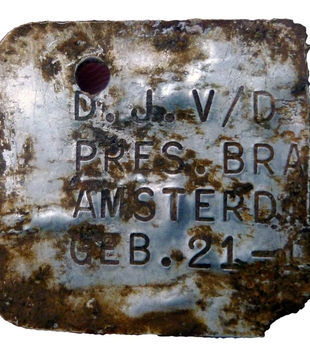 The Excavated Nametag of David Juda van der Velde
What is evoked when one encounters a child’s nametag, exhumed from the soil of a former Nazi death camp? For Holocaust archaeologists, such moments collapse temporal distance, raising pressing affective and ethical questions about the persistence of the past within the material present. When such objects enter museum narratives, they bring the emotional labor and spiritual attachments of families with them, complicating the “afterlives” of things displaced by war.
 Five Points of Entry: Judy Lachman's Group Photo from August 1942
Through war, ghettoization, deportations, and forced labor, Judy Lachman carried and protected from harm photographs of friends and family members, mementos of her life before and during World War II. One of these pictures depicts members of the youth Zionist organization Akiva. This article examines the photograph’s visual and material qualities, the transformations it underwent during the war, and its mediation and remediation after the war.
Our third section continues many of the themes of the previous one, in that items worn on the body also share in the body’s intimacy, especially those garments that are not visible, worn underneath other clothing. This invisibility extends to objects’ origins, in cases where the items were created covertly, and to their inaccessibility: many of the items discussed in this special issue are not on public view, and in this section we ask what that might mean for Holocaust memory and representation. How might “de-centering” the role of museum exhibitions lead to a broader consideration of the multiple functions of a museum and the different epistemes—worldviews—undergirding the objects in its care? The essays here extend the narrative potential of objects previously discussed, transcending time and space and reflecting on the ways objects themselves tell stories, both literally and metaphorically, revealing a material agency that can, at times, telegraph hopefully and poignantly into the future. In some cases, the artifacts themselves record and preserve accounts of life in the ghettos and camps, documenting experiences of labor and loss and serving as records of the transactional economies in spaces of incarceration. The objects in this section are purposive, reflecting the intentions of their creators while also assuming the qualities of the wearers. Archival records can try to capture these qualities, but we recognize that they are by nature incomplete; there is only so much we can know about these remnants, even with ongoing meticulous research. The authors of these essays ask us to consider the function of worn objects, whether decorative or ritual; readers will note several items’ individuality as well as the gender distinctions that mark particular garments historically. Here, artifacts are themselves mediators of memory, offering enticing visual records of ghetto and camp life and embodying the experiences of people before, during, and even after World War II, beyond both written narrative and oral testimony. - OBS, LSL
 Objects of Witness: Holocaust Jewelry Constructed in Camps and Ghettos
Covertly constructed from scrap or excess metal in forced labor factories and workshops, pendants, pins, bracelets, and other metal objects made in Holocaust-era ghettos and camps by prisoners were largely given as gifts to friends and family or exchanged for food or other resources. A consideration of these rare surviving objects reveals how prisoners understood the conditions they were living in and represented them in material culture, and by doing so asserted a form of material agency amid confinement and forced labor.
 Wedding Dresses: Soft Landings, a Ritual Garment, and the Promises and Perils of Life After
At the close of World War II, numerous Jewish brides in a Displaced Persons camp wore a remarkable parachute wedding dress now in the collection of the United States Holocaust Memorial Museum. According to the Oxford English Dictionary (OED) a parachute is "something which inflates to control the descent of a falling body." Not all who wore this dress or the others like it in the UHSMM collection experienced soft landings. Wedding dresses never come with guarantees.
 Inaccessible Objects: Armin Loeb’s Tallit Katan at the United States Holocaust Memorial Museum
The importance of the Holocaust for Jewish and general memory has led to scholarly discussion of the United States Holocaust Memorial Museum in religious terms. The USHMM, like many other Holocaust memorial museums, is not, however, owned or run by a religious community and does not serve as a space of prayer. Yet visitors treat the museum space and its objects with a sense of reverence reserved for ritual spaces and relics. But what happens if such religious objects are not on display? In this article, the author turns to Armin Loeb’s tallit katan to show the value of analyzing inaccessible objects.
The authors of the essays in this section focus on ritual-textual objects. These items had specific religious functions in their original contexts, before being brushed by violence. During and after the Holocaust, these objects accumulated additional accretions of significance. The reflections here reveal the multilayered meanings of sacred objects. They also demonstrate the entangled histories of texts and things, where documentation helps in identifying and, indeed, accentuating an object’s power. Remnants of the past, the artifacts discussed in this section are both surviving and survivor objects, and their sacrality is bound to both of these roles. How do we understand the “sacred” beyond its context in “religion?” These essays address overlapping categories of sacredness, including religious, historical, personal, and associative types, and the ways objects move or are made to move between these classifications depending on ownership and accessibility, provenance and display. What happens to revered objects when they are transferred between custodians and contexts? Is the “sacred” a transferable quality? What happens if a donor does not want to part with certain items? How do the interventions of creators and curators transform an object’s sacrality? Here, objects act as anchors, sources of comfort during difficult times and orientation points afterwards. They can be embedded in networks in which ordinary and extraordinary functions and meanings overlap. These objects reflect as well the individual agency and personalities of their original owners, inheritors, and donors and often reflect those individuals’ decisions regarding their creation, care, and custody. These items are, ultimately, deeply personal reminders of individual and familial experiences. - OBS, LSL
 Sacred in Function, Sacred in Memory: A Rosary and Missal from the Holocaust
This article examines a rosary and missal given to Beatrice "Trixie" Muchman for her confirmation while she was hiding in a small French town during the Holocaust. Although she returned to her Jewish faith following the war, she still revered the objects, keeping them long after donating the rest of her Holocaust-related materials to the United States Holocaust Memorial Museum for safekeeping. The article explores the multiple layers of sacredness imbued in Muchman's rosary and missal, and considers how a federal, non-denominational institution such as the USHMM should curate and display such objects.
 A Conversation with Holocaust Survivor Beatrice Muchmann
Susan Goldstein Snyder, formerly an acquisitions curator at the United States Holocaust Memorial Museum, interviews Beatrice "Trixie" Muchman, who survived the Holocaust in hiding in Belgium.
 Two Layers of Text, Many Layers of Meaning: The Materiality of the Pál Szegö Diary
Pal Szegö’s Holocaust diary is written in the only book he had available, a Hungarian language copy of the New Testament. While the diary entries are a rich text that merits attention, examining the diary as a unique bound object that preserves traces of the diarist’s interactions with it and some of the experiences detailed in the entries foregrounds Szegö’s individuality and agency amid changing circumstances, offers insight into his complex identity as a devoted Christian convert persecuted for being Jewish, and emphasizes the significance of the diary as a survivor object.
 The Missing Mezuzah
The mezuzah on a wall inside the United States Holocaust Memorial Museum, donated by Benjamin Meed, is the only object among the countless artifacts identified and displayed in the USHMM's Permanent Exhibition installed as if it is a useable object, i.e., without a display case and in the position of a ritually functional mezuzah. What is the place of such an object within the museum and what does it signify?
Tying a number of this special issue’s themes together, this final section features analyses of graphic objects that embody different forms of intentional communication: gratitude, instruction, desperation, desire, longing. These various, often personal, transmissions connect past with present and future and bridge wartime and postwar narratives. The range of forms of visual and textual objects discussed here constitute an appeal for materiality and its importance in telling the stories of the Holocaust. Paper, in particular. Paper is critically important for the survival and movement of both people and objects, especially in an increasingly digital age in which paper is already disappearing. Documents, both authentic and falsified, everyday and exceptional, record the spatial, temporal, and conceptual distances traveled from their origins to their final, often archival, resting places, serving as symbolic grave markers. They register multiple border crossings, both national and artistic, asking whether such boundaries are sites of constraint or negotiation, and what role bureaucracy plays in regulating identity. Yet, the contingency of the materials often used and the chance survival of the artifacts themselves point to these items’ precarity. At the same time, even tiny, nearly insignificant objects serve as powerful witnesses to an ever-distant past. The survival of such objects and their preservation testify to their resilience. These final essays have a tactile presence and an affective allure. They speak to the intimate experiences of exile and displacement for people as well as things. They show us how we may orient ourselves and navigate memory in time and space as they guide future generations in their journeys into the past. - OBS, LSL
 “The book is small so it can be hidden”: Leia Kreimer’s Tiny Book from the Vapniarka Concentration Camp
During the Holocaust, even within the extreme conditions of life in concentration camps, people chose to keep and—in some cases—create objects that do not appear to fulfill essential human needs. Leia Kreimer’s tiny book, made for her as a gift, is one example. Its production, exchange, and ultimate survival illuminate the enduring resilience of the book as a cultural form that is both text and object.
 From the Umschlagplatz to The Wiener Holocaust Library: Maria and Maximillian Wortman’s Last Letters
In September 1942, in the Warsaw ghetto in German-occupied Poland, Maria and Maximilian Wortman hastily wrote a letter to their daughter, Dziunia, from whom they had become separated. The couple had been selected for deportation to the death camp Treblinka, and they were gathered on the Umschlagplatz, the railway siding from where the deportation trains departed. Their final words to their daughter are written on the reverse of a scrap of paper no larger than 11 x 15 cm.
 Hedda Sterne’s Photomontages: Passport to Life
This essay examines Hedda Sterne's 1941 Romanian passport and her little-known photomontages from Life magazine as parallel "documents of exile." The passport traces her perilous flight from Europe, serving as an unintended autobiography of survival. Her photomontages, composed from magazine clippings, became visual testimonies that confront the dissonance between American popular culture and her feelings of anxiety as a refugee. This study uses a conservation and art history lens to explore how paper, in both bureaucratic and artistic forms, mediated Sterne's identity and experience of displacement.
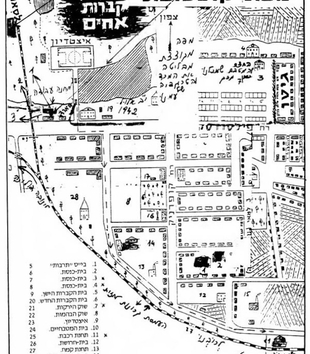 Maps as Artifacts of Remembrance: The Sefer Kostopol
Yizkher bukher, collaboratively authored memorial books devoted to single cities, can offer descendants of Holocaust survivors access to the places their ancestors were forced to flee. Jennifer Rich reflects on her encounter with Sefer Kostopol, the book written about her grandmother's hometown of Kostopol, Ukraine, and specifically the way maps in this and other yizkher bikher can help envision spaces now lost and destroyed.